

 Back
Back
As a key deadline for federal solar tax credits ticks closer, a Massachusetts program is helping the state’s nonprofits get solar projects underway before the incentive disappears.
The Solar Upgrading Nonprofits, or SUN, program provides nonprofits with financial and technical assistance to evaluate options for solar installations and seek out additional funding if they choose to go forward. The first round, in 2025, worked with 23 organizations. Five have decided to move forward with installations that total 1.5 megawatts of installed capacity — double the goal for that phase of the program.
The stakes are even higher for SUN’s second round, which kicked off at the end of March. President Donald Trump’s One Big Beautiful Bill, signed last summer, put an expiration date on tax credits that can shave 30% to 50% off the cost of commercial-scale solar projects: They must start construction by July 4, 2026, or be placed in service by the end of 2027 to qualify — a tight timeline for most organizations.
“There is still time, but it is dwindling very quickly,” said Rachel Gentile, marketing and communications manager for Resonant Energy, the Boston-based solar company spearheading the initiative with funding from the Massachusetts Clean Energy Center, a quasi-public economic development agency.
Adding to the urgency is the fact that nonprofits have had relatively little time to take advantage of the tax credit. While for-profit businesses have been able to claim the incentive for some 20 years, nonprofits became eligible only with the passage of the Inflation Reduction Act in 2022. So, the elimination of the credit means it is disappearing before many organizations have even had a chance to dig into the possibilities.
“Nonprofits that have other missions that they’re dedicated to, it’s not necessarily on their list of priorities,” said Sanne Wright, community partnerships manager for Resonant Energy. “They’re already usually pretty strapped for cash and tight on capacity.”
The SUN program tries to overcome this barrier by making it easier for nonprofits to evaluate their options. The idea is modeled on another Resonant program, Solar Technical Assistance Retrofit, or STAR, which provides similar support to affordable housing providers looking to add solar to their buildings. Since its launch in 2021, STAR has installed 4.8 MW of solar capacity, with another 13.5 MW in the pipeline. When nonprofits became eligible for the federal tax credits, Resonant started thinking about how to adapt STAR for a new constituency.
The Massachusetts Clean Energy Center, which also funds STAR alongside the Jampart Charitable Trust, awarded the SUN program $150,000 for its first round and another $150,000 for the latest cycle. Resonant works with two partner agencies — Providers’ Council and the Essex County Community Foundation — to connect with nonprofits that might benefit from the assistance.
“Power is very expensive here,” said Kate Machet, vice president of systems initiatives and government relations for the Essex County Community Foundation. “This program has really allowed us to bring to our nonprofits on the ground the ability to explore solar.”
Interested organizations do a short intake call to discuss their general goals for a solar project. Then they provide information about their electricity bills and roof age and condition, and Resonant completes an analysis of their options. Whether or not the nonprofit decides to move forward, it receives a stipend of between $2,500 and $7,500 as compensation for the staff time that went into the process. Those that opt to go ahead with an installation receive help identifying further funding opportunities and writing grant applications.
Grow Associates, a nonprofit that serves adults with developmental disabilities, applied to the SUN program in hopes of getting solar on the roof of its facility south of Boston. The grant-writing support helped the organization secure a $500,000 award from a state program that funds solar projects for nonprofits working with low-income populations. The money will cover almost the entire cost of the planned 162-kilowatt array.
“Without their help, we would not have been able to get the grant,” said Sarah Palin, Grow’s executive director. “We’re looking at saving about $72,000 a year in electricity costs that we can put back into our programs.”
Resonant is accepting applications for this round of SUN until at least July, but it will continue adding participants after that deadline as long as the funding holds out.
Though Resonant is trying to help as many nonprofits as possible take advantage of the expiring tax credit, organizations that aren’t able to make the deadline could still benefit from participating in SUN and installing solar, Wright said. Finding the money to cover the initial costs will still be a challenge, but the average 300-kilowatt array could still save an organization about $1.3 million over the expected 25-year life of the system, down from $1.6 million with the tax credit, according to Resonant’s calculations.
“Organizations are going to have to get a little more creative about how they fund the project up front,” Wright said.
After taking a beating for the first year of the Trump administration, the beleaguered wind energy industry may finally see a glimmer of hope.
President Donald Trump and Interior Department chief Doug Burgum have spent months in an all-out assault against the technology, and in particular against offshore wind projects in federal waters. They have frozen all new leases, repealed clean energy tax credits, and even paid off an oil company to not build a planned wind project. The most dramatic move came in December, when Burgum paused work on five under-construction wind farms on “national security” grounds.
The developers of these five projects — two off the Massachusetts coastline, two south of Long Island, and one off the coast of Virginia — sued over the stop-work orders, and a series of federal judges soon issued injunctions against the Interior Department’s interventions.
Burgum had vowed to fight back, but last week, the department quietly let the final deadline for appealing the courts’ decisions lapse. The move means construction of the nation’s first five major wind farms along the eastern seaboard can continue absent a change in the case. When complete, the wind farms will generate enough electricity to power well over 2 million homes.
The lack of appeals likely represents a recognition that the government couldn’t stop the five projects from moving forward, said Tony Irish, who served as an Interior Department lawyer for decades before leaving in 2025.
“If the actual reason behind the stop-work orders was legitimately founded in national security, I would be very surprised by the lack of appeal,” he said. “So I think the lack of appeal is telling in that regard.”
Developers of the five major wind projects haven’t wasted time, with several of the projects already producing power. Revolution Wind, a project from Danish company Ørsted, delivered its first electricity to the New England grid in mid-March. Coastal Virginia Offshore Wind, a project from the Virginia utility Dominion, is about 70 percent complete and also delivered its first electricity last month. The farthest-along project, Vineyard Wind, produced a massive amount of electricity earlier this year during Winter Storm Fern when other power resources were offline.
The lack of appeals could be good news for future wind projects as well. A bipartisan group of senators has been debating a long-delayed “permitting reform” bill for months. The bill would speed up environmental review for critical energy projects, make it easier to build interstate transmission lines, and protect clean energy permits from federal interventions like those of the Trump administration. (It would also likely afford the same protections to oil and gas projects such as the Keystone XL pipeline, which President Joe Biden scrapped after taking office in 2021.)
Those bipartisan talks broke down after Burgum’s stop-work order. Senator Sheldon Whitehouse, a Democrat from Rhode Island who is leading the talks, told congressional Republicans and the Trump administration that they would only resume if the Interior Department declined to appeal the court injunctions for the offshore wind projects. Senate Democrats are also hoping to see Burgum advance solar projects on federal lands.
A potential thaw on offshore wind might benefit the president as he tries to manage the fallout from the Iran war, which has sent gasoline prices soaring and contributed to fears of an energy shortage around the world. The White House’s “energy dominance council” has begun participating in the congressional permitting talks.
“There’s a confluence of market realities that make this a particularly hopeful year for us,” said Chris Phalen, vice president of domestic policy at the National Association of Manufacturers, in an interview with Bloomberg Government. Proponents of permitting legislation stressed that the next few months before the midterm election season are pivotal for achieving a deal.
A broader set of reforms to the National Environmental Policy Act, the nation’s bedrock environmental permitting law, would be controversial, but research shows that it might accelerate the deployment of onshore wind energy: A recent survey of around 50 renewable developers found that around 80% of them had selected a project site so as to avoid the federal environmental permitting process.
Other developers reported that reviews for historical artifacts and endangered species can add months or years to project timelines, and that the reviews may have held up at least 11 gigawatts of energy, or enough to power almost 5 million homes. A reform effort, likely modeled on the House-passed “SPEED Act,” would aim to shorten review timelines and limit litigation. (The environmental review for the five in-progress offshore wind projects took multiple years, even under the wind-friendly Biden administration.)
“Bipartisan permitting reform is the next critical step,” said Liz Burdock, the CEO of the Oceantic Network, a trade group that advocates for offshore wind. She added that ease of permitting could enable millions more homes’ worth of new wind development, but warned that “without a predictable path to build, manufacturers, shipyards, and skilled workers are forced to sit idle, creating gaps that raise costs and delay benefits for millions of ratepayers.”
RICHLAND COUNTY, Ohio — In a mostly rural stretch of Ohio nestled between Cleveland and Columbus, residents now have a rare opportunity: They get to vote directly on the future of renewable energy in their area.
Last July, Richland County banned large-scale wind and solar projects in 11 of its 18 townships. The decision not only caught many locals by surprise; it also struck them as bad for economic development and as encroaching on individual property rights.
Almost immediately after the county’s three commissioners made their decision, dozens of residents formed a group, called the Richland County Citizens for Property Rights and Job Development, to fight what they saw as an unjust restriction on renewable energy.
Their initial goal was clear but daunting: Collect thousands of in-person signatures within 30 days in order to put the clean energy ban on the ballot during the 2026 primary election. They succeeded.
Before early voting opened last week, the group held several town halls and spent months educating and canvassing voters. Now, their efforts face the final test. By May 5 at 7:30 p.m., every voter in Richland County will be able to weigh in on the question: Should the county keep its ban on most solar and wind farms — or scrap it and give clean energy a chance to be part of the area’s energy mix?
A majority of “yes” votes on the referendum will mean the ban remains. A majority of “no” votes will overturn it. The referendum comes as local restrictions on solar and wind energy have proliferated nationwide, rising by 16% from June 2024 to June 2025. More than 450 counties and municipalities across 44 states now severely limit whether renewables can be built, according to the Sabin Center for Climate Change Law at Columbia University.
In recent years, these rules have been a stumbling block for renewable energy projects, which are needed both to decarbonize the energy system and to meet the nation’s soaring electricity demand. New solar and wind are also among the cheapest forms of energy — a crucial distinction as utility bills rise nationwide.
Restrictions on renewable energy are especially common in rural areas, where the vast majority of the nation’s utility-scale solar and wind projects are located.
Ohio, in particular, is a hot spot for efforts to stymie renewable energy. A 2021 state law, Senate Bill 52, gave counties the right to ban new large solar farms and wind farms of 5 megawatts and up. Roughly three dozen counties now have such restrictions in one or more of their townships.
The Richland County Citizens for Property Rights and Job Development and its supporters would like to see their county removed from that list.
The group reflects the composition of Richland County, with a range of ages, income levels, and professions; many members hadn’t known each other or worked together before last summer. And while some are concerned about climate change and air pollution, the group’s main arguments — evidenced by its name — echo familiar American issues: property rights and job creation.
“I just don’t think it’s right for the county commissioners to tell other property owners that they can’t do what they want with their land,” said Emily Adams, the group’s treasurer. “I have what I want on my roof. And I think farmers and landowners should be able to do what they want with their property, too.”
The effort to overturn Richland County’s ban could empower other communities to push back on similar restrictions, said Shayna Fritz, executive director of the Ohio Conservative Energy Forum, which favors an all-of-the-above energy policy.
“If you gather enough people and you really voice your concerns to them, you have a chance to walk it back,” Fritz said. “This does not have to be permanent.”
Coalition member Brian McPeek, who is the group’s deputy treasurer and also the business manager for the International Brotherhood of Electrical Workers Local 688, hopes that’s the case. Union workers stand to get jobs from both renewable energy projects and from other businesses that may move nearby to take advantage of their clean energy.
“I think it’s very important for the nation to see what we’re doing here,” said McPeek, who was among the dozens of local citizens who attended and spoke out at the Richland County Board of Commissioners’ meeting last July, when it voted in favor of the restrictions. “I feel like it kind of flipped the blueprint for what others can do if their commissioners do the same thing. We needn’t close off the county for development.”
Richland County’s ban originated in Sharon Township, an area of approximately 9,000 people in the northwestern part of the county.
In January 2025, the township’s zoning board members requested that the commissioners impose a ban there. The following month, the commissioners asked all 18 townships in Richland County if they also wanted to prohibit renewables. (The county’s authority under SB 52 doesn’t extend to its nearly half dozen villages and cities.)
More specifically, the commissioners sent a fill-in-the-blanks resolution to ban solar and wind development to the township trustees. Trustees simply had to add names and dates and put marks on a few lines to sign on to the restriction.
Eleven townships’ trustees ultimately sent back filled-out resolutions asking the board of county commissioners to institute a blanket prohibition in their townships.
So, “that’s exactly what we did,” Commissioner Darrell Banks said.
The three county commissioners did not consult with the general public during this time, according to opponents of the ban. Few people knew their township trustees had even considered the issue until last summer, when it appeared on the agenda of the July 17 commissioners’ meeting.
Dozens opposing the ban showed up to that meeting, held on a weekday morning, to speak out. Still, the commissioners voted unanimously to adopt the ban for those 11 townships. Rose Feagin, a council member for the city of Ontario who opposes the ban, expressed disappointment with the way the commissioners went about the process.
“Other avenues would have been a better way to get input from people, and from across the board, not just a couple of people in a bubble or in a boardroom somewhere making decisions for other people’s lives,” Feagin said.
Under SB 52, county-level bans on renewable energy can be challenged via referendum — so long as enough local residents support a ballot measure. But the law gives groups only 30 days to get enough signatures on petitions.
By the Aug. 18, 2025, deadline, the coalition had managed to collect thousands of signatures, and on Sept. 3 the Richland County Board of Elections ruled that they had cleared the threshold required to put it on the ballot.
It’s only the second time a county-level restriction on renewable energy has been challenged via referendum under SB 52.
In 2022, Crawford County commissioners blocked Apex Clean Energy from developing the 300-MW project Honey Creek Wind. A field manager for the company then helped lead the campaign to put it before voters, but ultimately that referendum failed.
At this time, no company is looking to develop a large solar or wind project in Richland County, noted Nolan Rutschilling, managing director of energy policy for the Ohio Environmental Council.
So, the Richland County ballot measure isn’t spearheaded by a company looking to profit from a particular project. Rather, it’s the work of citizens who want to preserve possibilities for the future — and restore the right to consider opportunities on a case-by-case basis.
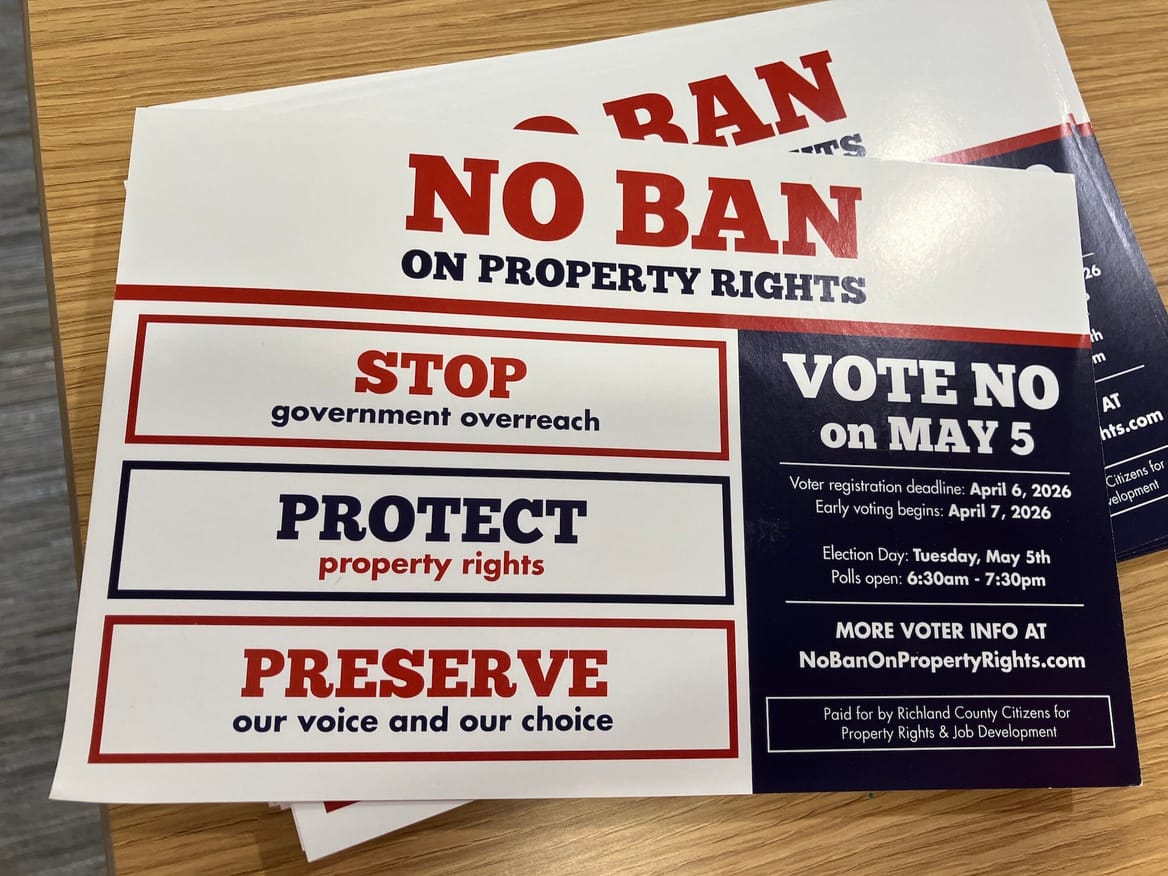
In the lead-up to the election, the Richland County Citizens for Property Rights and Job Development has been using a slogan meant to win over their neighbors: “No Ban on Property Rights.”
Dan Fletcher, a Madison Township trustee who isn’t actively involved in the referendum campaign, said he knows how he plans to vote: “Taking the rights away from the property owner? That’s wrong in my opinion.”
Richland County is a farming powerhouse. More than 120,000 acres of cropland stretch across nearly 500 square miles. Farmers here mostly grow soybeans and corn, and to a lesser degree, forage, wheat, and other crops. The county also ranks among the top fifth of the nation’s leading producers of poultry, livestock, and other animal products.
The region’s agricultural character is the main focus of the campaign to keep the ban in place, run by a group named Richland Farmland Preservation.
The group’s website calls for farmland preservation and “commonsense limits” on solar and wind. It also includes a badge of endorsement from the Richland County Republican Party, which might go a long way in a county that went heavily for Trump in the last presidential election.
Banks, the county commissioner, is on the advisory committee for Richland Farmland Preservation. Other members include Richland County Prosecutor Jodie Schumacher and a trustee from each of the townships of Sharon, Blooming Grove, and Jefferson.
The group may have links to The Empowerment Alliance, a nationwide pro–natural gas organization that has been an impetus behind bills and resolutions labeling the fossil fuel as “green energy.”
A filing with the Richland County Board of Elections identifies the treasurer for Richland Farmland Preservation as Dustin McIntyre, with an address for a building with several offices in Bellville. But VoterRecords.com does not note any Dustin McIntyre in Richland County, nor does Whitepages.com show him living there.
Federal Elections Committee data does list a Dustin McIntyre with an address in Virginia as treasurer for multiple super PACs, including the Affordable Energy Fund PAC. That group was set up by The Empowerment Alliance in 2021.
The alliance began as a project of former Ariel Corp. chair Karen Buchwald Wright and her husband, Tom Rastin, who was also an executive there. Headquartered in Mount Vernon, Ohio, Ariel makes compressors for the oil and gas industry.
The Richland Farmland Preservation website also features anti–renewable energy talking points espoused by The Empowerment Alliance and other groups, including a variation of a graphic used by The Empowerment Alliance that implies gas-fired power plants should be favored over solar because of their smaller land footprint. (The illustration ignores the large swaths of land needed for drilling and pipelines, as well as pollution.)
Neither McIntyre nor Richland Farmland Preservation responded to Canary Media’s emails or calls.
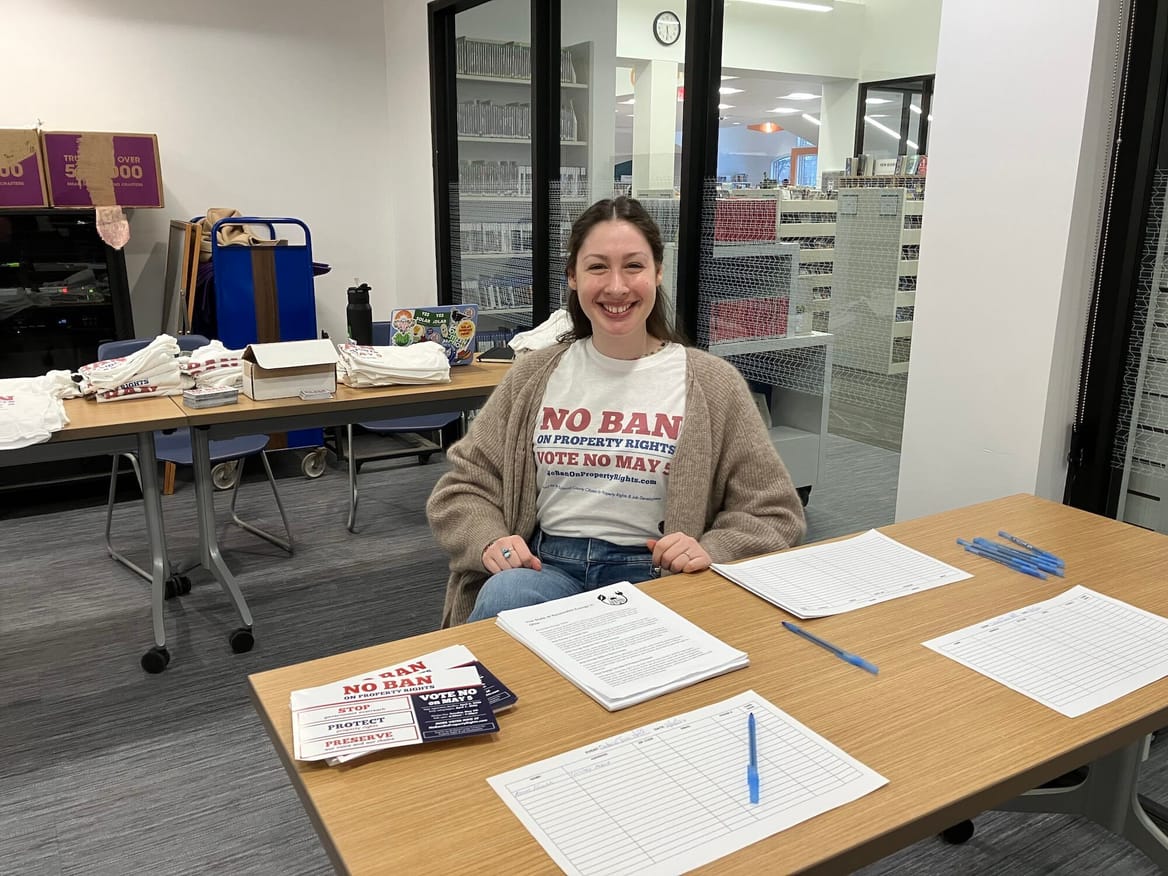
The No Ban on Property Rights campaign held a fundraiser in February, and its volunteers have been distributing lawn signs, door hangers, and brochures. Volunteers with the nonprofit Ohio Citizen Action have also been helping with efforts to raise awareness and get out the vote.
As to whether the Richland Farmland Preservation group was mobilizing in a similar way, Banks told Canary Media he didn’t expect it to hold a general fundraiser. Instead, he noted that they planned to “call a few people.” Without saying who, he said, “There’s some people who will put some money towards this.”
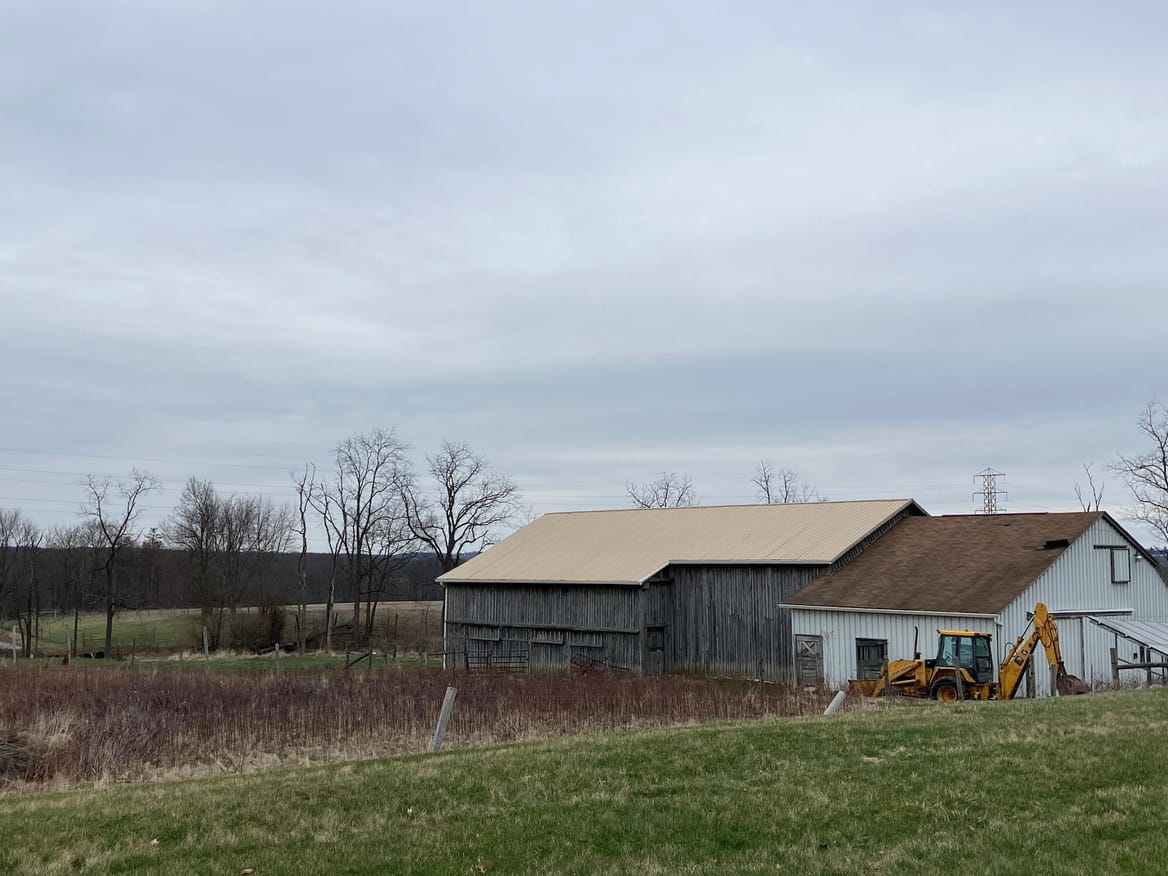
Nonetheless, the push to preserve the renewable energy ban is tapping into real anxieties about ceding land to non-farming uses.
“We’re seeing more and more farmlands being used up for developments, and we want to keep them as farmlands,” said John Jaholnycky, who previously worked for natural gas and electric companies and is now a trustee for Mifflin Township, which opted for the ban.
In Jaholnycky’s view, solar should go on buildings and over parking lots. “I think it’s kind of shortsighted that we want to use up all of this farmland to put these solar panels up.”
Richland County Commissioner Cliff Mears pointed out that the city of Mansfield plans to add a solar farm at the site of a former landfill. But he added, “We feel that farmland overall should remain farmland.”
Still, blocking renewables won’t necessarily preserve farmland. In fact, urban and suburban development has been the major threat over the past several decades.
From 2002 through 2022, Ohio lost over 930,000 acres of farmland. Researchers at The Ohio State University reported last year that most of that loss occurred around metropolitan areas, where urban and suburban sprawl was extending into formerly rural areas. The number of acres for certified and planned utility-scale solar projects, meanwhile, is about one-tenth that amount.
Data centers are also a growing concern, with roughly 200 already in the state, and plans for another 100 or so.
For farmers, leasing their land for renewable energy can supplement income and actually let them keep the land in their families.
“The alternative is that [landowners] will sell it for development or data centers or something,” said Annette McCormick, a county resident and opponent of the prohibition.
Nor are renewables necessarily incompatible with farmland preservation.
Agrivoltaics uses land under and around solar panels for grazing sheep or growing forage or other crops. “There’s a lot of opportunities for farming” amid clean energy installations, McCormick said. “Maybe just not think about corn and soybeans all the time” as the only farming options.
Permit restrictions also generally require renewable energy companies to restore agricultural land when projects finish using it.
Both Banks and Mears criticized SB 52’s provision that lets all voters in the county — not just those in the relevant townships — sign a referendum petition and then vote on the issue. “It has nothing to do with anybody in the cities or villages,” Mears said. In his view, voters “should have some skin in the game.”
That arrangement was once on the table. An earlier version of SB 52 would have given each township the authority to ban solar and wind and then left any decisions on referendums solely up to its own voters. Ultimately, however, the law put the decision to enact prohibitions — and the rights of voters to seek their reversal — at the county level.
“Every voter in Richland County should have a voice on this important issue because it’s a countywide policy,” said Jen Miller, executive director of the League of Women Voters of Ohio, who grew up in Richland County. Although the commissioners chose to defer to trustees in individual townships, “it is the role of county commissioners to represent every voter and to hear from every voter.”
Former Richland County Commissioner Gary Utt agreed: “It’s a county issue. Let the people decide.”
Energy costs are also a big issue this year, not just in Richland County but across the state. Utility bills are rising for all customers as electricity demand surges in Ohio, especially with the proliferation of data centers and growth in electrification. Solar power can come onto the grid faster than other sources. Adding more generation quickly could ease the supply crunch, and clean energy could help protect residents from the volatility of fossil fuel prices.
“That affects all of us — not just countywide, but statewide also,” said Christina O’Millian, a volunteer who worked on last year’s campaign to get the issue on the ballot.
Because SB 52’s hurdles apply only to solar and wind farms, it’s “picking winners and losers in what should be a free market,” said Fritz of the Ohio Conservative Energy Forum.
For McPeek, the electrical union business manager, blocking renewables also means fewer jobs for himself and other IBEW members throughout the county.
“Historically, communities that sort of close themselves off often see investment and innovation going elsewhere,” he said.
Even if residents defeat the ban, it doesn’t mean that any large solar or wind projects will be built in Richland County.
“It just restores the right of a project to be considered,” McPeek said. “There are a lot of hurdles that they have to jump through.”
In unincorporated areas without any ban, SB 52 still lets county commissioners review almost all new large-scale solar and wind farms of 5 MW or more before developers can even file a permit application with the Ohio Power Siting Board.
The law gives commissioners 90 days in which they can prohibit a project, change its footprint, or do nothing. No action means a company can then file its application with the siting board, provided the developer also complied with additional notice and public meeting requirements.
If a company does get to file an application for a solar or wind farm with the siting board, SB 52 then calls for two ad hoc representatives of counties and townships where the development would be located. Those individuals take part in the case as voting members. Any project also must satisfy a long list of other requirements before the siting board grants its approval to move ahead.
Even for projects that have otherwise met all legal criteria, the siting board sometimes simply defers to local government opposition to conclude they are not in the “public interest” — a stance that is currently under review by the Ohio Supreme Court.
Ultimately, it may take a repeal of SB 52 and some other legal changes to put all types of energy generation on an equal footing when it comes to siting and permitting.
But for now, advocates for a “no” vote on Richland County’s ballot issue are focused on what they can most immediately control: defeating a ban that makes solar and wind a nonstarter from the get-go.
“I want to make my children proud,” said Morgan Carroll, a Shelby resident who urges people to vote no. “I want to say that we tried to help them with their energy costs in the future, help the future of clean energy in the county.”
We’re glad you read this story. If you appreciate our independent, paywall-free reporting, please consider making a tax-deductible contribution in celebration of Canary Media turning 5! All donations are currently being matched.
The wind turbines arrived in Gloucester at the same time I did. My husband and I moved into a cheap third-floor apartment in the small coastal city in northern Massachusetts in November 2012, just as cranes were assembling the imposing white towers right next to the highway that ushered us into town.
I loved them immediately. Like me, they were newcomers in an old town, looking to the future. Gloucester celebrated its 400th birthday a few years ago, and many families, including my husband’s, have lived here for well over a century. Our daughter, born in 2016, is at least a fifth-generation Gloucesterite. As a toddler playing in our yard, she would glimpse the blades turning in the distance and announce excitedly, “The fans are spinning!”
There were originally three turbines, standing sentinel over the town at the ocean’s edge. Two of these provided electricity to the city through a 25-year power purchase agreement, offsetting 50% to 70% of Gloucester’s municipal energy use. The city also received 20% of the money the spinning blades generated each year, a number that ranged from around $100,000 in the first year of operation to as much as $478,000 in later years.
The first turbine to go up was also the first to come down, removed in 2023 after a series of mechanical failures and a blade unexpectedly falling off. The two that remained continued generating power for years, though supply chain problems delayed needed maintenance and caused unexpected downtime, the owners said. In recent months, residents noticed the turbines appeared to be dripping oil. When the blades stopped turning this fall, people started asking questions about their future.
In January, our local paper broke the news that the turbines’ owner had decided to decommission them. The explanation: The company, a major semiconductor engineering firm, wants to expand its footprint here and needs the land. In compensation for the early termination, Gloucester will receive a payment of $587,000.
Some staunch opponents of wind power have taken the announcement as vindication. Community Facebook groups immediately lit up with I-told-you-sos, declaring the turbines’ 13 years of operation a clear failure. Some even used the early end of Gloucester’s three land-based turbines as proof that large-scale offshore wind could never be successful.
“They are painting the reason why they are being taken down as a failure of wind power,” said City Councilor Jason Grow, a vocal supporter of the turbines.
A second, somewhat quieter group, though, is lamenting their imminent loss.
“I have a feeling of not despair, certainly, but I feel stalled,” said Janet Ruth Young, a local writer and musician. “I feel that there’s a stagnancy where there used to be hope and movement and change.”
When new solar farms or wind turbines are proposed, news stories usually follow detailing opponents’ objections, which are largely rooted in a connection to place and respect for the character of a community. The opponents chose to live in this place — the small mountain town, the historic waterfront city — for the trees and the air and the character, not the lines of turbines on a hilltop or the sun glinting off expanses of solar panels. These positions are, at their heart, emotional and, it seems to me, sincerely felt. I am not here to judge motivations or to parse how much weight such arguments should be given.
However, stories about the debate depict support for clean energy as all about the money to be saved and the greenhouse gas emissions to be lowered. The proponents of solar panels and wind turbines are rendered as a collection of financial and environmental abstractions rather than real people.
In Gloucester, it is clear that framing doesn’t fully capture the reality. Though our community is deeply — sometimes stubbornly — dedicated to history and tradition, the turbines worked themselves into the fabric of the city. They were symbols of progress, an indelible part of our skyline, friendly ambassadors welcoming visitors and residents driving into town.
Linda Brayton was involved in the turbine project from the very beginning, when she volunteered in 2005, she thinks, to serve on a task force investigating the possibility of bringing wind energy to the city. Renewable power was still on the margins of the energy conversation then — Massachusetts had less than a gigawatt of installed capacity, a number that more than quintupled from 2013 to 2024.
For years, Brayton sat in meetings and listened to opponents hurl insults and misinformation. She stuck with it through the evaluation of several potential sites, timelines, and ownership structures.
In October 2012, when the first components finally arrived by boat in Gloucester Harbor, she sat by the water with her niece and watched as a crane lifted the long white tower from a ship onto a flatbed truck, to be driven through the winding downtown streets to its destination in an industrial park.
“It was really the most amazing day,” Brayton said. “I broke into tears. It was so beautiful, and it had been such a long time coming.”
As the turbines were going up, the city held an event during which more than 2,000 residents inked their names on a blade, quite literally signing on to the progressive vision the project represented for many residents. At the event, then-Mayor Carolyn Kirk (who now heads up the Massachusetts Technology Collaborative, a public agency supporting innovation) read the poem “Sea-Fever” by John Masefield, placing the turbines squarely within the fishing town’s legacy of depending on the wind: “And all I ask is a windy day with the white clouds flying.”
The following year, Kirk remembers, she had a chance to climb to the top of one of the turbines, gripping the ladder rungs tightly as it shook and swayed. The experience of standing, exhausted, at the top, some 400 feet in the air, was “incredible,” she said.
The turbines punctuating the horizon quickly became part of the city. They even earned nicknames. Young wrote and performed a song for the city council praising the “Three Sisters.” Brayton recalls people referring to them as the “Three Magi.” In a letter in the Gloucester Daily Times, one supporter likened them to kinetic sculptures and shared the names he gave them: Remus, Romulus, and Big Earl.
One local resident said on Facebook that when she saw the turbines on her first job interview in Gloucester, she knew the community would be a great place to live. A neighbor told me that spotting them — they are highly visible from many spots in the city — often helped relieve some of his stress as a renewable energy supporter enduring the Trump administration’s relentless hostility. They were a sign of something going right.
As the two remaining turbines get ready to come down, though, must we feel that something has gone wrong? It is, perhaps, a hard conclusion to avoid when a once-promising project comes to an end 12 years early. If the turbines had been more profitable or productive or required less maintenance, maybe the owners would have chosen to keep them and expand elsewhere. And the decommissioning plan has fueled the fire of those who are anti-wind, onshore or off.
The world is a different place now than back when Gloucester first started discussing the possibility of turbines, and coal and oil were still significant contributors to energy production in New England. Vitriol against offshore wind may be at an all-time high, yet projects off Massachusetts, New York, and Rhode Island are churning out power, with more expected in coming years. While the Trump administration has done its best to pull back funding for solar, the grid operator ISO New England projects that by 2040 the region will add another 28 GW of solar capacity to the roughly 6.5 GW it had in 2024.
What those next 14 years will bring for Gloucester is an open question. The removal of the wind turbines, however, can not reverse the trends that have gained momentum throughout the region. Nor can it undo the excitement and joy the spinning blades brought to many residents. It can’t stop us from looking forward, and it can’t stop us from hoping.
Sunny Arizona closed out 2025 as the second-biggest state for battery and solar construction. Now, a policy that helped kick-start this success could be going away.
The Arizona Corporation Commission, the elected body that regulates utilities, unanimously voted in early March to eliminate the state’s renewable portfolio standard. The policy, which the commission set in 2006, called for 15% renewable electricity by 2025. The state hit that target; thus, in the words of Commissioner Kevin Thompson, it was time to move beyond “mandates that have outlived their useful life.”
The commissioners — all of whom are Republicans — critiqued the mandate for costs it imposed: It pushed utilities to sign long-term contracts for renewable energy years ago, when it was more expensive than it is now, and added surcharges on customers’ bills to pay for those contracts and for incentives for households to adopt clean energy.
State leaders around the country are searching for tools to bring down soaring electricity costs for their constituents. Arizona’s decision has parallels in many Democratic-led states that are currently targeting surcharges from their own climate policies in the name of improving affordability.
Crucially, it’s not clear whether the end of Arizona’s renewables standard will noticeably lower customers’ bills, given that utilities are still beholden to those long-term contracts they signed a while ago with renewable energy developers.
These concerns took on new pertinence Monday, when State Attorney General Kris Mayes, a Democrat, filed for a rehearing of the decision, charging that the commission failed to complete “the legally required economic analysis.” That gives the regulators 20 calendar days to grant or deny a rehearing. The repeal needs a sign-off from the attorney general to officially take effect, so this opposition could complicate that typically uneventful procedure.
Mayes, who is running for reelection this fall, sat on the commission back when it created the renewables mandate. Back then, it pursued the mandate in the interest of affordability: “An increased reliance on local free energy resources will avoid the negative impacts of energy cost run-ups as were experienced in 2005” after Hurricane Katrina and other storms destroyed swaths of U.S. fossil fuel infrastructure, the commission noted at the time. In the last decade, the same regulatory body chastised utilities for investing too heavily in gas power, and it developed a 100% clean energy standard for the state (though the commissioners ultimately voted down their own proposal).
Today, Arizona’s renewables market is booming, and the operating plants aren’t going to disappear just because the mandate might. But with utilities embracing big gas investments to keep pace with soaring demand, the mix could slip back below 15% renewables.
As Arizona’s power demand rises faster than nearly anywhere else in the country, electricity consumers there need effective, rather than symbolic, tools to contain costs.
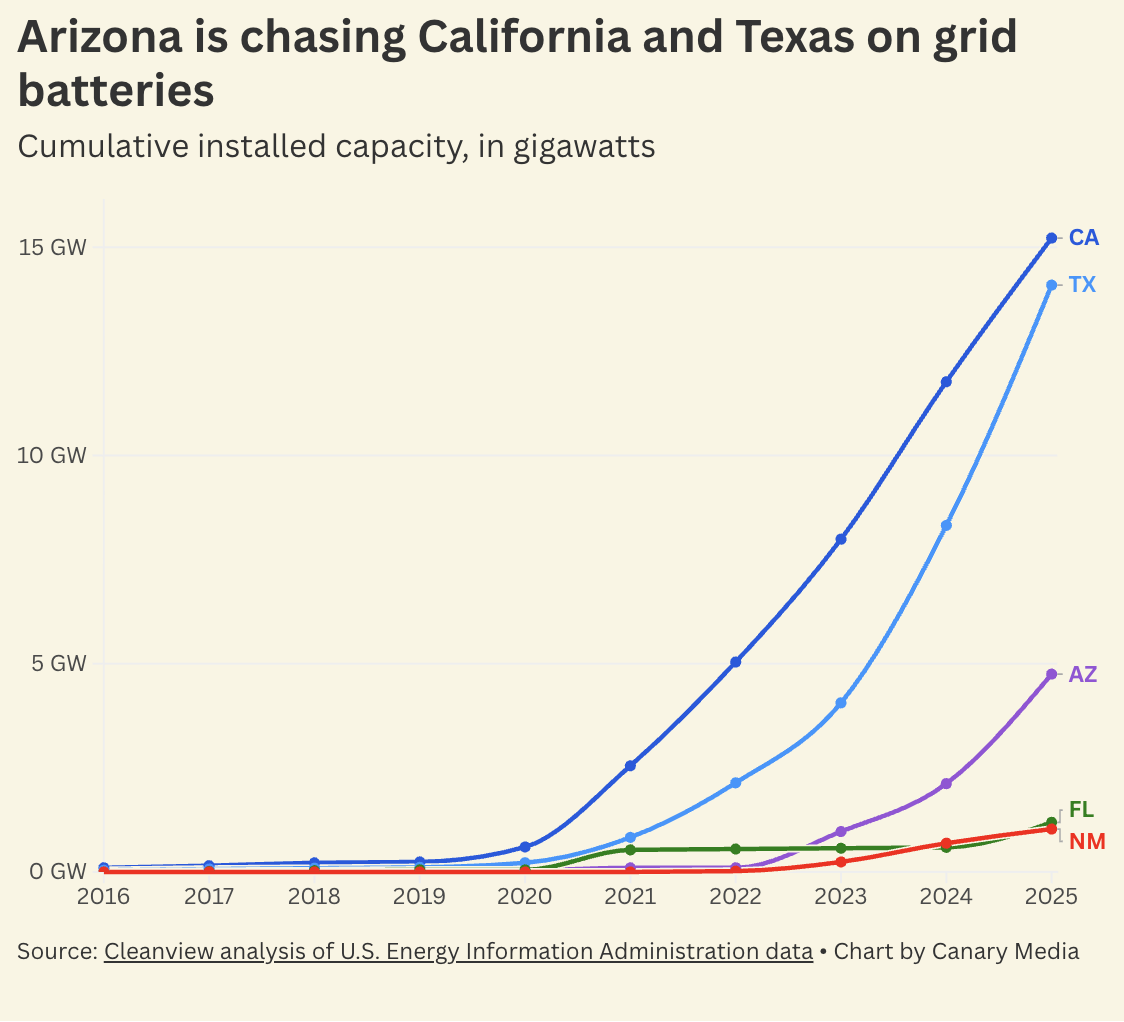
One thing that is undeniable: Clean energy has been crushing it in Arizona lately. The state holds the third-highest grid battery capacity (after California and Texas) and the fourth-highest solar capacity (after California, Texas, and Florida). Indeed, Arizona more than doubled its battery fleet from 2024 to 2025, hitting 4.7 gigawatts and growing at a much faster rate than the two leading battery states.
Overall, Arizona gets about 44% of its electricity from natural gas, a fuel that is not harvested within the state and must be imported from elsewhere in the country. Coal used to rule the roost but has declined to marginality over the last decade. The Palo Verde nuclear plant outside Phoenix has cranked out steady carbon-free power since the 1970s and now accounts for 26% of the state’s production. There’s a little bit of hydropower and wind, but solar — which generates roughly 16% of Arizona’s electricity — drives all the clean growth, with help from the lithium-ion batteries storing it for post-sunset hours.
Arizona has plenty to offer a solar or battery developer. Its desert environment furnishes ample sunshine, and there’s a lot of space to build. The state doesn’t have an open energy market like Texas does, but its utilities have proactively solicited competitive bids for new electricity supplies and handed out contracts to developers who bring winning solar and storage proposals. Indeed, Arizona Public Service, the biggest power company in the state, set an internal corporate goal back in 2020 to get 100% clean electricity by 2050 — and gained ample experience in contracting for clean energy. But it abandoned that ambitious target in August, choosing to extend the life of a major coal plant and invest more in gas infrastructure amid soaring demand.
For decades, Phoenix has attracted a steady influx of residents who like the affordable real estate and dry desert air, and aren’t deterred by the occasional bout of triple-digit heat. More recently, the region has also drawn a spate of data centers: Arizona hosts 2 gigawatts of active data centers, according to independent analyst Michael Thomas.
That’s just a taste of what might be coming. Thomas noted in a January post that Arizona Public Service has 30 GW of proposed data centers in its queue for grid connection, several times more than the utility’s peak demand record of 8.5 GW. That gargantuan mismatch is reason enough to doubt that much of the proposed buildout will ever materialize. Still, the utility has already mobilized to construct a 2-GW gas plant to keep pace with this new demand.
The propulsive growth in consumption creates new urgency for clean energy in terms of both planet-warming emissions and affordability. The state’s progress on cleaning up its electricity supply could slow or reverse if renewables stall out just as utilities fast-track constructing fossil fuel plants. And an assertive clean-energy expansion could help keep prices lower in a period of tight supply. That’s especially true as the turbines used in gas plants get more expensive amid yearslong supply chain backlogs. Furthermore, since Arizona lacks its own gas supplies, consuming more of the fuel requires building more pipelines and shipping more dollars out of state.
At this pivotal moment for Arizona’s energy outlook, details included in the Arizona Corporation Commission’s decision cast doubt on whether customers will save much money from the end of the mandate.
The regulators focused their criticism on costs imposed on customers over the years by the surcharges utilities levied to fulfill the renewables mandate. The implication was that eliminating the mandate would therefore lower people’s bills going forward.
But that rhetoric doesn’t match the facts in the official proceeding, said Autumn Johnson, who argued against the repeal as the leader of the state affiliate of the Solar Energy Industries Association.
The commission’s economic impact statement does say that utilities “may see some marginal savings” from forgoing the administrative work involved in complying with the requirements. However, it notes, one utility indicated that “most renewable-related costs will continue due to long-term contractual and programmatic obligations, which may limit overall savings.”
The rule changes don’t eliminate American contract law. Utilities will still have to pay for contracts they signed years ago, and those costs will continue to be recovered as surcharges, a commission spokesperson confirmed. Utilities had already fulfilled the requirement, so it wasn’t likely to force their hand in signing new deals. Even if it did, solar and battery proposals today compete extremely well on the cost of power; an extra nudge to pick the cheapest source of new kilowatt-hours should not unduly raise costs on consumers.
“What does it say to the country, what does it say to the industry, if even this tiny, anemic RPS [renewables portfolio standard] that’s honestly embarrassing, even that we have a problem with?” Johnson said. “This is just to signal that you don’t like renewables, which I think is really not smart from an economic development standpoint.”
As for why sitting regulators might want to signal such a thing, two of the regulators quoted in the press release are running for reelection in November, with a primary on July 21. Kevin Thompson and Nick Myers are facing primary challenges from state legislators Ralph Heap and David Marshall, who are campaigning to “stop the Green New Deal” and “oppose harmful rate hikes.” This vote gives the incumbents something to talk about to show they are working on affordability while pruning what they see as government overreach.
It’s also possible that the repeal, if enacted, won’t materially damage the pace of the clean energy buildout, since the mandate wasn’t driving that buildout anymore. Excising the old policy enables renewables developers to make a clearer case that they’re winning on the merits, not because of state favoritism.
Still, Arizona’s retreat on its renewables policy coincides with other forces acting against the clean energy industry. Local jurisdictions in the state are passing ordinances that could stymie solar and battery development through restrictive permitting, Johnson said. The Trump administration is phasing out tax incentives for wind and solar installations and holding up permitting for projects on public lands. Arizona’s rooftop solar market has contracted since the state lowered the rate of compensation for customers who send power from their panels back to the grid, and imposed what Johnson called “punitive fees” on those households.
In sum, Johnson hopes the recent clean-energy success story continues in Arizona, but stressed that this outcome is not guaranteed.
“You can’t maintain a third ranking for storage and fourth or fifth ranking for solar if you continue to do things that are antagonistic to those industries,” Johnson said.
Now, the fate of the renewables policy hangs on the wrangling between the attorney general and the commissioners, as election-year politics spices up the usually mild world of utility regulation.
See more from Canary Media’s “Chart of the Week” column.
The European Union is once again facing an energy crisis due to its reliance on imported fossil fuels — and is once again poised to lean into renewables to blunt the effects.
As the war in the Middle East upends global oil and gas markets, European Union energy chief Dan Jørgensen urged member states on Tuesday to build even more renewable energy, faster.
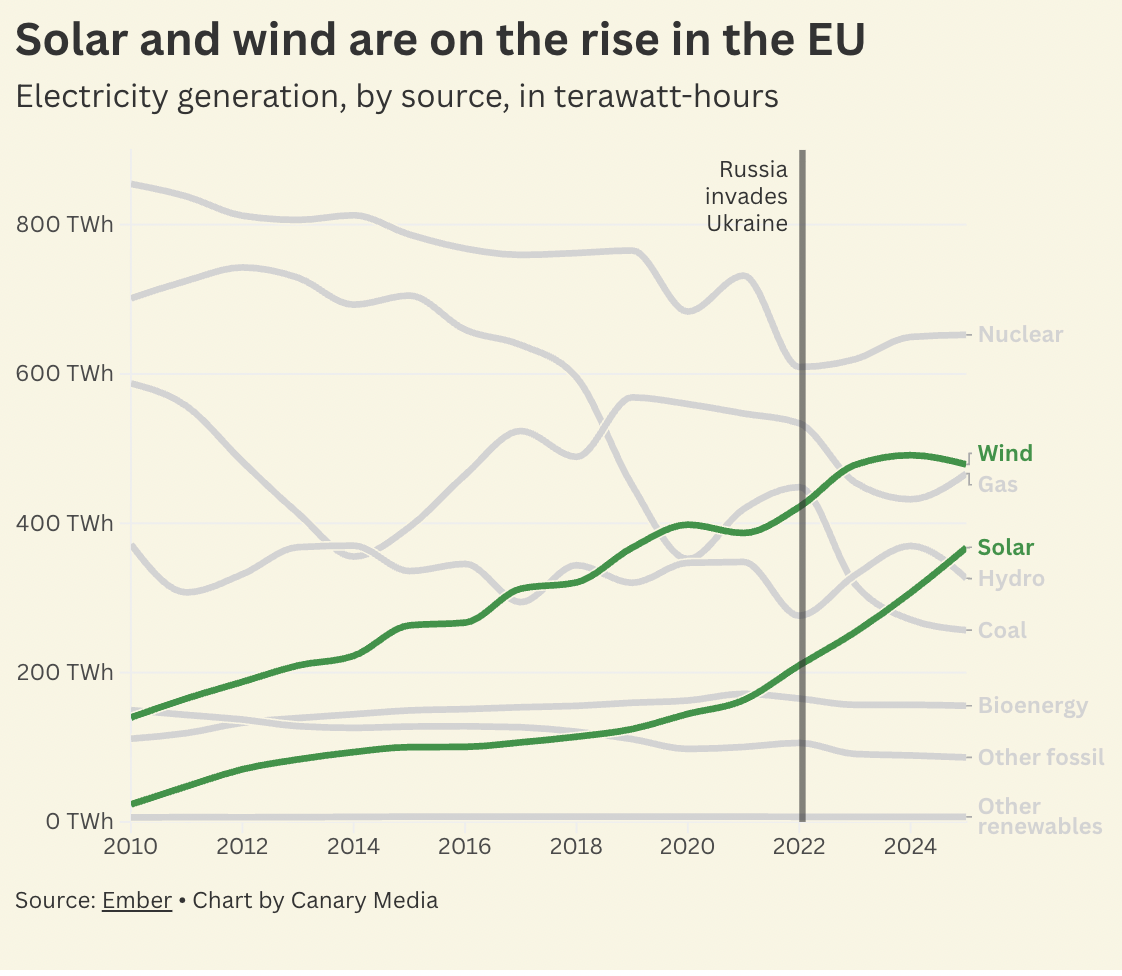
It’s an uncomfortable but familiar position for the EU. Following Russia’s invasion of Ukraine in 2022, the bloc rapidly reduced its reliance on Russian gas imports and swiftly built out new wind and solar power to cushion the blow to the region’s electricity sector.
The results speak for themselves. The European Union more than doubled its solar generation between 2021 and 2025. Wind grew at a more modest 24% over that time period, but it was already providing a higher share of the bloc’s electricity generation. Meanwhile, fossil fuel–generated electricity declined. For the first time ever, in 2025 the EU produced more electricity from wind and solar than it did from fossil fuels.
But the region has not ditched gas entirely. The EU got about 17% of its electricity from gas last year, and it imports almost all the natural gas it burns — 86% in 2024.
That means its energy system is still exposed to the historic disruption caused by the Iran war. The war has shut down liquefied natural gas production in Qatar, the world’s second-largest exporter of the fuel, for the past month. Gas prices globally and in the EU have surged as a result.
This energy shock will be messy and play out in different stages. For Europe, the most immediate and acute effects are being felt in the availability of jet fuel and diesel. But electricity costs will rise too, as nations are forced to buy much-more-expensive natural gas. In certain countries, it will also get dirtier, at least for a time — some EU nations are relying more heavily on coal-fired electricity to get them through the immediate fallout.
But over the longer term, this energy shock is likely to produce the same outcome as the previous one: an even faster transition away from imported fossil fuels and to domestic wind and solar.
This analysis and news roundup come from the Canary Media Weekly newsletter. Sign up to get it every Friday.
Renewable energy’s favorite season has arrived.
Spring is when everything comes together for clean power sources. Days get longer, boosting solar generation. Winter’s blustery winds keep blowing, propelling turbines to their max. And melting snow and heavy rains combine to drive hydropower generation.
Previous springs have shown us just what this wild weather is capable of. In the first week of March 2025, Texas’ power grid, known as ERCOT, set all-time records for wind and solar power production as well as battery storage discharge.
Now, just a few weeks into spring, and with plenty more renewable power generation added in the past year, Texas is once again reaching new heights. On March 14, ERCOT reached an all-time high of 28.7 gigawatts of wind power, according to GridStatus.io. Even more impressive is the state’s solar generation, which has already set multiple records so far this year.
And while Texas is the country’s clean power leader, it’s not the only region with renewable power victories to show. Solar records have been achieved across the Southwest Power Pool, PJM Interconnection, the Independent System Operator New England, and the Midcontinent Independent System Operator this spring. ISO-NE also hit a record level for wind power generation, while MISO reached its pinnacle for overall renewables generation.
And in California, batteries stored a ton of that clean energy, and then set record after record for dispatching it throughout March.
A lot of those records were only made possible thanks to the U.S. adding 26.5 GW of utility-scale solar power generation in 2025, and another 5.7 GW of wind generation. A massive 13 GW of grid battery installations last year helped make full use of those renewables.
There’s an added bonus to all these records happening as the weather starts to warm. Most of us are starting to turn down our furnaces and heat pumps, but haven’t yet turned on our air conditioners. That means overall power demand tends to be at its lowest in the spring, and with renewables at their peak, we need far less fossil-fueled power to pick up the difference.
That confluence resulted in something monumental in March 2025: For the first time ever, fossil fuels accounted for less than half of U.S. power production across a whole month, while clean sources generated the rest. Let’s see if the U.S. can repeat that feat this year.
A global energy crisis is in full swing
Continued conflict in the Middle East is highlighting the risks of relying on fossil fuels.
It’s been five weeks since the U.S. and Israel first attacked Iran, sparking a conflict that has largely shut down oil and gas production and transportation in the region. Domestic natural gas supplies have blunted the blow in the U.S., but much of the world is facing a major energy crisis. Thailand has encouraged workers to ditch business suits to curb the use of air conditioning, while Sri Lanka has implemented a four-day workweek to limit fuel use.
The EU’s energy chief this week similarly urged residents to drive and fly less, and pushed countries to speed their transition to clean energy, saying fossil fuels’ price volatility won’t end even with a resolution in the Middle East. That’s been especially clear in the years since Russia’s 2022 invasion of Ukraine, which spurred the EU to cut off Russian gas supplies and turn its attention toward a solar and wind buildout instead.
Residential electricity price hikes aren’t slowing down, report finds
A new report offers a few explanations for why residential electricity prices are on the rise.
Across the U.S., average prices rose by 33% from 2019 through 2025, the Lawrence Berkeley National Laboratory and the Brattle Group found. That’s a big jump, but it tracks with the rising cost of groceries, housing, and other everyday expenses.
Still, that average hides the fact that some parts of the U.S. are experiencing far more dramatic hikes than others. While 29 states actually saw inflation-adjusted retail electricity prices fall from 2019 to 2025, costs spiked in California, Illinois, New England, and some mid-Atlantic states.
The report credits rising fuel costs, growing power distribution expenses, and storm recovery as some of the biggest drivers behind the power price swell. And with utilities requesting rate increases at record levels, researchers anticipate customers won’t see much price relief anytime soon.
Electrify easier: A new study finds many households can adopt energy-efficient, bill-lowering electric appliances and heating without the need for expensive electric panel upgrades. (Canary Media)
Prepare for extinction: The rarely convened Endangered Species Committee rules that federal endangered species protections will no longer apply to oil and gas drilling projects off the Gulf Coast, exposing the Rice’s whale and other creatures to potential harms. (Houston Chronicle, E&E News)
Fossil fuels’ human toll: A Texas refinery explosion last week damaged homes in a neighboring, largely Black town, revealing the human impact of the Trump administration’s push to ramp up fossil fuel production. (Capital B)
Geothermal heats up: Next-generation geothermal projects have the potential to deliver tons of clean power around the clock, but a need for permitting and safety reforms could slow the industry’s progress. (Canary Media)
No resolution: The Ohio trial of two former FirstEnergy executives accused of bribing a former consultant, who went on to become the state’s top energy regulator, ends in a hung jury, with the state vowing to retry the case. (Signal Ohio)
Stuck in limbo: The fate of more than 300 clean energy projects remains unclear after the U.S. Energy Department announced their grants were canceled without officially de-obligating their funding. (Latitude Media)
Harris Ranch Resort isn’t close to much. Residents of California’s major cities know it mainly as a rest stop about halfway between Los Angeles and San Francisco on Interstate 5’s long run through the San Joaquin Valley. The sprawling stucco building has a Western-themed gift shop and a couple of good restaurants where travelers can enjoy regional specialties like tri-tip tacos and almond-smoked prime rib — perhaps while they charge their EV at one of the Tesla stations outside.
But in the vast expanse of California’s Westlands Water District, the ranch is about the most central spot for a meeting. On a sunny afternoon in late January, Jeff Fortune, Ross Franson, and Jeremy Hughes, three of the nine directors of the country’s largest agricultural water agency, gathered there for lunch to discuss an ambitious plan to rescue some of the most productive farmland in the U.S. from a decades-long water crisis.
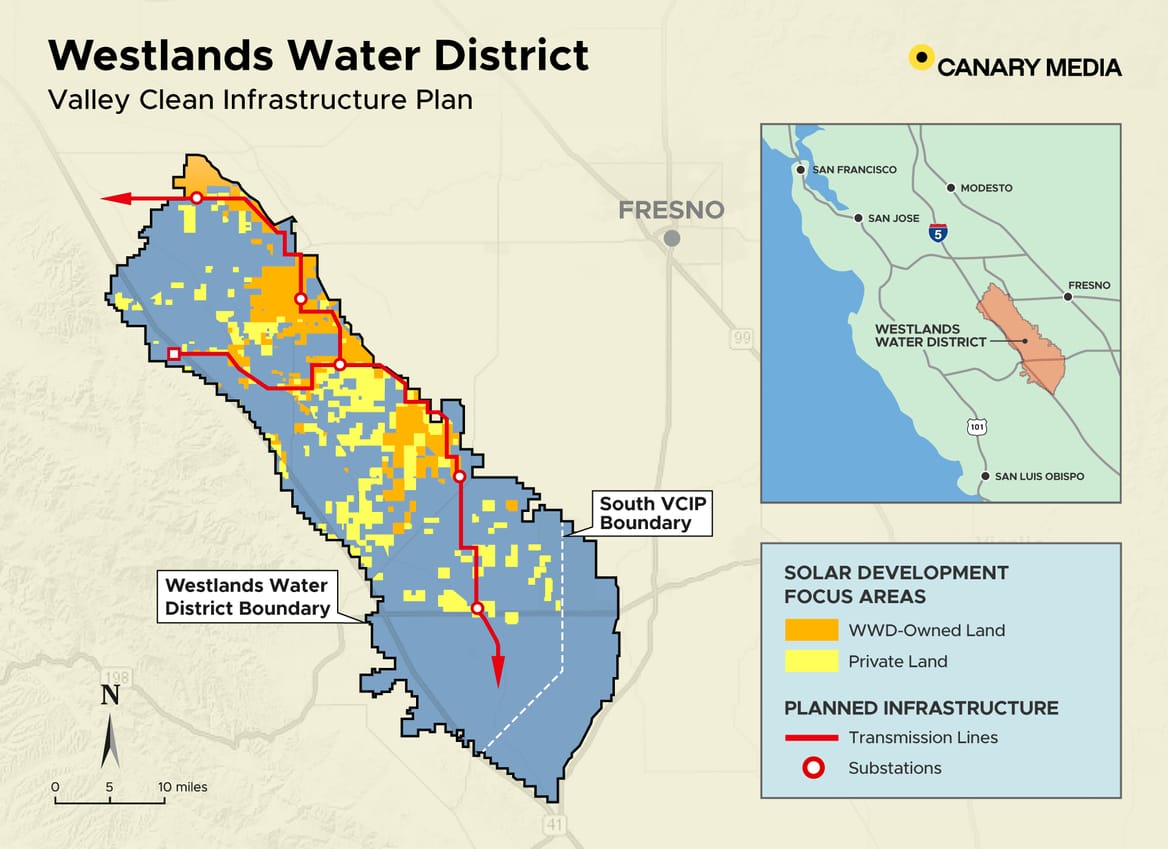
The Valley Clean Infrastructure Plan (VCIP) envisions converting 136,000 acres of land into 21 gigawatts of battery-backed solar power — nearly as much utility-scale solar capacity as has been installed in California to date.
“This will be not only the largest project in California, or the largest project in the United States,” said Fortune, a third-generation farmer and the district’s board president since 2022. “This will be the largest project in the world.”
The scale of the plan matches that of the land. Westlands Water District was formed more than 60 years ago to collectively manage water resources and irrigation infrastructure for the farmers within its 1,000-square-mile territory. The district’s 614,000 acres grow billions of dollars’ worth of crops per year — grapes, lettuce, tomatoes, onions, garlic, citrus fruits, almonds, pistachios, and many others. Those crops make up a major share of the bounty in a region that produces a quarter of the country’s food, including 40% of its fruits and nuts.
Fortune, Franson, and Hughes run family farming operations that collectively own or manage thousands of acres of a landscape transformed by industrial-scale irrigated agriculture. The water flows from reservoirs hundreds of miles north and is pumped from the Sacramento–San Joaquin River Delta via the Central Valley Project, one of the biggest water projects in the state. The water supply is augmented by wells that have delved ever deeper into the region’s aquifers.
But that water supply is drying up. Since the 1990s, surface-water cutbacks from the environmentally stressed delta have led to the fallowing of hundreds of thousands of acres. And under state law, Westlands farmers face increasingly strict limits on the groundwater they use.
Now, after decades of fighting state and federal agencies and lobbying Congress to increase the flow of water, Westlands farmers are shifting to a new approach. “Our hand is forced,” Fortune said. “Everyone’s in the same sinking ship together.”
VCIP could keep the ship afloat by financing a wholesale conversion of fallowed land into solar farms and battery storage systems capable of powering the equivalent of 9 million homes. To carry those clean electrons to market, the district will finance and build a transmission network that will speed interconnection to California’s congested grid and expand power flows between the state’s two biggest utilities, Pacific Gas & Electric and Southern California Edison.
None of this has happened yet, and completing it will take 10 years or more. But after years of work with developer Golden State Clean Energy, VCIP is now poised to move from concept to reality.
In December, Westlands Water District’s board approved the programmatic environmental impact report that lays out a master plan for the project. Hughes, a fifth-generation farmer who has been operating in Westlands for a quarter century, said that about 150 contracts so far have been signed by growers to make land available — including about 800 acres of his family’s land.
“The way we look at it is as a new crop,” he said. “We’re harvesting the sun and producing electricity.”
Critically, farmers will retain land ownership under VCIP’s lease and easement deals, and thus, access to the water allocations. And under Westlands’ agricultural-land repurposing plan and its VCIP master plan, water allocations for acres put into solar can be redirected to remaining farmland.
“You’re making the district more sustainable,” Fortune said, summing up the plan. “And that just helps the grower, it helps the communities, it helps the farmworkers — everybody.”
That help is desperately needed. The farms that make up Westlands Water District — many of them sprawling, multigenerational family-run organizations with substantial landholdings — have struggled for years with drainage challenges, salination, and other effects of heavy irrigation, which have polluted watersheds. The communities in and around the district have high rates of poverty and unemployment, a lack of economic opportunities, tainted groundwater, and inadequate investment in roads, schools, and public safety. State law requires VCIP to include a community benefits plan that delivers economic value to not just its growers but also the local governments and residents.
While it will be a massive and complicated undertaking, California needs four to five times as much new clean energy and storage as this project is slated to provide in the next 20 years, said Franson, president of farming at Woolf Farming & Processing, which cultivates 30,000 acres across the San Joaquin Valley, most of it in Westlands.
The master plan could provide a model for what the state must accomplish to meet that need for power on a grand scale, he said. “There’s so much talk in the state about the demand they’re seeing, about energy transition, about water issues … This hits all those boxes.”
Highway 33 runs south from the Mendota pool, a key water-exchange point for the San Joaquin Valley’s interlocking irrigation systems, and into Westlands Water District’s northeastern zone.
On a cold winter morning, Jose Gutierrez, the district’s assistant general manager, and I drove along the two-lane road through a thick blanket of Tule fog. Despite the limited visibility, Gutierrez had no trouble pointing out the solar farms on both sides of us. Farther down the road, pile drivers rattled away, busy planting anchor posts for yet more solar projects.
The installations there now are a fraction of what’s envisioned under VCIP. If that plan is fully realized, the trucks roaring up and down Highway 33 will pass solar fields stretching uninterrupted for roughly 30 miles, Gutierrez said. The surrounding area is slated for solar for a simple reason: It’s no longer irrigable.
Much of the land designated for solar development under the master plan is drainage-impaired — undergirded by a shallow layer of clay soil that prevents water from percolating deeper. As water accumulates above the clay layer, it becomes increasingly salty, but cannot be flushed out — and there’s no easy fix, thanks to a decades-old impasse between the federal government and the water district.
Under a 2015 settlement agreement with the U.S. Bureau of Reclamation, Westlands was required to retire at least 100,000 acres from irrigated agriculture. In 2022, the district launched a land purchasing program to take on managing the retirement and eventual remediation of those drainage-impaired acres.
That land can still be planted with wheat or other cereal crops that tolerate being irrigated by rainfall alone, or leased to sheepherders. “But its value from a commodity perspective is pretty low,” Gutierrez said. As a result, it has mostly been left unused.
In fact, it’s a financial drag on the district. Idle land must still be managed to prevent pests and invasive weeds from setting in and endangering neighboring farms. Several times while on the highway, I spotted signs on utility poles advertising barn-owl boxes for rent — the birds help control gopher populations. And the debt the district took on to buy the fallowed acres must be paid off.
All this makes the land ideal for solar in a region whose clean energy potential is well understood. State agencies have designated large swaths here as the Westlands Competitive Renewable Energy Zone, meaning they are primed for solar development. Studies from universities and nonprofit groups indicate that the San Joaquin Valley can build solar while retaining sustainable levels of agriculture.
In the 13 years Gutierrez has worked for the district, eight solar projects have been launched on non-irrigable lands that the district has purchased and sold to developers. The biggest ones include the Darden Clean Energy Project, a 1.15-gigawatt solar-battery system being constructed on about 9,500 acres in the district’s central area; and Westlands Solar Park, a 2.27-gigawatt multistage development on roughly 20,000 acres in the district’s southern reaches.
Private landowners, like Fortune, Franson, and Hughes, have also been making deals with developers, and many other farmers could follow suit, Gutierrez said. In fact, VCIP expects that roughly half the 136,000 acres of solar and batteries it plans to develop will be on privately owned land.
Water shortages are the primary reason that Westlands growers are seeking alternatives to farming. But growers are facing other pressures, too, Gutierrez said. Volatile commodity prices have driven a boom and bust in certain crops, such as almonds. Rising energy and labor costs have taken their toll.
Landowners are eager to move more acres into solar to defray these costs, hedge against market risks, and bolster their bottom lines, he said. But there are roadblocks. Solar developers face long and onerous environmental reviews for each project under the California Environmental Quality Act, as well as drawn-out county permitting processes. And in California, as in many other parts of the country, limited grid capacity is forcing projects to wait for years in clogged-up interconnection queues.
Patrick Mealoy, partner and chief operating officer of Golden State Clean Energy, the VCIP developer, summarized the situation as a convergence of factors. “The land use planning, the water restrictions in the valley, the congestion on the transmission grid,” he said, “screamed for a master plan.”
Mealoy was part of the development team that put together a similar, if much smaller, master plan for Westlands Solar Park, the biggest solar-battery project in the district to date. That plan set key terms for individual developers on issues ranging from environmental mitigation and land management practices, to standard lease and contract requirements, to agreements regarding the arrays’ eventual decommissioning.
VCIP takes essentially the same approach, Mealoy said. Golden State Clean Energy itself will likely develop less than a fifth of the 21 gigawatts and will be working with independent developers for the rest, he said. But it’s far more efficient to create a master plan than to have each developer go it alone.
“When you look at the sheer magnitude of the tens of thousands of megawatts we need to build in California, the targets are getting higher. We’re doing a remarkable job, but we’re actually falling behind,” he said. “VCIP is enormous, but it’s a fraction of what we have to add.”
The programmatic environmental impact review approved by the district in December is the culmination of that master planning effort, Gutierrez said. It took two years, but now that it’s done, “it sets a standard for all VCIP solar developments of what they’re going to have to follow.”
That includes requirements for limiting construction impacts like air pollution, noise pollution, traffic safety, fire prevention, and the like, he said — an important consideration for nearby communities.
It also sets out how solar farms will be maintained once they’re built, said Allison Febbo, Westland’s general manager. That’s good not just for the neighbors but also for the developers.
Individual projects will still need conditional land use permits and construction permits from Fresno County, which encompasses the VCIP project boundaries. But with the approved guidelines in place, “we believe that we’ve knocked off two years in the planning process,” Gutierrez said, as opposed to “if a solar developer was to come in and do a one-off.”
Golden State Clean Energy has also laid out common financial terms and conditions for landowners and solar developers, Mealoy said. “If you’re farming near Kerman or if you’re farming near Huron, you have the exact same deal.”
The district hopes that all this planning ahead will help bring enough privately held land on board to roughly match the amount of district-owned land on the table, Gutierrez explained. That is vital to achieve the scale needed to enable the most unusual aspect of the plan, he said: building out the transmission.
“The district had enough land to make it interesting,” Gutierrez said. “But we knew we needed more land on the private side to justify the investments in infrastructure.”
To be reminded of how important new power lines and substations are to achieving the VCIP vision, Ross Franson need only look out his office window.
I met up with Franson at the white-painted, single-story field operations offices of Woolf Farming & Processing, which sits just east of Interstate 5, near Huron, the district’s sole incorporated city. To the south, past a field now under solar development, a spiderweb of power lines and transmission towers march southward. They converge just over the horizon, at PG&E’s Gates Substation — a critical juncture for solar power to interconnect to the larger state grid.
Of the 20,000 or so acres the company farms, roughly 1,200 have been built out in solar, Franson told me. Woolf plans to develop up to 3,000 acres in total. “We’re a little bit unique, in the sense that our farm is right next to the Gates Substation,” he said.
That’s not the case for much of the district’s acreage, he explained: “It’s far away from transmission lines and substations. And so the cost of doing that isn’t ideal.”
Enter Assembly Bill 2661, a state law passed in 2024. It allows Westlands to finance and build its own grid infrastructure. It also allows the district to use the clean energy it generates for its own purposes, and to sell the rest to utilities and other power buyers via the transmission system run by the California Independent System Operator.
In that sense, as Hughes said over lunch at Harris Ranch, VCIP is a “transmission play, not a solar play. The solar is doable because of the transmission.”
VCIP’s 500-kilovolt system will entail five new electrical substations and roughly 70 miles of high-voltage transmission connecting to the CAISO grid to the north, south, and west, Hughes said. In essence, it will provide an eastern parallel to the two 500-kilovolt transmission pathways already running along I-5 on the district’s western border.
Transmission is notoriously hard to build. But Westlands hopes that its master plan can forestall landowner and environmental opposition that has stymied many other projects. Much of the 70-mile line has been sited to cross district-owned lands. Where transmission will be situated on privately owned land, Westlands has crafted standard easement agreements to give landowners confidence they’re getting the same deals as their neighbors, Gutierrez said.
Westlands is taking on a significant financial commitment to unblock the grid bottleneck. Gutierrez estimated the price tag of building the project’s grid infrastructure is more than $1 billion.
The district will need to negotiate agreements with CAISO to earn back that money through transmission access charges. That’s the same way the state’s major new grid expansions are repaid over time via increases to utility customers’ bills.
But Mealoy believes those costs will be more than counterbalanced by benefits to the state at large. A study commissioned by Golden State Clean Energy found that VCIP could yield more than $9 billion in net energy cost savings over the next 25 years, both by adding more clean power and by reducing grid congestion that drives up rates and reliance on fossil gas–fired power plants in Northern California.
State agencies are loath to approve massive transmission investments to accommodate future clean energy projects. But as that buildout lags, CAISO’s grid remains congested — and clean energy developers face potentially project-killing costs for upgrades to connect to it.
That’s why VCIP relies on doing solar, batteries, and transmission together, Mealoy said. “To get transmission built, you needed size and scale,” he said.
Owning the power lines also gives Westlands control over some of its energy-related expenses. Several California irrigation districts operate their own utility services, including Turlock Irrigation District and Modesto Irrigation District in the Central Valley and Imperial Irrigation District in the southeast corner of the state.
Westlands, which is served by PG&E, isn’t becoming its own utility, Fortune stressed during lunch at Harris Ranch. “PG&E is not fighting us, and we’re not fighting PG&E.”
But running the district’s massive pumping stations requires a lot of power, as does operating well pumps and drip irrigation motors, he said. “The district is going to get lower power costs to supply the water, and [growers] are going to get the option of lower-cost power on their end — so the water cost is going to come down.”
The central role of water in Westlands is evident to anyone driving along I-5. Scattered among the fields and orchards are signs — posted on fences and on wheeled trailers once used to haul cotton — broadcasting slogans like “No Water = Lost Jobs,” “Stop the Politicians Created Water Crisis,” and “Congress-Created Dust Bowl.”
The angry sentiments stem from the decades-long conflict over California’s massive state and federally managed water distribution. Westlands secured its water allotments from the Central Valley Project in the 1960s. But since the 1990s, joint federal and state efforts to restore endangered fish species and protect the delta’s environment have increasingly restricted flows from the massive pumping stations that move water southward. And as the most recent water district to be created and served by the federal water system, Westlands is a junior holder of water rights, which makes it first in line for cuts.
Historically, San Joaquin Valley farmers and politicians have held a hard line on keeping the water flowing, with Westlands-bankrolled lobbyists often taking the lead. But as those political efforts faltered and drew public pushback during the state’s historic drought of 2011 to 2017, Westlands growers shifted their stance.
In 2022, Franson, Hughes, and two other growers won seats on the district’s board on a “change coalition” platform, aimed at putting an end to the adversarial water policies of Tom Birmingham. The district’s general manager for more than 20 years, Birmingham announced his retirement after the election.
To be clear, Westlands hasn’t surrendered the fight for water, said Febbo, who replaced Birmingham in 2023. “Our growers have shifted, from saying we don’t want to repurpose any of our agricultural lands, to a position where we have to fallow a significant portion of our area,” she said, “and that we should do that in a planned and thoughtful way until we determine a way to restore our water supply.”
If decades of on-again, off-again surface water allocations were the instigating incident, the Sustainable Groundwater Management Act was the hard closer. Passed in 2014, SGMA created the first statewide regulations to manage groundwater resources that provide roughly 40% of California’s water and that have sustained San Joaquin Valley agriculture for more than a century.
But overpumping has reached a crisis point in the San Joaquin Valley. Thousands of public and private wells have run dry. The land itself is sinking, as water from underground aquifers gets depleted by as much as 2 feet per year in some parts of the valley. That subsidence is threatening to undermine critical infrastructure, including the San Luis Canal, the section of the California Aqueduct serving Westlands Water District.
SGMA requires overdrafted water basins to achieve sustainability by the early 2040s, which will entail both significant cutbacks on pumping and replenishing depleted aquifers. Complying with the law will likely necessitate fallowing about 500,000 acres across the San Joaquin Valley, according to the nonprofit Public Policy Institute of California.
Under the Westlands groundwater management plan approved by the state in 2022, the district must roughly halve the amount of water it normally pulls from the ground during dry years by 2030, Gutierrez said. That reduction, along with the uncertainty around future surface water deliveries from the Central Valley Project, forces growers to face the prospect of reducing by half the amount of land they’re able to irrigate every year.
This prospect has helped convince a critical mass of Westlands growers to support VCIP, Franson, Hughes, and Fortune said over lunch.
“I really do think SGMA forced the issue,” Franson said. “When push comes to shove, we needed to come up with an alternative plan.”
Allowing farmers to put land into solar without losing its water allocations is essential to making that plan work, Fortune said. Typically, allocations for land repurposed or sold for nonagricultural uses revert to the district, he explained. But under VCIP, landowners with long-term leases or cash-up-front easement deals with solar developers keep both surface water and groundwater allocations, which they can apply to remaining farmland.
That’s important for Westlands growers like Rebecca Kaser, owner of Avellar-Moore Farms. Her family has been farming in Westlands for four generations. She hasn’t put land into VCIP yet, but her father has.
“We have fallowed over half our acreage,” she said. “We still have property taxes, we still have horticultural expenses … and they don’t return any income. And we do this just for the water allocation, so we can continue to grow, to help out our neighboring communities providing jobs and paying property taxes.”
VCIP offers “financial relief from the incurred expenses year over year on this fallowed acreage — and the way it was designed, we could still keep our water,” she said. “What I really want to emphasize is that if we can keep on farming all of it, we would. The VCIP is a tool in the tool box to at least stay farming with the little that we can.”
If VCIP develops as intended, it’s not just the growers who will benefit but all residents in Westlands Water District.
Danny Garcia, 41, has lived his entire life in Three Rocks, an unincorporated community in the middle of the district. He hopes that building the world’s biggest solar and battery project will bring prosperity to Three Rocks, which is also known as El Porvenir, which means “the future.” But he and his family have their doubts.
“People are struggling right now,” he told me when I stopped by his home. “There’s many ways that people could work on solar.” Garcia makes a living as a trucker, hauling produce and delivering fruit and nut tree seedlings from nurseries for planting in the fields. He can envision participating in the construction boom when VCIP gets underway.
Almost everyone who lives in Three Rocks is employed in agriculture in one way or another, he said — including longtime farmworkers like his mother, Rosa Ramirez. She’s worked in the fields since she moved here from Mexico about 50 years ago, she told me in Spanish as Garcia translated. She can earn up to $600 per week when jobs are steady, but less than $200 a week when it’s slow.
And work has been slower and slower, Ramirez said, sitting at her son’s dining room table. “Back in the ’90s, they used to have tomato fields, lettuce, onions.” But as water has become scarcer, “a lot of almond trees are knocked out because of water — less and less.”
With solar panels eating up more and more farmland, “how is she going to pay her bills?” Garcia asked. “Is she going to work there with the solar system? She has no experience.”
The San Joaquin Valley includes some of the poorest counties in the state. The confluence of water stresses, environmental degradation, and rising heat and weather disruptions from climate change are only set to intensify the area’s challenges, according to a report issued as part of California’s 2021 climate change assessment.
Agriculture provides 17 percent of the San Joaquin Valley’s employment and 19 percent of its revenues. Those economic ties are even tighter in the sparsely populated Westlands, where agriculture generated $3.6 billion in economic activity and more than 27,500 jobs as of 2022, according to a 2025 study commissioned by the district.
But those figures were down from an estimated $4.7 billion in economic activity and about 35,000 jobs in 2019, driven largely by increases in fallowed land due to water restrictions. Those declines led to roughly 30% less in public tax revenues for counties, cities, and special districts, meaning millions of dollars no longer available for roads, water systems, schools, and other public services.
VCIP could help buck those trends, Mealoy of Golden State Clean Energy said. Building the solar and battery farms and grid infrastructure will require employing about 6,000 people for at least 10 years — in what he described as “good-paying, labor union jobs” — as well as about 1,000 full-time operations jobs once the project is complete. Some of those positions could be filled locally through apprenticeship and training programs with community colleges and workforce development agencies.
Businesses in the region could provide equipment and services to developers, and secondary spending will boost local economies, he added. The cost of building solar and battery projects ranges from $1 million to $1.5 million per megawatt, he noted.
And the towns, school districts, and county services will benefit from “billions of dollars that could be injected” into the tax base, once the state’s current property tax exemption for solar projects expires at the end of 2026, he said. It’s hard to predict future property tax revenues for Fresno County, but they’re certain to be significantly higher than those collected on fallowed fields, he said.
How those economic benefits will flow to communities suffering from generations of underinvestment and facing the loss of agricultural jobs has yet to be defined, however. In January, Westlands’ board voted in favor of a draft approach to meet the requirements in AB 2661, the law making VCIP possible, to “ensure that local communities have meaningful opportunities to participate and access benefits” from its clean energy transformation.
That plan for the community benefits agreement commits the district to work with Fresno County and seven incorporated cities to “commit a portion of project revenues” to workforce, energy-affordability, environmental, and quality-of-life benefits.
But Westlands doesn’t plan to start making that money available for “at least 60 months out, coinciding with the commercial operation of the facilities,” Russ Freeman, the district’s deputy general counsel, said at the January meeting before the vote took place.
That’s worrisome to community groups that feel they’ve been neglected by Westlands’ power players and the region’s political leaders. Rural Communities Rising, representing 36 communities across western Fresno County, was formed last year so that residents “are heard, respected, and prioritized,” as the clean-energy developments envisioned by VCIP move ahead.
“We believe in a big-tent concept. Everybody should participate,” Espi Sandoval, a Rural Communities Rising board member and educator, said at that January meeting. His group is advocating for a formal organization, including local governments, school and water districts, labor associations, workforce agencies, nonprofits, and local representatives, to “work collectively with developers to address … priorities.”
Community groups are focused first on mitigating impacts from construction, like limiting vehicle traffic that can clog narrow roads, worsen already poor air quality, and kick up dust carrying fungi that cause a pulmonary ailment known as valley fever. They’re also demanding more emergency services, including fire stations located closer to solar and battery sites that could pose fire risks.
And they’re asking for remediation of longtime problems like high energy costs and polluted water supplies. Ramirez’s electric bill from PG&E was $331.74 for the month of November — far more than she thinks she ought to be paying for a small single-story home. California has the highest electric bills in the mainland U.S. That’s a particular burden for low-income San Joaquin Valley residents during days or weeks of triple-digit summer temperatures.
Ramirez’s water bills have also risen, even as the water remains undrinkable, she said — a problem plaguing hundreds of thousands of California residents, many of them in the San Joaquin Valley. In Three Rocks and nearby Cantua Creek, the cause is disinfectant by-products from chemicals, such as chlorine, used to treat surface water delivered from Westlands to a Fresno County–managed treatment facility.
“That’s why we have the water jugs,” Garcia said, pointing to the five-gallon containers arrayed under the trampoline in his front yard. “Every two weeks, the water man comes in and leaves them.”
Clean energy could provide an economic lifeline for the region — but that’s not guaranteed. A 2024 report from the Sierra San Joaquin Jobs Initiative, a joint project of the Fresno-based Central Valley Community Foundation and the state-funded California Jobs First Council, found that the four counties of Fresno, Kings, Madera, and San Joaquin could host 29 gigawatts of solar and energy storage through 2045, adding up to about $10 billion in investment and an estimated 73,000 new jobs paying an average of $32 per hour.
But it also found that workers “feel inadequately prepared for this transition” in terms of education, training, and opportunity to break into the industries involved.
Elizabeth Cabrera, city manager of San Joaquin, a town of about 3,700 people in western Fresno County, has attended meetings held by nonprofit groups working with solar developers to offer jobs and training to locals. But less than a third of San Joaquin residents have a high school degree or equivalent, she said. Many speak only Spanish, and “a high percentage are undocumented. That’s already three major barriers to entry.”
Leticia Fernández, the 63-year-old owner of the Half-Way Store in Cantua Creek, is also doubtful that solar development can make up for the loss of agriculture in the area. She started working at the store when she was 16, and bought it from the previous owner in 1997. But business has declined as more land has been fallowed, and the solar projects being built haven’t reversed that, she said. “They’re not spending the money like they tell us at the meetings.”
That’s not to say that solar projects aren’t doing some good, Fernández said. She pointed to the new fire station being built in Cantua Creek, financed in part through a $15 million commitment from Intersect Power, the initial developer of the Darden Clean Energy Project (the project is now owned by IPX Power).
Intersect also committed to community benefits plans that will make $2 million in direct investments in the next 10 years and $5 million over the project’s lifetime. The initial $2 million has gone to support affordable housing, provide grants to small businesses, bolster school programs, plant trees, and give away about 250 window air-conditioning units, among other benefits.
“We want to build strong partnerships, and we want to bring the community into the project, whether that’s supplying concrete or getting a union job and working on-site,” said Elizabeth Knowles, head of community engagement at Intersect Power. The Darden project is expected to create more than 1,600 all-union construction jobs, generate more than $70 million in state and local sales tax revenues during its construction, and provide more than $200 million in property taxes in the first 10 years, she said.
Still, some people say the Darden project’s original community benefits agreement didn’t direct money to the most pressing needs. They want to make sure the process for VCIP, which will be more than 15 times larger than Darden, doesn’t leave them out of the loop.
“We understand the project will take at least 10 years to build out. But we want residents to be part of conversations before decisions are made,” said Mariana Alvarenga, a senior policy advocate with the nonprofit Leadership Council for Justice and Accountability.
The challenge is that most of the economic impacts of clean energy projects are tied to “jobs and spillover work for local businesses” during construction, said David Adelman, a professor at the University of Texas at Austin School of Law who studies local opposition to clean energy developments. Beyond that, “virtually all of the benefit is in increased local property taxes,” he said. “Most of that impact gets buried in county and school district budgets” that are “not very visible to the local community.”
These facts could bolster arguments for larger up-front community benefits payments, he said. But that might be hard for clean energy developers already struggling with the looming loss of federal tax credits, rising equipment and labor costs, and other economic headwinds. Nor do solar project developers want to be held responsible for repairing past harms to communities and to the environment that were caused by others.
County tax revenues from clean energy projects could be directed to helping the communities near those projects. But that requires commitments from county politicians and administrators to ensure those revenues aren’t redirected elsewhere — and like many other rural counties, Fresno County is facing major budget pressures.
Justin Diener, controller of Red Rock Ranch, understands these concerns. He grew up on his family farm in Five Points, which has won recognition for its sustainable water and soil management. After graduating from Stanford University, he was employed in agriculture finance for 12 years, then returned to work with his father in 2016. He won his seat on the Westlands board of directors in 2022 as part of the change coalition — and unlike most Westlands farmers, he lives on the land that his family farms.
“I love to be out here,” Diener said on a stroll outside the modest one-story building that houses his family’s farm operations. “I grew up out here, across the street. But you know, it’s not a walk in the park, either.” It’s a half-hour drive for him or his wife to take their daughter to and from school. Last fall, crops left rotting in nearby fields because they were unsuitable for market caused a fly infestation that plagued the area for months.
Diener has also seen the decline in Fresno County services over the decades. “When I was younger, the roads got paved more frequently,” he said. “The potholes were taken care of.” He’d like to see VCIP money coming into the district prioritized for critical needs. “Do you have shelter? Do you have food? Do you have water? Is where you live safe?”
He thinks that long-term funding from Fresno County and municipal governments, rather than one-time community-benefits dollars, is the logical source for supporting those kinds of fundamental services. “I’d look to ongoing community benefits dollars to be an enhancement to government dollars, rather than a replacement,” he said. It’s also important that community benefits be ongoing, rather than one-off donations.
Still, Diener says VCIP could be “transformational” for Westlands. “The district’s not going to see the benefits today or tomorrow,” he said. “But five to 10 years down the road, I think things are going to be very different.”
A correction was made on March 25, 2026: This story originally misstated the expiration date of California’s property tax exemption for solar projects. It expires at the end of 2026, not the end of 2027.
Ohio regulators have blocked yet another major solar project because of local pushback, even though a significant number of public comments opposing the array appear to be fabricated. It’s the latest blow to solar in a state that defers to local governments on renewable energy, but not on fossil fuels.
The Ohio Power Siting Board decided last Thursday to deny a permit for the 94-megawatt Crossroads Solar Grazing Center, which would combine solar panels with sheep grazing in central Ohio. Although the project otherwise met all legal requirements, the board concluded that it “fails to serve the public interest.”
Regulators acknowledged that Crossroads Solar would have statewide benefits, create jobs, and increase local tax revenue. But they said the project’s merits are outweighed by the existence of “consistent and substantial opposition” from local governments and nearby residents.
Critics of the decision are troubled that the regulators basically shrugged off the fact that a substantial number of public comments filed in opposition to Crossroads Solar were duplicative, anonymous, or seemingly faked. A recent Canary Media review found that dozens of comments contained apparent lies about people’s names or residence in Morrow County, where the project site is located. The board acknowledged those concerns in its ruling but asserted that substantial public opposition existed regardless of the potentially fabricated comments.
The controversy about those false comments, along with anonymous or multiple submissions, feeds into broader criticism that the board has reduced renewable energy siting to a local popularity contest.
“When the volume of public input is prioritized over its substance, it weakens trust in the process and makes it harder to build the energy system Ohio needs,” said Nathan Rutschilling, managing director of energy policy for the Ohio Environmental Council.
Like many states, Ohio faces soaring electricity demand and rising power bills. Clean energy could help address those challenges — provided it can get built.
“If we’re going to deny solar the ability to compete in Ohio’s marketplace, I think that’s going to result in an artificially high price for Ohio consumers,” said Democratic state Sen. Kent Smith, who is a nonvoting member of the siting board. He described the board’s Crossroads Solar denial as “a dangerous thing for the state in terms of both affordability and reliability.”
State and local restrictions on renewable energy have proliferated across the country in recent years, and Ohio is no exception. The state’s wind and solar developers face hurdles that fossil fuel companies do not, thanks to a 2021 law that lets counties ban renewable energy developments — an authority they do not have over oil, gas, and coal projects.
Morrow County instituted such a ban across half its townships last year. But because Crossroads Solar was in the regional grid operator’s queue before the 2021 state law took effect, it is exempt from the blanket prohibition.
However, for the past few years, the Ohio Power Siting Board and its staff have denied or recommended against permits for solar farms when all nearby local governments have been against a project. The Ohio Supreme Court has not yet ruled on a legal challenge to that practice, even though oral argument was held more than a year ago.
Initially, it seemed as if Crossroads Solar might escape this fate. Although Morrow County commissioners and the boards of trustees in two townships where parts of the project would be built were against it, the board in a third township — Cardington — remained neutral. Since opposition wasn’t unanimous, the siting board’s staff recommended in early December that regulators deem the project in the public interest.
But shortly after that recommendation, meeting minutes show that one Cardington township trustee changed his position because the staff report “did not set well with him.” That led the Cardington trustees to pass a 2–1 resolution opposing Crossroads Solar. The switch-up ultimately resulted in the siting board staff reversing its stance, filing testimony in January that encouraged regulators to rule against the project.
The Power Siting Board relied on that reversal to declare that Crossroads Solar was not in the public interest. It also asserted that there was “strong, united opposition to the project” by people in the area. It’s worth noting, however, that many locals supported Crossroads Solar. Its developer, Open Road Renewables, found that nearly half the public comments from people in nearby towns approved of the project, once the duplicate, anonymous, and unverifiable submissions were removed.
The Crossroads Solar case exposes deeper flaws in Ohio’s renewable energy siting process, some say.
It’s problematic that a single person’s vote on a town council “essentially derailed the whole project,” said Heidi Gorovitz Robertson, a professor at Cleveland State University’s College of Law. She argued that instead of reciting objections, regulators should evaluate whether those concerns have a factual basis and whether a developer’s plans already address them — and then decide whether any remaining issues actually justify denying a permit.
In the case of Crossroads Solar, Open Road Renewables agreed to address specific concerns about the project. In a late December settlement with the Ohio Environmental Council, the Ohio Chamber of Commerce, and various landowners, the company promised to follow best practices to keep roads clear and clean, use panels with an antireflective coating, minimize impacts to agriculture during construction, file a sheep-grazing plan to manage vegetation, work with a landscaping company to screen the panels from public view, and more.
But the Power Siting Board wasn’t swayed by the compromise, noting that the local governments and individual opponents who intervened in the case didn’t take part in the settlement negotiations, despite being invited to do so.
The board also appeared to buy into several obviously unfounded objections to Crossroads Solar, said Craig Adair, vice president of development at Open Road Renewables. For example, its ruling cited community skepticism about the company’s intention to graze sheep around the panels, since no contracts for such an arrangement had yet been signed. The board also noted opponents’ fears that the permit would later be transferred to another firm that wouldn’t make good on Open Road Renewables’ promises.
But the application’s commitment to use sheep would become part of the permit conditions, Adair noted. And, as a matter of basic contract law, any company that acquired the project would be subject to the same conditions as Open Road Renewables regarding permits, leases, easements, and other agreements.
The board also didn’t examine whether local governments’ objections to Crossroads Solar were based on misinformation, such as a laundry list of concerns about fires, contaminated drinking water, heat islands, and stray voltage.
“It’s taking fact and truth out of the equation, and it’s truly about concerns and politics,” said Doug Herling, a vice president at Open Road Renewables.
Instead, the board “denied a project that has no fuel requirements while we’re in the middle of an oil and gas crisis,” Herling continued, referencing the current supply disruptions caused by war in the Middle East. He also pointed out that solar can be built faster than gas plants, which face yearslong supply chain backlogs, and it doesn’t emit planet-warming and health-harming pollution.
Herling and Adair said the company plans to ask the board to reconsider its ruling.
Meanwhile, the permit denial “sends a dangerous signal to investors,” Adair said.
“I wish the state of Ohio luck in meeting its power needs and keeping power prices from going through the roof,” he said. For renewable energy developers, “it’s now a game of Russian roulette as to whether you would get a permit and what those criteria are.”
After years of false starts and amid an acute regional energy crunch, large-scale onshore wind power could finally take off in Maine in 2026. Utility regulators in five New England states are considering developers’ proposals to build up to 1.2 gigawatts of onshore wind capacity in Maine’s far north, following a deadline for bids earlier this month.
The coordination between Connecticut, Maine, Massachusetts, Rhode Island, and Vermont — all of which have ambitious clean energy goals — means this procurement is more likely to succeed than those that have fizzled out in years past, said Francis Pullaro, president of clean-energy industry association RENEW Northeast.
“The states have come together, and that’s a pretty impressive accomplishment on their part,” he said. “We’re in a much better position now that we have the states going into the process having conferred.”
Maine’s Public Utilities Commission confirmed that at least one bid was submitted, but declined to share any further details at this time.
New England leaders have for nearly two decades discussed harnessing northern Maine’s robust winds to boost the region’s supply of renewable energy, but the idea has gained more urgency in recent years. Financial challenges and hostility from the Trump administration have dampened the prospects for the offshore wind developments that much of the region was counting on to meet their clean energy goals. At the same time, soaring utility bills and volatile oil and gas prices driven by conflicts in Ukraine and the Middle East have strengthened the case for turning to power generation with no fuel costs.
“It’s becoming more apparent that there is a need for solutions to confront the cost of energy,” said Eliza Donoghue, executive director of the Maine Renewable Energy Association. “Certainly, this is not a silver bullet, but it is a way we can have more renewables injected into the system.”
Maine’s attempts to lean in to wind power began in 2008, with the adoption of a law that set a target of having 3 GW of wind power — some of it offshore — by 2020. Reality fell short of that goal: As of October 2025, the state had about 1.2 GW of land-based wind capacity and no offshore wind, according to the federal Energy Information Administration.
Clean energy boosters have long considered Aroostook County on the Canadian border a promising location for onshore wind development. However, the county is part of a small, local electrical network that is not connected to the New England grid. Any wind projects in the area would require new transmission lines to carry the power produced to the rest of the region.
Attempts to develop projects in remote Aroostook County floundered in 2016 and again in 2023. In both cases, the complications and cost of building transmission infrastructure were major obstacles.
Wind supporters are hoping this time will be different as the multistate collaboration supports much-needed power lines and streamlines bid assessment. All five states have set aggressive emissions-reduction targets: Maine is aiming for 100% clean energy by 2040, for example, and Massachusetts and Rhode Island both want to be carbon-neutral by 2050.
In recent years, they’ve worked together to achieve these goals across the region.
Last March, at the recommendation of the New England States Committee on Electricity, an organization representing the area’s governors on energy matters, grid operator ISO New England issued a request for proposals for transmission infrastructure connecting central Maine to the rest of the grid, shortening the distance power lines would have to travel from wind turbines in Aroostook County. ISO New England received six proposals, which it narrowed down to two after preliminary analysis. The organization will continue its assessments and may announce a preferred proposal in September, after which it will be up to the states to decide whether to proceed.
Also, the Maine Legislature passed a measure in 2023 allowing Maine to partner with other New England states on wind procurements. This move means Maine is sharing bids received in response to the most recent request for proposals with the other participating states, which will then coordinate on selecting a recommended wind farm. A winning bid is slated to be announced by the end of May.
“The fact that we’ve got five of the states signed on and committed to this is pretty important,” Pullaro said.


.svg)
