

 Back
Back
Big boxes of steel, iron, and mineral oil.
That’s how John Gajda, a long-time utility engineer and professor at North Carolina State University, describes the power transformers Siemens Energy plans to build in Charlotte.
The hunks of metal are named for their vital function: transforming the electricity produced at power plants to a voltage suitable for transmission, then transforming the voltage again for use in our homes and businesses.
“Transformers are the key technology that allow us to carry power over a distance,” Gajda said.
Central to the intricate network of cables, wires, and scaffolding seen at power substations, transformers have long played a critical — if not flashy — role in our electric grid.
“It’s maybe not the sexiest part of power generation,” said Richard Voorberg, president of Siemens Energy’s North America hub. “Everybody likes to talk about the generation side — big wind turbines or solar panels or nuclear plants. But this is one of those quiet backbone things that are necessary.”
Transformers come in all shapes and sizes, from the 200-ton version at a power plant switchyard to the small green box outside a home.
Siemens Energy plans to build the former, highly specialized pieces of equipment whose lead times have ballooned from about 18 months to up to five years, thanks to a global shortage.
One factor leading to more demand: large power transformers in this country are about 40 years old on average, according to the U.S. Department of Energy, and brushing up against their expiration dates.
“Some units in the grid are even more than 70 years old and still operating,” the agency says in a recent report. “Aging [large power transformers] cause higher failure risk.”
The worldwide push to electrify transportation and heat, combined with the transition to renewables from fossil fuels, has also created a surge in need.
“We need to build a lot more wind and solar,” said Luke O’Dea, vice president of engineering at Durham-based Cypress Creek Renewables, “and we need one or more of these transformers at every site where we want to build a new project.”
The U.S. Department of Energy says the country bought about 750 large power transformers in 2019. Three years from now, the figure will grow to 900, the agency predicts.
Compounding the problem, only about a fifth of U.S. large power transformers are produced domestically. Much of the rest are produced in Eastern Europe and Asia.
“We’ve got to be making these more in our country,” Voorberg said, “not only because of political instability in certain regions — but also plain old logistics issues.”
Siemens Energy’s new investment in North Carolina will help. The company will expand and refit its existing factory in Charlotte to produce 57 large power transformers and bring in another two dozen for service each year, adding 475 jobs. It will mark the energy giant’s first such facility in the United States.
To be sure, the transformers will serve the entire country, not just the Carolinas. But the equipment will be vital for Duke Energy, which is required by law to zero out its carbon emissions by midcentury, and is planning now for transmission upgrades required to interconnect more solar, wind, and battery storage.
“We’re building a lot of new substations,” said spokesperson Jeff Brooks. “That’s part of growing capacity on our system to support not only new business and industry, but also the dynamic power flows required to add more distributed technologies across the grid.”
Siemens Energy will also confront another challenge posed by the clean energy transition: Transporting renewable electricity hundreds of miles from where it’s readily produced to where it’s needed, such as from large wind farms in the Midwest or in the Atlantic Ocean to the populous East Coast.
“To transfer it that long distance, you need to convert it to DC,” said Voorberg, referring to direct current as opposed to alternating current. “Otherwise, you’re getting way too many losses going on.”
That’s why the company will add 84 jobs in Raleigh to design and test high-voltage DC transmission systems. “It’s more like a lab in Raleigh,” he said, “and a factory in Charlotte.”
North Carolina Gov. Roy Cooper, a second-term Democrat who has long championed the state’s clean energy economy, helped bring about the investment along with a host of government partners.
“Bringing production of these high voltage transformers onshore not only creates American jobs but makes our electric grid more resilient and ready for the transition to clean energy,” Cooper said in a statement.
Gajda, part of the Future Renewable Electric Energy Delivery and Management research center at N.C. State, certainly agrees. But when he saw the news, he said, he first viewed it through the lens of a professor.
“I can tell my students, ‘Hey, here’s another cool place where you can go to work,’” Gajda said. “I’m just excited about what it does for the energy ecosystem in North Carolina.”
This article was originally published by the Maine Morning Star.
The International Energy Agency has estimated that offshore wind could generate $1 trillion in worldwide investments in the next 15 years.
Gov. Janet Mills said, “the time has come to bring some of that investment to Maine.”
Mills announced at a press conference Tuesday afternoon that Sears Island in Searsport is the preferred site for a designated port to support the state’s budding offshore wind industry because of its economic and environmental opportunities. The turbines will be fabricated and assembled at the dedicated port.
Within Searsport, there were two potential locations: Sears Island and Mack Point. Both are in Penobscot Bay and have garnered conflicting reactions from the public. Since Sears Island is undeveloped, proponents see it as a blank canvas ready to be transformed into an offshore wind port. But opponents argued against clearing more natural land over the redevelopment of Mack Point.
Mills laid out half a dozen reasons why she believes the 941-acre Sears Island is the best choice financially and environmentally for the people of Maine, although she emphasized that she didn’t make the decision lightly.
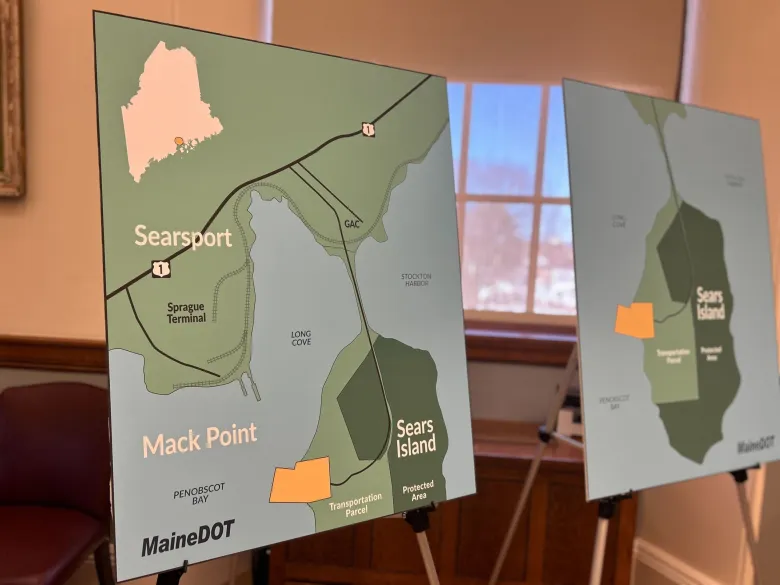
Since the state already owns the land, it will minimize upfront costs and eliminate the potential for leasing, making Sears Island more cost-effective in the short- and long-run, Mills said. She didn’t provide an exact number, but Mills said the entire project could ultimately cost several hundreds of millions of dollars.
The island also has the required physical characteristics, namely a large, level surface with access to deep water.
Knowing that some people may be unhappy about the decision, Mills said she has hiked the island and circumnavigated it by boat so she understands the appreciation for the island. In 2009, the state put about 600 acres — two-thirds of the island — into a permanent easement. That portion will remain untouched by the port, which will be built on about 100 acres outside of the protected area.
Searsport and the surrounding region has faced economic challenges in the past decade after a paper mill closed and took more than 500 jobs with it.
“We have not recovered from that loss,” said James Gillway, town manager of Searsport. “Offshore wind will change that.”
Representatives from Maine State Chamber of Commerce, Maine Conservation Voters and Maine Audubon were also present at the press conference in support of the announcement. Sen. Chip Curry (D-Waldo) also spoke about the opportunities this will offer by creating a new industry to “strengthen families up and down the Midcoast” with good-paying jobs.
“Offshore wind will be essential to our transition away from expensive and dirty fossil fuels, and to realize this incredible opportunity, we need port infrastructure,” said Beth Ahearn, director of government affairs for Maine Conservation Voters, who was also part of the 19-member Offshore Wind Port Advisory Group.
Organized by the Maine Department of Transportation, the advisory group met six times between 2022 and 2023 to explore prospective sites and help inform the governor’s decision.
Maine relies on natural gas to support much of its energy needs, so diversifying power sources can help stabilize prices for ratepayers, said Dan Burgess, director of the Governor’s Energy Office.
“This is an investment in Maine-made, clean energy that we think will stabilize rates,” Burgess said of offshore wind. He added, “the more we can do homegrown, the better.”
In a statement, Sean Mahoney, vice president of the Conservation Law Foundation Maine, which was also part of the advisory group, said, “Offshore wind will grow our economy and help us meet our obligations to ditch polluting fossil fuels. It’s critical that this process is now moving forward and we’re one step closer to getting this clean energy on the grid.”
In November, a coalition of organized labor and environmental groups voiced support for building a new port for offshore wind, highlighting benefits such as job-creation and the use of innovation developed by Maine people. They also stressed the urgency of moving forward with the project for environmental reasons.
The state is still waiting for the federal Bureau of Ocean Energy Management to publish a final map showing where offshore wind can be developed in the Gulf of Maine.
In the meantime, Maine DOT will begin applying for state and federal permits. That process is expected to take about a year. Construction, however, will take multiple years. Mills estimated it could wrap up in 2029.
Even before the governor’s decision, Searsport stood out among the other options.
While the water is plenty deep, there isn’t enough space in Portland, so it wasn’t a viable option, explained Kathleen Meil, senior director of policy and partnerships for Maine Conservation Voters.
Eastport, another potential location, would require going through Tribal land and has a lot of rock, granite and other materials that would need to be blasted.
“So, that leaves us with Searsport,” Meil said in an interview with Maine Morning Star last week.
OFFSHORE WIND: Eversource Energy says it will sell its stake in the South Fork and Revolution wind projects to Global Infrastructure Partners for $1.1 billion as it posts a fourth-quarter loss. (Reuters)
ALSO: A nonprofit business program selects nine Maryland companies aiming to enter or expand in the domestic offshore wind industry for free consulting and project development services. (news release)
TRANSIT: Boston’s city council may consider a traffic congestion pricing plan similar to that of New York City to improve air quality and support public transit use. (Boston Herald)
FOSSIL FUELS:
GRID:
BUILDINGS:
ELECTRIC VEHICLES: Vermont Electric Cooperative begins tracking how many electric vehicles are plugged in to charge overnight and manages their charging times to prevent grid overload but still fulfill demand. (WCAX)
SOLAR: A central Maine town’s board sends solar-related zoning recommendations to its city council centered around wetlands protection and when it’s appropriate to rezone land for solar. (Morning Sentinel)
NUCLEAR: The chair of the federal Nuclear Regulatory Commission tours the Oswego, New York, nuclear plant and says nuclear power is critical for the state to reach its clean power goals. (Spectrum News 1)
CLIMATE: The future of some traditional New England sports like pond hockey are threatened by the milder winters and thinner ice coverage associated with climate change. (Associated Press)
RENEWABLES: Corporate climate commitments along with federal incentives are helping get clean energy projects off the ground, panelists say at a Cleveland event. (Energy News Network)
ALSO:
PIPELINES:
GRID: Iowa Republicans for the second time advance a bill to give incumbent utilities first rights to build transmission lines, criticizing a state Supreme Court ruling that blocked lawmakers’ previous attempt. (Des Moines Register)
UTILITIES: Michigan regulators issue several new orders to establish a framework for utilities to comply with new energy laws that include higher clean energy targets and energy storage requirements. (MLive)
OHIO:
ELECTRIC VEHICLES: An oil and gas lobbying group aims to engage voters by taking out an ad during the Super Bowl in key swing states accusing the Biden administration of forcing people into buying electric vehicles. (Detroit News)
EFFICIENCY: Michigan regulators approve a settlement agreement that will require Consumers Energy to increase energy efficiency investments in communities most affected by high energy burdens. (Michigan Advance)
SOLAR:
AIR POLLUTION: A Detroit neighborhood will install six air quality monitors to provide data that residents hope will force city leaders to take action. (WDIV)
CLIMATE: Teenage climate activists call on Wisconsin’s attorney general to sue fossil fuel companies for their role in contributing to climate change. (WKOW)
GEOTHERMAL: The Biden administration awards $60 million to three enhanced geothermal energy pilot projects in California, Utah and Oregon. (The Hill)
TRANSPORTATION: New Mexico lawmakers pass legislation requiring reductions in transportation fuel greenhouse gas emission intensity and establishing a carbon credit market for fuel producers. (NM Political Report)
OIL & GAS:
WIND:
SOLAR: A report finds California and Arizona lead the nation in rooftop solar capacity, but recent net metering policy changes threaten further progress. (news release)
UTILITIES:
COAL:
CLIMATE:
NUCLEAR: Gillette, Wyoming, looks to lure a nuclear microreactor company to establish a manufacturing facility in the Powder River Basin coal mining town. (Cowboy State Daily)
MINING: A Wyoming company claims to have found a 2.34 billion metric ton deposit of rare earth minerals in the southeastern part of the state. (Cowboy State Daily)
COMMENTARY: A Wyoming columnist urges lawmakers to drop a proposed $10 million carbon dioxide-enhanced oil recovery stimulus bill, saying it would only benefit ExxonMobil. (WyoFile)
WIND: Virginia lawmakers delay until 2025 consideration of a bill to allow entities other than Dominion Energy to build offshore wind facilities, rewarding the utility’s intense lobbying against the bill and disappointing clean energy advocates. (Energy News Network)
BIOMASS: Financially troubled biomass company Enviva, which operates wood pellet factories across the Southeast, reaches a critical point as its 30-day grace period to pay bond holders expires, likely requiring either a streamlining of its operations or a move toward bankruptcy. (Wilmington StarNews)
SOLAR:
NUCLEAR:
PIPELINES: A lawyer for six Virginia landowners along the Mountain Valley Pipeline says they’ll appeal to the U.S. Supreme Court after a judge dismisses their suit challenging the pipeline’s use of eminent domain to build on their property. (Cardinal News)
OIL & GAS: At least six liquified natural gas projects are underway in Mexico but will rely mostly on gas shipped from the Permian Basin and other regions in the U.S., including from facilities currently under scrutiny by federal officials. (Canary Media)
EMISSIONS:
ELECTRIC VEHICLES:
GRID: A Texas Congress member carries legislation to require the state’s standalone power grid to connect with the nation’s major grids. (KEYE)
HYDROGEN: California’s transportation department plans to spend $127 million to purchase six hydrogen-powered passenger trains. (Bloomberg)
OIL & GAS:
POLITICS: New Mexico’s oil and gas industry shifts some of its political donations away from Republicans to Democrats, who hold most of the state’s elected offices. (Capital & Main)
PUBLIC LANDS: The federal Bureau of Land Management proposes withdrawing 4,213 acres in New Mexico from new oil and gas leasing and mining claims in an effort to protect sacred tribal land. (news release)
CARBON CAPTURE: A California oil and gas company that has reduced emissions by electrifying equipment now looks to make its operations “carbon negative” by capturing and sequestering carbon dioxide. (Forbes)
UTILITIES:
SOLAR:
GEOTHERMAL: New Mexico lawmakers pass legislation creating a geothermal energy research and development grant fund. (NM Political Report)
MICROGRIDS: San Diego Gas & Electric unveils four new battery-powered microgrids in southern California communities aimed at increasing grid resilience. (San Diego Union-Tribune)
MINING: An Australia firm plans to invest $2.16 billion in its proposed zinc and manganese mine in southern Arizona. (KVOA)
TRANSPORTATION: Denver’s climate action office experiments with paying residents to ride their bikes instead of driving cars. (Denverite)
COMMENTARY: A Colorado advocate calls on state leaders to improve residents’ quality of life by redirecting transportation spending from highways to public transit and bicycling and pedestrian infrastructure. (Colorado Sun)
SOLAR: An Arizona company announces plans for a $344 million solar panel recycling facility in rural Georgia, which will also manufacture enough glass to supply 5 GW worth of new panels per year. (Associated Press)
ALSO: Virginia lawmakers table separate bills that would have increased the state’s cap on distributed generation and allowed the state to override county rejections of solar farms. (Utility Dive, Suffolk News-Herald)
GRID: ERCOT officials are skeptical of a U.S. House bill to connect Texas’ grid to the rest of the country, suggesting the plan could disincentivize construction of new generation in the state. (E&E News, subscription)
LITHIUM: An inaugural Lithium Innovation Summit in Arkansas attracts more than 700 people, as boosters say the state could meet more than 15% of global demand for the element. (Arkansas Advocate)
ELECTRIC VEHICLES:
WIND: Louisiana businesses with expertise in oil and gas extraction are finding opportunities in offshore wind. (Governing)
UTILITIES:
NUCLEAR: Kentucky lawmakers introduce bills to support development of nuclear energy in the state. (WKMS)
OIL & GAS: Federal regulators approve two projects along the Gulf Coast that are expected to accelerate natural gas exports. (E&E News)
COAL: A federal lawsuit claims a coal company owned by West Virginia Gov. Jim Justice improperly paid millions to settle a bank debt that should have gone to other creditors. (Cardinal News)
SOLAR: The Ute Mountain Ute Tribe expects to break ground later this year on a planned 756 MW solar installation on its land in southwestern Colorado. (KSUT)
ALSO: A California lawmaker introduces legislation that would require state regulators to consider all economic and environmental benefits of rooftop solar when setting net metering rates. (PV Magazine)
CLEAN ENERGY:
UTILITIES:
OIL & GAS: Occidental Petroleum predicts its plan to inject captured carbon into its Permian Basin oil and gas wells will increase crude production by as much as 12,000 barrels daily by 2026. (E&E News, subscription)
PIPELINES: Tribal nations and advocates push back against a proposed pipeline that would carry Permian Basin natural gas to an export terminal in Mexico, saying it threatens sacred sites and could fuel the LNG boom. (DeSmog)
ELECTRIC VEHICLES:
CLIMATE:
GRID: Los Angeles’ municipal utility votes to move forward with joining California’s grid operator’s extended day-ahead power market. (RTO Insider, subscription)
WIND: Oregon commercial fishermen and Indigenous communities criticize the Biden administration’s finalization of wind energy areas off the state’s southern coast, saying the federal agency failed to account for potential impacts. (Oregonian)
Companies have a smoother road for getting management to greenlight clean energy projects now than they did five years ago, thanks to corporate climate commitments, federal incentives and more.
And if last month’s turnout of more than 800 people for the Greater Cleveland Partnership’s sustainability summit is any guide, businesses want support and guidance on navigating a process that is more compelling yet also more complex than it was years ago. The Jan. 23 program drew twice as many attendees as last year’s inaugural event.
Sustainability “is a major market trend at this point. It’s a massive market opportunity,” said Baiju Shah, president and chief executive officer for the Greater Cleveland Partnership, which is one of the United States’ largest metropolitan chambers of commerce. At the same time, sustainability is crucial if businesses want to stay competitive in a global marketplace, he said.
Roughly a third of the Greater Cleveland Partnership’s largest member companies have pledged to be carbon neutral by 2050, according to Emily Keller, GCP’s manager of sustainability initiatives. And, she added, practically all member companies have committed to some environmental sustainability practices.
Those pledges and goals have an impact when it comes to getting the green light for clean energy projects, especially when companies report on their progress towards environmental, social and governance objectives.
“Explaining an energy efficiency project [to management] or even being able to get a renewable energy project across the finish line five years ago was much different than what it is today,” said Rebecca Karason, the environment and sustainability director for Huntington National Bank. Decisions on three solar arrays for the company were based on economic factors, but a good part of the decision also hinged on the company’s renewable energy commitment, she said.
Ideally, clean energy projects add to businesses’ bottom lines.
“At its core, the development and the analysis of these projects is no different than any other capital project, but it is a complicated process,” said Gino Scipione, whose practice with Cohen & Company centers on compliance and financial reporting.
For any project, “you have to be able to prove at its core that it’s going to return value,” Scipione said. Most projects are capital expenditures, so for accounting purposes they get capitalized and depreciated over time, instead of being treated as an expense for a single year. How much comes from equity versus debt financing affects the calculations, too.
Beyond the general tax considerations that enter into any business deal, companies should also consider if a project can qualify for tax credits under the Inflation Reduction Act’s clean energy incentives, Scipione noted. Those reductions in tax liability reduce the total cost for a project. And larger tax credits are available if projects are located in disinvested or energy communities and satisfy other requirements. In some cases, there also may be an opportunity to sell renewable energy credits, or RECs, which can provide income to further offset costs.
All of that, for example, means a company can see savings sooner from an investment in solar energy compared to the costs of otherwise purchasing electricity from the grid.
“The amount of money that I’ve seen in the last two years coming from the federal government is really helping,” said Rishabh Bahel, Nestlé’s manager of energy and sustainability for North America, who is based in Solon, Ohio. The company has announced it plans to power all its operations sites with renewable electricity by 2025, and one of its strategies has been investing in solar farms.
If a project meets enough requirements for the Inflation Reduction Act’s tax credits, “essentially you can get 40 to 50% paid by the government,” Bahel said. “So you have to make sure you’re looking at all the incentives and plans available in the market.”
Energy efficiency is another big emphasis for Nestlé.
“Any time you’re saving energy, you’re saving money,” Bahel said.
Those energy savings cut the costs of production and support the business case for the investment. In contrast, if companies merely pay for carbon offsets, “that really doesn’t have any payback,” he said.
Businesses in disinvested neighborhoods also need the economics of clean energy projects to work, because a company with too much debt won’t succeed, said Michael Jeans, CEO of Growth Opportunity Partners and its GO Green Energy Fund. He and others at Growth Opps often guide companies through the financing process and provide advice to help them make projects succeed.
Even as financial incentives boost the business case for clean energy investments, companies also face added compliance requirements for reporting greenhouse gas emissions.
“It’s sort of a carrot and stick,” said Kaitlin Bergan, head of sustainable client solutions for BlackRock’s U.S., Canadian and Latin American team, as she reported on overall trends in industry.
In 2022, the Securities and Exchange Commission issued proposed rules for publicly traded companies to report on climate risks and their contributions to greenhouse gas emissions. The rule will likely be finalized sometime this spring. The European Union already has adopted reporting requirements for some companies. And as Karason sees it, reporting requirements will trickle down even to smaller companies.
Reporting requirements can be a challenge, especially if different customers need data reported in different formats, said attorney Richik Sarkar, Dinsmore & Shohl’s ESG equity partner in Cleveland. Yet as sustainability managers do that, he suggested they also should think about how to explain projects to their companies’ financial officers.
So, Sarkar challenged: “How do you make the business case and explain to them it’s not only a matter of doing good, but it’s a matter of doing well?”
To be sure, not all companies are moving ahead on clean energy projects. About 50 attendees walked out during Bergan’s talk, as a protest against BlackRock’s continuing investments in fossil fuels. And last week, FirstEnergy reneged on its commitment to reduce greenhouse gas emissions 30% by 2030.
Craig Ickler is an energy democracy organizer for Cleveland Owns, which was among the groups organizing the protest. With BlackRock being an exception, Ickler felt the Greater Cleveland Partnership is “talking about sustainability seriously.” He also wants more involvement of local neighborhoods in energy projects and decisions. “My focus is as much on removing fossil fuels from the energy equation as it is about who’s going to own those clean energy assets and who’s going to benefit from them,” he said.
Emily Bacha, vice president of public affairs for the Ohio Environmental Council, also attended the Jan. 23 conference. She said she saw “real momentum to push forward equity in climate and sustainability strategies” — something she wouldn’t have expected ten years ago.
Now Bacha and others will be watching to see what further strides companies make. “It’s important that we’re not just talking the talk, but walking the walk across all sectors,” she said.


.svg)
