

 Back
Back
The United States is facing a new energy crisis — one that could make the climate crisis even worse.
After more than 30 years of falling or flat demand for electricity, electric utilities are forecasting the nation will need the equivalent of about 34 new nuclear plants, or 38 gigawatts, over the next five years to supply power for data centers, electrification and new industry according to filings made to the Federal Energy Regulatory Commission and compiled by Grid Strategies.
Since those reports, several utilities have further increased their near-term forecasts.
And those estimates don’t necessarily include the growth of hard-to-track, but energy-hogging cryptocurrency or cannabis farming, which are estimated to be using up to 2.3% and 1%, respectively, of the nation’s electricity. Energy demand in these industries has skyrocketed as the popularity of cryptocurrency and as legalization of marijuana have spread.
The utilities “were either just caught unaware or not believing what they were hearing,” said Rob Gramlich, president of Grid Strategies, which provided a cumulative look of the demand in December.
In response to this demand, which seems to have power providers in the United States flat-footed, many utilities want to build new power plants to burn methane, a fossil fuel also known as natural gas, or to delay closing their coal plants.
“I can’t recall the last time I was so concerned about the U.S. energy trajectory, as major utilities maneuver for mass gas capacity expansion in the face of load growth. Unless course is changed … (greenhouse gas) goals are effectively dead,” Tyler Norris, a doctoral fellow at Duke University, said in a recent tweet.
The issue is also a global one, as a recent International Energy Agency report says electricity for data centers, including for AI and cryptocurrency, could double by 2026.
At the same time, there hasn’t been enough construction of enough new transmission to bring renewables such as solar and wind to the grid.
“We see (the gas buildout) as a huge threat — we are at a moment where we need to be phasing out fossil fuels and not locking it in for decades longer,” said Gudrun Thompson, energy program leader for the Southern Environmental Law Center.
Norris said in 2022 he pointed out in hearings on Duke Energy’s carbon plan that the company seemed to be “low-balling” the need for more electricity, including for the growing amount of electric vehicles. At about the same time, Georgia Power told regulators it only needed the equivalent of one more mid-sized power plant to meet growth for the rest of the decade after its two new nuclear units at Vogtle came online.
But late last year, Georgia Power said it will need 17 times more electricity — the equivalent of four new nuclear units — than what it had forecast just 18 months earlier because of new data centers and manufacturing in this state.
One Georgia Public Service Commissioner, known for backing Georgia Power, questioned whether the company should have seen that growth coming ahead of time.
“Talk with me about why I should have any confidence whatsoever in these projections when the 2022 projections were so off,” a heated Tricia Pridemore asked in a PSC hearing.
Economic development interests in the state call the demand a measure of success. Georgia Gov. Brian Kemp has aggressively recruited new industry to the state, and its economic development arm and Georgia Power tout low electricity prices there as a way to attract that industry.
The same is true in Texas, where data mining centers have requested the equivalent of roughly 41 new nuclear power plants to power their energy-intensive computer processes to find the cryptocurrency.
In Virginia, data centers are no longer as welcome as they once were. Dominion has threatened to turn away new centers, saying it can’t meet the power demand.
The utility said in 2023 that demand for electricity from those centers would increase 376% by 2038. Even if that demand is tempered, Dominion still expects overall demand for power to grow by 85% over the next 15 years as consumers shift to electric appliances, heating and cooling units and vehicles.
The Tennessee Valley Authority is also a hotspot for new data centers, with 65% of its new load growth since 2019 coming from data centers. TVA has contracts from additional centers not yet online that will increase its load another 40% to 50%. The quasi-public utility has proposed or is building eight new natural gas plants to fill the demand.
“The timeframe that they can get online has been aggressive on their part,” said Lori Stenger, TVA’s director of enterprise, forecasting and financial planning.
This underscores one point made by observers: Data centers and data miners aren’t just going to places where power is cheap, but where they can get power the fastest. In fact, some crypto miners are purchasing coal plants to provide electricity for their operations.
Utilities say they can’t meet the skyrocketing growth with wind, solar and other renewable energy, but a large group of businesses including Google and Microsoft, beg to differ. The 400-member Clean Energy Buyers Association said fossil fuels are not aligned with their goals.
“Georgia Power’s proposals to add more fossil fuel resources into its resource mix in this docket send the wrong message to the business community and large customers evaluating Georgia as a place to do business,” said Priya Barua, CEBA’s director of market and policy innovation, in written testimony over Georgia Power’s request to add more capacity.
Despite the utility’s forecasts, it’s still unclear exactly how much power is needed.
Jeremy Fisher, a principal advisor for climate and energy with the Sierra Club, said while data centers in Northern Virginia are using roughly the equivalent of three nuclear plants worth of energy, the centers themselves are building almost four times that much in backup diesel generation around their centers, according to a review of permitting data. The backup power could be an indication those centers are preparing for future growth, Fisher said.
“There’s such little data, it’s frustrating,” said Mandy DeRoche, a lawyer at Earthjustice who has been tracking data centers.
That lack of clarity around the nation’s electricity use — no single agency has a full picture of how much is needed or used — was in the spotlight this year after the federal Energy Information Administration sent an emergency request to cryptocurrency miners requiring them to share how much electricity they use.
Texas miners sued to stop the request, and the EIA has agreed to go through a more formal process that will take longer to gather that data.
At least one publicly traded Bitcoin miner, Riot, which sued the EIA to stop the data collection, highlighted the risk of such data becoming public in its annual report to the Securities and Exchange Commission last year.
“It is possible that mandatory surveys such as this will be used by the EIA to generate negative reports regarding the Bitcoin mining industry’s use of power and other resources, which could spur additional negative public sentiment and adverse legislative and regulatory action against us or the Bitcoin mining industry as a whole.”
Floodlight is a nonprofit newsroom that investigates the powerful interests stalling climate action.
A group of energy equity advocates in Boston is launching a community solar cooperative they say could be a scalable model for both reducing carbon emissions and building wealth in disadvantaged communities.
The Boston Community Solar Cooperative is in the pre-development stage of an 81 kilowatt solar project on the roof of the Dorchester Food Co-op, in one of the city’s lowest-income neighborhoods. Residents will be able to buy or earn ownership stakes in the project, which will be governed by a board of community stakeholders. The food store will buy the power at a discounted rate and the revenue created will be shared among this group of owners.
When the Dorchester project is up and running, the coalition plans to replicate the model in other neighborhoods around Boston, as well as share details and lessons more widely so other communities can create their own co-ops.
“The idea is that the majority of the ownership for the Dorchester project will be owned by Dorchester community members,” said Gregory King, a co-founder of the cooperative and interim president of the board. “It’s about a community empowerment movement.”
Community solar, in which subscribers or co-owners pay for a share of the power generated, has been around for close to 20 years. Though it took about a decade to catch on, adoption began to pick up in the mid-2010s, and, today, some seven gigawatts of community solar capacity has been installed nationwide, up from just one gigawatt in 2018. Massachusetts is home to 882 megawatts.
From the beginning, advocates saw the potential in community solar to help bring the benefits of renewable energy to low-income and other historically disadvantaged communities. The approach allows anyone to buy clean energy, usually at a lower price than utility supply, without needing a sunny rooftop of their own or thousands to invest upfront.
“If you’re a renter, actually having your own solar array is almost impossible,” said Kendra Beaver, climate justice coordinator at the Fairmount Indigo CDC Collaborative in Boston and a co-founder of the cooperative. “For folks who do own their homes, there’s still a huge financial investment you have to make to put solar panels on your home.”
So far, though, the promise of using community solar to help narrow the wealth gap has not been realized: In 2022, just 2% of community solar customers were low-income, according to a report produced by Wood Mackenzie in collaboration with the Coalition for Community Solar Access. The trend is moving in the right direction, however. By the second half of 2023, low-income households made up 10% of community solar customers. And provisions of the 2022 federal Inflation Reduction Act (IRA) are likely to expand opportunities for low-income consumers even further.
“Community solar is a really great tool for energy equity and environmental justice. But our very first wave of community solar programs and projects served a more general market, with a larger portion of middle-income to upper-income customers,” said Kate Daniel, Northeast regional director for the coalition. “The trend is growing really quickly toward the direction of serving low-income customers.”
The Boston Community Solar Cooperative grew out of a desire to maximize the economic and social impact community solar could have in disadvantaged neighborhoods. To achieve this goal, organizers designed a strategy with several key differences from standard community solar models.
“We’re laying out a framework for what I refer to as ‘community solar 2.0,’ that really provides ownership to members,” King said.
Most community solar developments use a subscription model: Consumers sign up to buy a share of the power produced by a given development, but the array is owned by a third party that operates the system and keeps the revenue. Projects developed by the Boston cooperative will also have local subscribers who realize savings on the cost of electricity, but the arrays will be owned by community shareholders and governed by a board of local stakeholders.
Area residents can pay $1,000 for a share in the development. A “solidarity fund” will allow the organization to fund ownership stakes for some interested community members who can’t afford the cost. There will also be worker members who will help with project development and community outreach, earning a regular hourly rate for their work and eventually becoming entitled to an ownership share, much in the way corporate employees can earn stock options.
For the first project, the cooperative will accept roughly 30 investor members, to ensure that each owner receives meaningful money from their investment, King said. More members will be added as new projects are developed.
The coalition is also dedicated to hiring people of color and women or minority-owned businesses whenever possible in the design and construction process, allowing more money to flow into the community.
“A lot of solar developers are not inclined to erode their profit by taking on more expensive labor than they need to — we have the opposite mindset,” King said. “We’re making sure we’re proactively engaging minority businesses and trying to create an income stream for contractors that work for us.”
The community solar cooperative could also offer benefits beyond the financial, Beaver said. Seeing more solar panels on your block and hearing your neighbors talk about their investments in them could increase engagement in climate solutions, she said.
“There’s empowerment in participating in something that feels meaningful with people who live in your neighborhood,” she said.
There is growing interest in cooperative ownership of community solar and the ways it can share the financial benefits of renewable energy with community members, Daniel said. However, it has traditionally been difficult to make the model work.
“The challenge is just that this is a very hard thing to do to organize,” she said. “It takes a lot more effort, it takes more intricate funding and financing mechanisms.”
Indeed, it is a provision in the relatively new IRA that has really made the numbers work for the Boston coalition, King said. Tax equity financing, in which an investor puts money into a project in exchange for the tax credits it generates, has long been a common component of community solar financing. In the past, however, federal rules required the investor to remain an owner in the project for years. The IRA modified that regulation, allowing investors to simply take the tax credit without continuing on as part owners. That change allows community solar cooperatives to retain the revenue and profits for themselves — and their members.
The Solar for All program, another program created by the IRA, could also expand opportunities for low-income community solar cooperatives. Massachusetts has applied for $250 million from the program, and its plans include provisions that would help community solar cooperatives get more traction. The U.S. Environmental Protection Agency anticipates making awards to winning plans starting in July 2024.
Even as it continues to watch these developments and hone its plans for the Dorchester installation, the Boston cooperative is already actively looking for sites for additional arrays, focusing on the neighborhoods of Dorchester, Roxbury, and Mattapan, and considering how to communicate everything they’ve learned to other communities interested in forming their own cooperatives.
“One thing we’re hoping to do is share some of the things we’ve learned on our journey,” King said. “We’d love to see other communities around the state of Massachusetts adopt a similar model.”
Overnight in early July last year, Vermont solar installer Bill Chidsey got a call that a grocery store he worked with in his village of Hardwick was flooded. He arrived to find feet of water in the Buffalo Mountain Market’s utility room, spilling over from the rising Lamoille River in a record-breaking rainstorm.
“The grocery store survived by an inch,” Chidsey said. “If it had rained fifteen more minutes, they’d have lost four compressors.”
He’s now helping the co-op build a net-zero energy system that will use solar power and recycled waste heat from the store’s refrigerators. But it’s going to be a long project — just one of countless examples Vermont has seen since last year of how sustainable rebuilds in the wake of a flood don’t happen quickly.
“I think we’re just getting started with this,” Chidsey said.
Advocates, utilities and state agencies have seen slow progress and mixed success since July 2023 in trying to replace flood-damaged home and business energy systems with more efficient, cost-effective, low-carbon technology. Now, they hope to redouble these efforts as part of a long-term recovery — both to keep people affected last year from falling through the cracks, and to be more resilient in the next storm.
“We consider that we’re now about to start ‘phase two,’ where we hope to go back and talk about energy systems,” said Sue Minter, who leads Capstone Community Action in central Vermont. “In the emergency — with winter and nowhere else to go, and oh, by the way, no contractors available, labor shortage, material shortage, crisis — we couldn’t do the transition work, but that doesn’t mean we won’t.”
More than a decade ago, Minter was the deputy secretary of Vermont’s Agency of Transportation when the 2011 Tropical Storm Irene — comparable in its severity to the 2023 floods — washed out hundreds of miles of roads and bridges across the state.
As the state’s Irene Recovery Officer, Minter spent the next two-plus years grappling with federal regulators and pushing through new policies and programs to rebuild “stronger, with resilience in mind,” she said. This included allowing easier upsizing of culverts and clearing development out of floodplains.
Many places with these post-Irene resilience upgrades and reforms saw less damage in the July 2023 floods as a result, Minter said. Vermont officials even came to a recent meeting of the Maine Climate Council, after a pair of weather disasters there, to talk about their approach to flood-resilient infrastructure.
“When you know you’re in an emergency, and you know everything has been destroyed, you also know it’s an opportunity to innovate … to rebuild differently,” Minter said.
Vermont, often called a potential haven for future climate migrants, is nonetheless seeing more frequent and intense rain and floods as one of its top impacts from human-caused climate change. The state also relies heavily on pricey, carbon-intensive heating oil.
After last year’s floods, Vermont leaders wanted to seize the moment to help affected residents make future-looking energy and efficiency upgrades on a widespread scale.
“They’re ripping out drywall, they’re having to update systems — this is the time to make sure that you do it properly,” said Efficiency Vermont supply chain engagement manager Steve Casey.
Efficiency Vermont, a statewide energy efficiency utility, created an emergency flood rebate program for affected homeowners and renters, reallocating $10 million in pandemic aid already set aside for low-income weatherization projects.
The new program offered up to $10,000 per household to repair or replace flood-damaged energy systems and other appliances, on top of existing funding for efficient electric heat pump water heaters and electrical panel upgrades. Similar rebates for damaged businesses were just raised to a $16,000 cap.
But uptake on this funding has been slow. As of January, only 155 households had received flood rebates of $5,100 apiece on average, according to state legislative testimony from Efficiency Vermont director Peter Walke.
It’s partly because the initial $10 million was “an overshoot to ensure we wouldn’t run out of funds,” allocated quickly “without knowing what the actual need would be,” said spokesperson Matthew Smith.
But people also ran into myriad barriers to using the money quickly.
Some lacked up-front cash to pay for upgrades that would be rebated later. In response, Efficiency Vermont has begun offering a 100% cost-coverage program for the lowest-income clients, where contractors are paid directly by the state. That program had paid out nearly $92,000 to 10 people as of January, per Walke’s testimony, with 58 more in the pipeline.
“The households that are still in significant need at this stage were vulnerable households to begin with,” Casey said. “We do have this repeating situation where flood events kind of just exacerbate some vulnerabilities for certain households.”
The timing of the 2023 floods was another complicating factor. The upcoming heating season loomed in the months after the disaster, and limited housing stock meant people couldn’t relocate from damaged homes, unlike after Tropical Storm Irene, said Sue Minter.
“In 2023, July, people had to get into their homes as quickly as possible,” she said. “You always have to have life and safety first.”
The repairs and retrofits needed most urgently were not simple. Many people’s water and space heating systems and electrical panels were in basements, “the first place to flood,” said Casey.
Parts of Vermont are trying to change this norm — Waterbury, for example, requires basements to be above flood elevation in new or substantially improved home construction, among other flood protections.
Chidsey, the solar installer in Hardwick, said he and his electrician have tried to shift to putting electrical panels on the outside of homes, with any indoor subpanels out of the basement. Ideally, he said, the cellar becomes “just a hole in the ground that holds up the house, because water comes in often now.”
But moving HVAC infrastructure out of a vulnerable basement, whether to meet a local requirement or voluntarily, isn’t easy, especially after major damage, Casey said. People may not have a ready space for that equipment on the first floor, or may need mold remediation before taking on serious flood-proofing.
It means that the advocates working to facilitate upgrades have had to take a long view.
Last fall, Efficiency Vermont, Capstone, the state’s utilities and a range of other partners stood up a new system of Vermont Energy Recovery Teams, who went into damaged homes to help people plan and prioritize repairs before winter, including coordinating holistically across contractors and funding sources.
Some homes were able to switch straight to heat pumps as a cheaper, cleaner method of water and space heating, officials said. But for many, a replacement oil or gas system was the simplest short-term option.
Efficiency Vermont does not normally offer incentives for installing fossil fuel systems, but made exceptions for high-efficiency Energy Star-rated models as part of its flood recovery rebate program.
“In every case, we looked for something that was more efficient than what they had before,” said Vermont Gas energy innovation director Richard Donnelly, who was part of many recovery team home visits.
In each of those visits, the teams would take note of residents’ long-term needs and goals for decarbonization, resilience, comfort and lower energy burdens, with an emphasis on heat pumps.
“We left off with sort of the promise that we’ll be back,” said Vermont Gas CEO Neale Lunderville — that “there’s money available for some of these technologies, that we can help you with the same process.”
The recovery teams are now under the umbrella of GreenSavingSmart, a pilot energy and financial coaching program for low-income residents run by the Vermont Community Action Partnership. They’ll soon begin revisiting last fall’s clients to facilitate a new round of resilient improvements.
“In the grand scheme of things, it’s a hopeful pathway to allow these households to have — once they’re fully made whole and recovered from all of this — a lower energy burden and cost burden than the situation they were in to begin with,” said Steve Spatz, an account manager on the supply chain team at Efficiency Vermont. “It really is an opportunity to … upgrade the conditions for the household.”
A pair of cousins who want to lease land for a contested solar project in central Ohio say a vocal minority is trying to interfere with their property rights.
“I have rights as an owner, farmer and investor that shouldn’t be limited by a small group of individuals who are opposed to any solar development,” said Richard Piar. He and Ethan Robertson jointly own two parcels of property in Knox County, which they want to lease to developer Open Road Renewables for the proposed 120 megawatt Frasier Solar project.
Much of the public debate surrounding the project has pitted local groups that oppose solar energy on agricultural land against the developer and clean energy advocates. But for the cousins, the project is a way to bring in new revenue and help keep the land in the fourth-generation farm family.
“Solar gives my family opportunities it otherwise would not have for a financial future,” Piar said.
Robertson is now seeking to intervene in the Ohio Power Siting Board case that will decide the project’s fate, and the cousins recently shared with Energy News Network how the project is important to them and their property rights.
“When someone who is not a farmer can tell us farmers what we can do with our land, it creates a slippery slope for property rights,” Piar said.
Concerns about conservation also factored into the cousins’ decision to lease the land, which the solar farm will have to restore at the end of the project. In Robertson’s view, those terms counter opponents’ arguments about blocking the project to protect farmland, especially when much of it – on the outskirts of Mount Vernon in Clinton and Miller townships, about an hour’s drive from Columbus – could otherwise become residential subdivisions.
“My children are nine, seven and five years old. This project is a key way to protect our land from the many ways this county may change over the next four decades,” Robertson said.
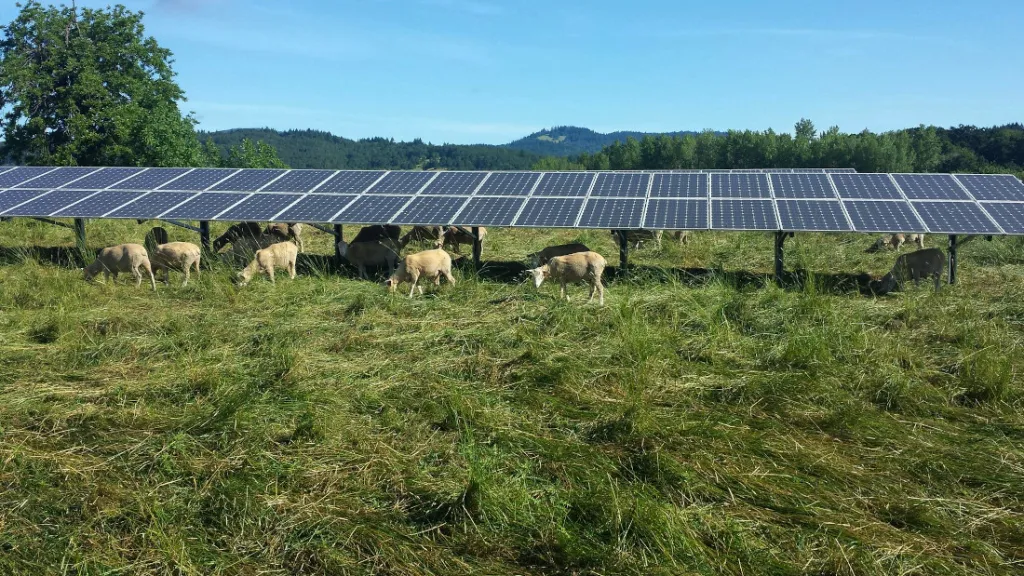
And much of the land in the Frasier Solar project will still be used for agricultural purposes while the solar project is in operation. On March 8, Open Road Renewables and New Slate Land Management announced they signed a letter of intent to use sheep grazing to manage vegetation for the project.
Brad Carothers, who runs New Slate, lives in Knox County and raises Katahdin sheep. When a letter came from Open Road Renewables about the Frasier Solar project, he reached out to the company.
“One of the main issues new and emerging farmers face is access to land,” Carothers said. “We’re a first-generation business. And so land is not something that I have from previous generations to utilize. And so this is how we can expand our business.”
Under Ohio law, a landowner generally gets to control who has access to real property and how it is used, including the right to lease it to others. Zoning can restrict some uses to certain areas, such as industrial or commercial activities.
For electric generation facilities, however, state law and rulings of the power siting board generally take precedence, except as provided in Senate Bill 52, said Jacob Bryce Elkin, one of Robertson’s lawyers who is with the Renewable Energy Legal Defense Initiative at Columbia Law School’s Sabin Center for Climate Change Law.
The 2021 law lets counties ban solar projects from parts of their territory, but only if they were not already in the grid operator’s queue when the law became effective.
“Frasier Solar clearly fits the bill to be grandfathered” under that exception, wrote Ohio Rep. Bill Seitz in a Feb. 23 letter urging the Ohio Power Siting Board to approve the project. Under the law, one county and one township representative will serve as ad hoc board members on the case.
Elkin also noted that while the Knox County Commissioners decided to ban wind farms in 2022, the same resolution said they would allow large solar facilities. So, because of SB 52, “if the OPSB grants the approval for the project, there’s nothing in local law that prohibits this project from being developed,” he said.
Yet when Knox Smart Development, an anonymously funded group opposing the solar project, hosted a program last month, speakers there talked about zoning and hypothetical situations that don’t apply to the solar farm case.
“For anybody preaching property rights, I always just like to ask them flat out: Does that mean you want to just ban or abolish all zoning?” said Jared Yost, a Mount Vernon resident who incorporated the group. Surely, he suggested at the Feb. 24 event, landowners wouldn’t want a chemical plant going in next door or sewage flowing into their yards.
Kevon Martis, a frequent opponent of renewable energy projects, took a similar tack, suggesting no one would want a 24-hour truck stop or adult bookstore next door – uses already governed by local zoning rules.
“Everybody says, ‘I should be able to do what I want on my private property,’” Martis said. “And while they may mean that about them, they never mean that about their neighbors.”
A company official with Open Road Renewables was denied entry to the group’s Nov. 30 “town hall meeting” on the project. The group’s events have also denigrated the perspective of farmers and other landowners who will benefit from solar.
“In this project and a lot of projects like this, it’s easy for the supporters of the project to have their voices drowned out by a vocal minority of people opposing the project,” Elkin said.
Even aside from SB 52, zoning doesn’t let governments arbitrarily limit people’s use of their property, Elkin said. Instead, it needs to be rationally related to legitimate land use concerns.
“The onus is really on the opponents to put forward a case that’s grounded in fact, and they haven’t done that,” Elkin said.
Filings by Preserve Knox County and Knox Smart Development in the Ohio Power Siting Board case claim the Frasier Solar project could interfere with adjacent owners’ property rights. And Robert Bryce, a former fellow with the Manhattan Institute, which has been linked to fossil fuel interests, claimed it was “BS” to think solar projects wouldn’t hurt property values in an area.
Among other things, Bryce cited a 2023 study in the journal Energy Policy by researchers at Lawrence Berkeley National Laboratory and the University of Connecticut. The study team’s analysis of 1.8 million real estate transactions found, on average, a 1.5% impact on sale prices for homes within half a mile of a solar project.
However, data for the study ranged from 2003 through 2020, which wouldn’t necessarily reflect the current real estate market. The study also didn’t compare the effects on property values near projects with or without measures to prevent potential negative impacts, although the authors did note that developers or policymakers have various tools to employ, such as landscape measures or compensation for neighbors.
The Ohio Power Siting Board revised its rules for solar farms after the Berkeley Lab study came out. The rule changes require setbacks from property lines, homes and roads. The rules also call for “aesthetically fitting” fencing and other requirements.
Open Road Renewables also stressed steps it takes to accommodate nearby landowners.
“We offer good neighbor agreements at all of our solar projects, and they generally include some sort of compensation,” said Craig Adair, the company’s vice president for development. Payments compensate for periodic disturbances during construction, while also letting neighbors benefit financially from the project, he explained.
Payments also encourage many neighbors to cooperate by sharing drainage tile information. That helps the company protect against problems with drainage or even improve local conditions, said Open Road president Cyrus Tashakori.
Robertson, Piar and other potential lessors are not alone when it comes to valuing property rights in Knox County.
Resident Steve Rex said he attended a Knox Smart Development meeting, which he felt was one-sided and presented inaccurate claims. Property owners shouldn’t have to worry about what other people think about how they use their land, he noted.
Franklin Brown, another Knox County resident, took exception to solar opponents trying to limit the rights of property owners for the Frasier Solar project. “The same conservative people say, ‘Well, we don’t want government up in our faces,’” Brown said. “But oh, here they do?”
The Ohio Power Siting Board is supposed to use statutory factors to decide whether a project moves ahead, rather than the number of supporters or opponents. However, the board has referred to local opposition in some past decisions blocking solar projects. The board will hold a public hearing on the Frasier Solar Project on April 4 at the Knox Memorial Theatre in Mount Vernon. The evidentiary hearing is currently scheduled for April 29.
CLEAN ENERGY: For every dollar the Inflation Reduction Act put toward clean energy incentives, policy analysts say the private sector has matched $5.47, totaling nearly $750 billion in the first year after the law passed. (Grist)
ELECTRIC VEHICLES:
CLIMATE:
OIL & GAS:
COAL:
PIPELINES:
BUILDINGS: A New York City public housing pilot project currently underway shows promise in reducing greenhouse gas emissions and making apartments more comfortable through window-mounted heat pumps. (Associated Press)
GRID: Connecticut regulators approve the first round of pilot projects in a new program aimed at testing innovative hardware and software to decarbonize the electric grid. (Energy News Network)
MINING: Tribal nation citizens urge a federal human rights commission to push back on a predicted uranium mining boom, saying Indigenous communities continue to suffer from Cold War-era extraction of the fuel. (Inside Climate News)
BIOFUELS: California advocates call on the state to overhaul its low-carbon fuel standard program to support and fund electric vehicles and charging infrastructure rather than biofuels. (Canary Media)
COMMENTARY: An ecologist suggests that solar projects designed to have synergy with agriculture and ecosystems can preserve farmland and natural environments as the U.S. builds out solar arrays. (The Conversation)
OIL & GAS: Oregon regulators reject climate plans from all three of the state’s natural gas utilities, saying they are overly optimistic about the prospects for “renewable” gas and hydrogen. (Oregon Capital Chronicle)
ALSO: New Mexico regulators reject a utility’s plan for a liquified natural gas storage facility, saying the benefits don’t justify the cost. (Source NM)
CARBON CAPTURE: A California company has raised $80 million for a proposed direct-air carbon capture facility in Wyoming. (Canary Media)
WIND:
SOLAR: A cannabis company proposes a 102 MW solar project to help power its research facility in rural New Mexico. (Renewables Now)
ENERGY STORAGE:
CLIMATE:
OVERSIGHT:
UTILITIES: Hawaii lawmakers debate a bill that would allow the state’s largest utility to securitize a bond to help pay for wildfire costs. (KITV)
EFFICIENCY: A landmark federal courthouse in Salt Lake City is undergoing extensive energy efficiency upgrades, with an aim of eventually reaching net-zero status. (Salt Lake Tribune)
TRANSPORTATION: Utah data shows both electric and hybrid vehicles are becoming more popular, but those sales are dwarfed by a surge in pickups and SUVs. (Salt Lake Tribune, subscription)
COMMENTARY:
SOLAR: To get around New Hampshire’s 5 MW solar net metering cap, the town of Bow plans to develop 6 MW of capacity across three municipal sites — double the capacity of the largest array in the state. (Concord Monitor)
ALSO:
OFFSHORE WIND: The head of the Connecticut Port Authority says New York’s selection of the Empire Wind and Sunrise Wind projects promises more turbine assembly activity at the New London state pier. (The Day)
GRID:
CONSUMERS: Maryland lawmakers advance new residential ratepayer protections for those purchasing power from retail suppliers, including a price cap over the standard service offer. (Associated Press)
HYDROPOWER: Dover-Foxcroft, Maine, considers whether to remove or restore a former hydroelectric dam that provides an attractive backdrop for daily life but is structurally unsound. (Bangor Daily News)
CLIMATE:
COMMENTARY: New Hampshire’s consumer advocate writes that Eversource Energy is undertaking a $400 million transmission line upgrade project in a way that indicates the utility is “hoping nobody, or almost nobody, will notice.” (In-Depth NH)
HYDROGEN: Pennsylvania’s governor says at a divisive public meeting that the state is “all in when it comes to the hydrogen hubs,” but environmentalists say the hard-to-reach location of the meeting shows a lack of interest in community engagement. (WHYY)
FOSSIL FUELS:
SOLAR: In New York, Niagara County’s environmental coordinator says the county’s solar panel recycling law is improving end-of-life panel management, but not all solar projects are complying. (Union-Sun & Journal)
ELECTRIC VEHICLES:
GRID: New Jersey lawmakers mull the potential impact of two bills, which would codify a gubernatorial order to have all electricity sales involve clean energy by 2035 and spend $300 million on grid upgrades. (RTO Insider, subscription)
POLICY:
STORMS: Massachusetts plans to appeal federal emergency management officials’ decision to not issue a major disaster declaration over the severe flooding that swept through the state in September. (Associated Press)
CLIMATE: The president of the New York Farm Bureau says his farmers support climate action but worry the push for electrification comes before electric farm equipment can handle the long hours required. (Spectrum News 1)
TRANSIT: Two Somerville, Massachusetts, council members plan to introduce a resolution to remove “unnecessary” parking spaces from new developments to help meet climate goals. (Boston Herald)
OFFSHORE WIND: Ørsted and Eversource begin sending power from their 132 MW South Fork wind project to the New York grid, the country’s first commercial-scale offshore wind farm to open. (Associated Press, Bloomberg)
ALSO: Federal regulators approve an interconnection agreement for the 810 MW Empire Wind offshore project between New York’s grid operator and utility Con Edison. (news release)
CLEAN ENERGY: Maryland legislators advance legislation to stop local jurisdictions from banning or limiting certain renewable energy resources, including incineration facilities, but some municipalities say it supersedes their zoning authority. (Frederick News-Post)
FOSSIL FUELS: A development group finishes dismantling a former oil refinery in south Philadelphia, once the East Coast’s largest such facility, and begins construction on an industrial space and life sciences lab. (Philadelphia Inquirer)
CLIMATE:
SOLAR:
UTILITIES:
CLEAN VEHICLES:
PIPELINES: Residents who live along the Mountain Valley Pipeline complain that Virginia regulators are ignoring erosion and pollution complaints as construction nears completion. (WVTF)
ALSO: The Mountain Valley Pipeline’s biggest stakeholder announces it will merge with its former owner, Pittsburgh gas company EQT, in a $5.5 billion stock deal. (Cardinal News; Bloomberg, subscription)
ELECTRIC VEHICLES:
SOLAR:
OIL & GAS:
COAL:
UTILITIES: The prosecution rests and defense begins its case in the trial of two former executives who are accused of scheming to collect bonuses by privatizing Jacksonville, Florida’s municipal utility. (WTLV)
CLIMATE:


.svg)
