

 Back
Back
As the Trump administration wages a high-profile attack on the nation’s offshore wind farms, it has also been quietly fighting a brutal battle with renewable energy projects on land.
Since President Donald Trump took office nearly a year ago, his administration has announced at least two dozen policy and regulatory actions aimed at hindering the build-out of wind and solar projects, including rescinding federal tax credits, withdrawing grants and loans, and freezing permitting approvals. Yet one measure in particular has had an outsize chilling effect — and is facing a new legal challenge from clean energy groups.
Last summer, the U.S. Interior Department announced that all decisions related to wind and solar projects would require an “elevated review” by Secretary Doug Burgum, saying this would end the Biden administration’s “preferential treatment” for renewables. In a July memo, the agency listed nearly 70 types of permits and other actions that now need Burgum’s personal sign-off, adding cost and time and creating significant anxiety for developers, experts say.
Over 22 gigawatts of utility-scale wind and solar projects on public lands have been canceled or are held up as a result of the order, according to Wood Mackenzie data and the Interior’s Bureau of Land Management website. That’s enough capacity to power roughly 16.5 million U.S. homes — a significant amount at any point, but especially when the country is clamoring for more low-cost electricity as energy demand and utility bills soar.
“We’re seeing electricity costs go up all around the country, and the cheapest electrons that we can put into the supply side of that equation are all stuck on Secretary Burgum’s desk,” Sen. Martin Heinrich (D-N.M.) told Canary Media.
Solar represents the bulk of that figure, with 18 GW of facilities scrapped or considered inactive as of December, by Wood Mackenzie’s count. Nearly 90% of those projects also included energy storage, given that many were slated for desert regions in the Southwest, said Kaitlin Fung, a research analyst for the consultancy.
“It’s created a choke point,” Fung said of Interior’s memo. She noted that the Bureau of Land Management has advanced permits for only one renewable energy project since July: the 700-megawatt Libra Solar facility in Nevada. Meanwhile, federal oil and gas permits have surged in the first year of Trump’s term.
Many other projects remain stuck in permitting limbo as developers await the approvals they need — from quick consultations to complex reviews — in order to secure financing and begin building their large-scale renewable energy installations. That’s true for wind and solar farms on private and state lands as well, since those projects might require federal approval for things like wildlife and waterway impacts.
The holdups are occurring as the United States teeters on the edge of an electricity crisis. Demand is climbing across the nation, causing household utility bills to soar, and more power plants are needed to satisfy the surge in AI data centers, factories, and electrified cars and buildings. Large-scale solar and onshore wind projects are among the fastest and lowest-cost ways to add power to the grid — faster than Trump’s preferred path of building new gas-fired power plants or restarting shuttered nuclear reactors.
Heinrich, the ranking member of the U.S. Senate Energy and Natural Resources Committee, cited the gigawatts of stalled projects in a Senate floor speech earlier this month. He and other Democratic leaders have said that any efforts to pass bipartisan legislation on energy permitting reform are “dead in the water” so long as the Trump administration continues to block development of onshore wind and solar and cancel fully permitted offshore wind farms.
“The concern is that we put a balanced legislative package together that gives certainty to both traditional [oil and gas] energy and renewables — but if this administration is going to say yes to all of the fossil projects and create a de facto moratorium on all of the renewable and storage projects, then we haven’t accomplished anything,” Heinrich said by phone.
In recent weeks, a coalition of clean energy organizations sued to overturn the July memo and other actions from Interior and the U.S. Army Corps of Engineers, which issues permits for energy projects near navigable waters. Both the Army Corps and Interior say they’re prioritizing projects that generate the most energy per acre, a measure that favors coal, oil, and gas and undercuts renewables — and which has its roots in fossil-fuel industry misinformation.
Such actions “arbitrarily and discriminatorily place wind and solar technologies into a second-class status compared to other energy sources,” the groups said in a statement this week. “The Trump administration has choked private developers’ ability to build new and urgently needed energy projects across the nation.”
For solar and storage in particular, nearly 520 proposed projects totaling 117 GW of capacity have yet to receive all the necessary federal, state, and local permits, which puts them at risk of being delayed by the Trump administration, according to the Solar Energy Industries Association. The projects represent half of the country’s new planned power capacity.
Many developers are simply receiving radio silence from agencies whose approval or advice they need, said Ben Norris, SEIA’s vice president of regulatory affairs, who likened the agencies’ actions to a “blockade on solar permits.” Fung noted one mundane but significant effect of Interior’s memo: Wind and solar developers are now excluded from using an online government planning tool that helps streamline environmental reviews, a move that creates additional costs and complexity for companies.
The delays come as developers are racing to qualify for federal tax credits under the newly shortened timelines. Wind and solar installations must either start construction this summer or be operating by the end of 2027 to access incentives. “Time is really of the essence for many of these projects,” Norris said. In the absence of Congress passing a permitting-reform bill, he added, the Trump administration could simply remove many of the roadblocks it created by revoking its memos and other actions.
“If they were really serious about affordability and addressing power bills, they could take these steps today,” he said.
This analysis and news roundup come from the Canary Media Weekly newsletter. Sign up to get it every Friday.
The Trump administration had a tough week in court, starting with a Monday ruling that could pave the way for states and cities to unlock billions of dollars in revoked clean-energy grants.
Back in October, the Trump administration terminated a massive $7.6 billion in federal funding for climate and clean energy projects. There was a clear pattern to the clawback: Nearly every grant would’ve benefitted a state that voted for Democratic nominee Kamala Harris in the 2024 presidential election.
And the White House wasn’t exactly hiding its politically driven motivations. In a post on X announcing the rollback, Russ Vought, director of the Office of Management and Budget, referred to the revoked grants as “Green New Scam funding to fuel the Left’s climate agenda.”
St. Paul, Minnesota, was among the cities, states, and organizations that lost funding — $560,844 for expanding EV charging, to be exact. So the city partnered with a handful of environmental groups to fight back in a lawsuit that resulted in a big admission from the Trump administration. In a December filing, Justice Department lawyers said they would not contest the assertion that a state’s votes for Democrats influenced the termination decisions.
U.S. District Judge Amit Mehta called out that assertion in his ruling, writing that “defendants freely admit that they made grant-termination decisions primarily — if not exclusively — based on whether the awardee resided in a state whose citizens voted for President Trump in 2024.”
While Mehta ordered the Trump administration to release about $28 million to St. Paul and its fellow plaintiffs, billions of dollars’ worth of other grants remain frozen. But one former U.S. Energy Department official told Latitude Media the win lays a clear path for other awardees to sue: “If the administration doesn’t reverse all of the terminations, then they should prepare for hundreds of additional similar lawsuits.”
Three big wins for offshore wind
Offshore wind is beginning to move and groove again after the Trump administration’s December order that the nation’s five in-progress wind farms halt construction.
On Monday, a federal judge allowed Revolution Wind to resume work off the coast of Rhode Island. Equinor won a similar ruling on Thursday to keep building its Empire Wind project near New York. And Friday brought a third victory, with a judge letting Dominion Energy’s Coastal Virginia Offshore Wind forge ahead. There’s no word yet on whether the two other affected installations can restart construction.
The federal stop-work order has put billions of dollars, thousands of jobs, and gigawatts of much-needed power in jeopardy. Grid operator PJM Interconnection intervened in the Virginia project’s lawsuit late last week, saying its delay would threaten power supplies in the region. Equinor had said it may need to cancel Empire Wind altogether if it couldn’t restart work this week.
Meanwhile, Revolution Wind developer Ørsted said it’s not taking the court win for granted, and will hurry to install its final seven turbines before more setbacks arise.
A disappointing rebound in carbon emissions
After two years of declines, U.S. carbon emissions rose in 2025, according to a new Rhodium Group report. The 2.4% year-over-year increase is the third largest the U.S. has seen in the past decade, and shows that while the country is still heading toward decarbonization, major hurdles stand in its way.
Part of the increase can be chalked up to statistical “noise,” including an extra-cold winter that increased buildings’ space-heating needs, Rhodium Group analyst Michael Gaffney told Canary Media’s Julian Spector. But electricity usage also surged, largely thanks to data centers and other large power consumers, and carbon-spewing coal plants ramped up to meet that demand.
“This year is a bit of a warning sign on the power sector,” Gaffney said.“With growing demand, if we continue meeting it with the dirtiest of the fossil generators that currently exist, that’s going to increase emissions.”
Coal plans confirmed: U.S. Energy Secretary Chris Wright says the Trump administration intends to keep many more coal plants open past their scheduled closing dates, which could saddle utility customers with excessive costs. (New York Times)
Dismissing public health: The U.S. EPA plans to stop calculating how much money the country saves in avoided health care costs and deaths when it curbs fine particulate matter and ozone pollutants. (CNBC)
Make way for clean energy: California’s Westlands Water District approves a plan to build up to 21 GW of solar generation and another 21 GW of battery storage on water-parched land, which would be the largest solar and battery project in the country. (Canary Media)
You can pay your own way: New York Gov. Kathy Hochul (D) announces a plan to make sure data center power demand doesn’t raise costs for residents — a concept President Donald Trump also voiced support for in a social media post this week. (Axios, Washington Post)
Steel status report: 2025 saw major U.S. steel companies backing away from decarbonization investments and recommitting to coal-fired blast furnaces, but global demand for green steel is still on track to grow in the new year. (Canary Media)
The state of solar: Illinois’ solar industry is thriving despite federal obstacles, creating jobs that workforce training programs are preparing young people to fill. (Canary Media)
The tale of the clean energy transition is long and winding — and unfortunately, we here at Canary Media don’t have a crystal ball to tell you exactly what’s coming next.
But we can let you in on the big storylines our reporters and editors are keeping a close eye on as we head into 2026. Here’s the list, covering everything from companies on the cusp of tech breakthroughs to policy debates that are hitting a boiling point.
Things are getting messy. President Donald Trump has gutted the only significant decarbonization law the U.S. ever managed to pass. Blue-state governors are backsliding on clean energy goals and easing up on fossil fuels under the cover of affordability. Oil and gas companies have dropped the pretense of caring about climate. ESG is dead. The “climate hawk” is dead. The words “pragmatism” and “realism” have become as inescapable in climate policy discourse as reminders of planetary warming are in the weather reports.
Yes, the climate conversation has changed dramatically over the last year, at least in the Western world. But the techno-economic trends that are driving decarbonization forward have not. Clean energy — mostly solar — is still being built at a blistering pace. EVs are beginning to run gas cars off the road. China’s emissions could be starting to decline. The world is on track for far less warming than it was when the Paris Agreement was signed a decade ago, and we’re still in the early innings of clean energy deployment.
In 2026, I’ll be watching this dissonance between decarbonization vibes and reality. Will politicians, companies, and others grow increasingly quiet on climate, all while the clean energy revolution speaks louder and louder? — Dan McCarthy, senior editor
What do you do when you can’t build actual power plants fast enough to keep the lights on and the air conditioners humming? You turn to virtual power plants.
Utilities and regulators have in recent years begun to embrace these networks of rooftop solar panels, backup batteries, plugged-in electric vehicles, smart thermostats, remote-controllable water heaters, and other “distributed energy resources” in homes and businesses. By controlling this equipment to lower electricity demand and provide energy to the grid, utilities can replicate much of the value of a traditional, centralized power plant.
Now, the AI boom is forcing decision-makers to take VPPs even more seriously. Gigawatts of planned data centers are pushing up already high and rising utility bills. Equipment shortages are making it nearly impossible to quickly build gas plants, while interconnection bottlenecks are preventing lots of utility-scale renewables from coming online. And the risks of overbuilding to serve what could end up being an AI bubble are rising.
VPPs could help solve all those problems by enlisting energy tech that people are already buying. What I’m eyeing in 2026 is whether utilities, grid operators, and the state and federal regulators overseeing them put their weight behind the VPP build-out. — Jeff St. John, chief reporter and policy specialist
2026 is a threshold year for the American nuclear industry as it strives to lay the foundation for an unprecedented scale-up of atomic energy in the U.S. — quadrupling nuclear generating capacity by 2050, as per President Trump’s executive order.
The operators of the Palisades and Three Mile Island plants are pledging 2026 and 2027 restart dates for those mothballed reactors. Additional Trump executive orders are aiming for three advanced nuclear startups to achieve criticality in 2026. (One reactor has already staked that claim.)
Over the coming months, I’ll be tracking whether the industry keeps its bold promise of power-plant restarts and advanced reactor development. We’ll be reporting on the crop of nuclear startups and whether they can deliver on their audacious claims. And we’ll be watching whether the U.S. can start building nuclear reactors at scale.
If those plans are backed by sufficient capital and follow-through, they could restore some of the country’s lost atomic luster. If not, the U.S will have ceded its global nuclear leadership to China and Russia. — Eric Wesoff, executive director
Northernmost Maine has strong winds and lots of open space. But renewable energy developers have not yet managed to capitalize on these conditions to build substantial onshore wind farms, even though the idea has been floating around the state since at least 2008. Last year, Maine energy officials and regional grid operator ISO New England kick-started yet another effort to get turbines spinning up north with requests for proposals for both generation and transmission lines to carry the power south to the rest of the region.
I’ll be watching closely for a few reasons: First, the New England grid needs more power supply as the climate-conscious states it serves make moves to electrify buildings and transportation, and 1,200 megawatts of onshore wind would certainly help. Also, if the plan succeeds, it could offer valuable lessons about the economics of developing renewable energy in the face of federal hostility, which, I think we can all agree, is unlikely to abate anytime soon. — Sarah Shemkus, Northeast reporter
As voters worry about the cost-of-living crisis, all-electric new buildings could help keep mortgage payments and energy bills down.
Though exact savings depend on local energy costs, a growing number of analyses have found that all-electric new construction makes financial sense. Building a home with only an electric system is often a simpler feat than building it with both electricity and gas. In some cases, all-electric homes can save people thousands of dollars over the lifetime of super-efficient electric appliances, such as heat pumps and heat-pump water heaters. Even retrofitting an existing structure with these technologies can pay off in the long term, especially in areas with favorable electricity rates.
Yet policymakers who once pushed ambitious electrification standards have been pulling back. Los Angeles Mayor Karen Bass (D) waived her city’s requirement that new buildings be all-electric after last year’s catastrophic wildfires, then repealed it completely. In June, air-quality regulators in Southern California punted a plan that would have incentivized a gradual phasedown of gas furnaces and water heaters sold in the region. And New York Gov. Kathy Hochul (D) delayed her state’s first-in-the-nation all-electric building code, which would have taken effect on Dec. 31, 2025.
In 2026, I want to see if politicians and regulators will recognize that electrification can in fact boost affordability, especially in newly built homes. — Alison F. Takemura, staff writer
Geothermal energy startups have raised huge sums of money in recent months and years to develop next-generation technologies for harnessing Earth’s heat. But so far, the companies have delivered relatively little carbon-free electricity to the grid.
That will change this year, when Fervo Energy flips the switch on its Cape Station facility in Utah. The startup is building an “enhanced geothermal system” that uses fracking techniques to create geothermal reservoirs in hard, impermeable rocks. The first 100 megawatts (of an eventual 500 MW) are slated to go online in October, which would make Cape Station the biggest project of its kind to connect to the grid worldwide.
The development will send “a powerful signal that next-generation geothermal is moving from promise to commercial reality,” said Jeremy O’Brien of geoscience software company Seequent. “We expect this milestone to accelerate both investor interest and government support globally.”
Fervo isn’t alone in its ambitions. The company Eavor will start working this spring to expand its first-of-a-kind geothermal project in Germany, and firms like Sage Geosystems, Quaise, XGS, and Zanskar are accelerating efforts to satisfy demand for clean, around-the-clock power. I’ll be watching closely to see whether 2026 proves to be the pivotal year the industry is hoping for. — Maria Gallucci, senior reporter
Ohio, where I report from, has for years been a hotbed for dark money and a testing ground for national efforts to hinder action on climate change. State lawmakers and regulators continue to throw up obstacles to renewable energy development, while giving preference to new fossil-fueled power plants. One pending bill, for example, calls for energy permitting decisions to make sure facilities “employ affordable, reliable, and clean energy sources,” with “reliable” meaning energy that’s available at all times and “clean” defined to include natural gas. I’ll keep investigating those efforts in 2026 to hold the people in power accountable as the public struggles with rising energy costs and worsening climate change impacts.
But it’s not all bad news in the Buckeye State, as some communities rally in support of clean energy. One story I’m particularly excited to cover is a May referendum that will give voters the chance to overturn a local solar and wind ban covering most of their county — an approach that could take off elsewhere in Ohio and in other states that allow local restrictions on renewable power. — Kathiann M. Kowalski, contributing reporter based in Ohio
2026 will be the year we start seeing batteries bridge the gap between data centers’ sky-high power demand and what the U.S. grid can actually deliver.
A well-placed battery system can secure electricity for AI computing hubs in the relatively few hours each year when the grid can’t supply them. That can allow data centers to get built far sooner than if they waited for pricey and time-consuming power network upgrades.
Storage developers are reporting a frenzy of interest in such projects, but these typically are shrouded in secrecy. I recently reported on the first publicly confirmed project of this kind, which entered construction in Oregon for Aligned Data Centers and should start operating in 2026. Utility Portland General Electric will own that one and use it to guarantee power a few years earlier than it could have with conventional grid upgrades.
What I found most intriguing is that the data center developer is paying for this smart grid upgrade. This arrangement lays out a rare positive vision for the nation’s energy future: The companies that stand to make boatloads of money on data centers could fund grid upgrades that benefit everyone, as opposed to the general public subsidizing those upgrades to pad the profits of AI ventures. In the year ahead, I’ll be tracking the proliferation of batteries for data centers, and what they mean for consumers’ energy bills. — Julian Spector, senior reporter
Over the past decade, scores of Midwestern coal plants have closed, as environmental regulations kicked in and coal-fired generation became more expensive than natural gas or renewables.
Now, the tables could be turning again.
Utilities are pushing back retirement dates for coal plants as electricity-demand forecasts increase exponentially due to proposed data centers — many of which may never get built. The Trump administration is ordering plants on the brink of closure to stay open and easing up on rules around pollution from coal power. Indiana’s Republican Gov. Mike Braun issued an executive order last spring calling for coal plant “life extensions,” and Illinois experts are researching controversial “clean coal technologies,” including at a demonstration carbon-capture plant that went online in 2024.
Coal is embedded in the culture in these states, and it’s highly political, as I’ve heard many times from elected officials, grassroots activists, and coal miners. In 2026, I’ll be closely tracking how this campaign to revive coal progresses and what it means on the ground in Midwest communities where it is burned and mined. After all, coal isn’t just an increasingly expensive way to generate electricity; it’s also incredibly polluting. — Kari Lydersen, contributing reporter based in Illinois
The future of America’s offshore wind sector may well be in Canada — a country prepping its first projects and willing to share power generated from its frigid ocean breezes with U.S. states just across the border.
Thanks to President Trump’s ire, it’s likely that no new offshore wind farms will be completed in the U.S. until 2035, save for the five projects already being built, BloombergNEF predicted in early December. Even those projects aren’t guaranteed, a fact underscored by the 90-day pause on wind farm construction issued Dec. 22 by the Interior Department.
But Northeast U.S. states aren’t giving up on the renewable energy source. Massachusetts is exploring sourcing offshore wind power from Canada, with Democratic Gov. Maura Healey meeting with Nova Scotia’s premier last month to discuss partnering on energy needs. Maine also seems interested.
In 2026, I’ll be keeping a close eye on whether these deals materialize — and what they mean for North America’s offshore wind workforce and supply chain, which grew under the Biden administration and could otherwise wither away under Trump 2.0. — Clare Fieseler, reporter
Ohio’s largest utility wants to slash compensation for rooftop solar owners — which would affect not only future investments but also thousands of regulated utility customers who have already installed panels on their homes based on existing rules.
Later this year, the Public Utilities Commission of Ohio will decide whether to keep its statewide net-metering rules intact or whether to switch ratepayers to a less lucrative program proposed by American Electric Power’s Ohio utility.
The changes put forth by the utility are drastic and would raise costs and discourage others from going solar, a broad range of critics say.
“In a time that people are struggling to pay their bills, they are trying to gut net metering, which is one of the ways folks who are able to [can] save money by putting solar on their rooftop,” said Nolan Rutschilling, managing director of energy policy for the Ohio Environmental Council.
AEP’s proposal will be considered as part of the PUCO’s ongoing five-year review of the state’s net-metering rules. Parties’ case filings were due last month, although public comments can still be submitted.
The rules apply to the state’s investor-owned utilities: AEP’s Ohio Power Company, Duke Energy Ohio, AES Energy Ohio, and FirstEnergy’s three Ohio utilities. Ohioans have added more than 20,000 residential solar projects statewide since the current net-metering rules took effect about seven years ago, according to data from the sustainability consulting group Unpredictable City.
In effect, AEP wants to include distribution charges for all electricity flowing into a solar-equipped household, even if a big chunk winds up going back to the grid. The company describes the change as a shift from net usage to net billing. And it wants to limit net metering to customers who don’t pick their own electric generation supplier or take part in a community aggregation program.
The reduced compensation could substantially lengthen the payback period for rooftop solar investments.
“Residents that have already invested in solar have taken on the upfront capital cost because of the long-term utility savings supported by net metering requirements,” Casey Shevlin, director of sustainability and resilience for the city of Akron, wrote in a comment. “Their consumer rights need to be protected from net metering changes that could result in them benefiting less from solar investments they have made.”
Battles over net-metering rules have played out recently across the United States, including in the leading rooftop solar market of California.
There and elsewhere, critics of net metering argue that it forces the average customer to overpay for rooftop solar’s extra energy and that net billing is a fairer system. Supporters of net metering say that it provides systemwide cost savings by increasing distributed energy and that it’s a proven tool for deploying and democratizing clean electricity.
Among utilities, only AEP has formally opposed the recommendation by the commission’s staff to keep net-metering rules in place. The company’s proposal is supported by the Ohio Consumers’ Counsel, which said it wants to ensure there’s no “cost shifting” to people without rooftop solar.
But the AEP proposal has received massive pushback from environmental advocates, business groups, local governments, and others since its filing on the day before Thanksgiving.
The Citizens Utility Board of Ohio, Interstate Gas Supply, the Retail Energy Supply Association, Solar United Neighbors, the Ohio Environmental Council, and the Environmental Law & Policy Center have all filed formal replies with the PUCO, urging regulators to reject AEP’s arguments and to keep the current net-metering rules in place for all ratepayers.
AEP’s Ohio media relations office wrote via email, “Under net metering, a portion of the distribution-related charges are essentially shifted to other customers when the charges are calculated only for the net portion of the electricity delivered,” because infrastructure costs “are designed to be spread across the customers the system was built to serve.”
The company did not respond to Canary Media’s request for data showing how it or other regulated utilities would be hurt by net metering for customers who pick competitive energy suppliers or take part in community aggregation programs. The company has come after net metering before — and ultimately lost.
More than a decade ago, AEP took its arguments to limit net metering to the Ohio Supreme Court. The court ultimately dismissed that case after the PUCO released new rules that generally favored the company. A year after hearing lawyers’ arguments urging it to reconsider those rules, however, the commission changed course.
The current policy, adopted in December 2018, requires regulated utilities to compensate all rooftop solar customers for excess power, but it does not allow credit for distribution charges or for any avoided capacity charges.
AEP’s gambit to change the rules now surprised advocates for renewable energy, such as Mryia Williams, Ohio program director for Solar United Neighbors. “The PUCO staff had already concluded that net-metering rules are working as intended, and they didn’t think any changes needed to be made,” she said, referring to a Nov. 5 administrative law judge’s order in the rules docket.
The utility has not offered any data or other detailed assessment to justify its proposed changes, Williams said. And many rooftop solar owners relied on the current regulations when calculating whether to make the investment. “Everybody is just wanting to make sure that what’s already been promised is continued,” she said.
Plus, rooftop solar customers already pay for equipment to feed excess power to the utility. Levying distribution costs for electricity that customers wind up feeding back to the grid would, in effect, charge them for supplying the utility with distributed energy. Other energy suppliers don’t have to pay that expense, so it shouldn’t be something utilities can charge residents for either, said Nat Ziegler, manager of community solutions for Power a Clean Future Ohio.
Moreover, reducing net-metering compensation and limiting who can get it would discourage more people from adding rooftop solar, said Joe Flarida, executive director for Power a Clean Future Ohio.
“More generation on the grid will help limit the amount of price increases we’re seeing,” Flarida explained. “Certainly, if we can encourage more distributed energy, that would offset the amount of added power we need on the grid.”
Power a Clean Future Ohio is among the hundreds of groups and individuals who filed public comments with the PUCO, in addition to the formal party filings. That level of response represents a big change from a decade ago, Rutschilling said, noting increased interest in rooftop solar over the past few years.
People’s electricity bills have already jumped dramatically as grid operators like PJM have sounded the alarm about needing more electricity to meet demand from data centers, increased electrification, and other factors. And results of the most recent auction will almost certainly increase costs even more.
A bill introduced last fall would declare it state policy to “ensure affordable, reliable, and clean energy security,” with “clean energy” specified as meaning electricity from nuclear or natural gas, with no reference at all to renewables. But any new nuclear power requires years of review, and even with expedited permitting, Rutschilling noted, orders for new natural gas plant turbines have lag times of several years.
“We need as much generation as possible,” he said. “We need to have things like distributed energy.”
Last year, I made a habit of checking the live feed of a particularly pitiful webcam.
The view showed a muddy gravel lot bisected by a chain-link fence in the coastal marshes of southern New Jersey. No person or vehicle ever entered the frame, though I half expected the site to be bustling with activity as the state transformed it into a billion-dollar port for offshore wind.
Only once when I checked this live feed did I see something different. On a summer evening, I logged on and the camera panned to another angle, which showed an adjacent site where some construction work on the New Jersey Wind Port had started and then stopped. A view of the vast Delaware Bay loomed in the background. I watched the sun set over the half-built, now-abandoned port.
Some metaphors write themselves.
The Garden State megaproject, championed by former Democratic Gov. Phil Murphy, is just one offshore wind project among many that were disrupted by the Trump administration last year. Throughout 2025, the federal government clawed back federal funds, sunsetted wind tax credits, and froze permitting for wind farms. It ended the year with a bang: About two weeks ago, the administration issued a sweeping stop-work order to all five offshore wind farms under construction in the U.S.
The fall of New Jersey’s offshore wind port mirrors the fate of planned wind farms, ports, and manufacturing sites that many states, particularly in the Northeast, had spent decades building up.
Still, multiple experts told Canary Media it was inaccurate to call the industry “dead.” At least one described the state of affairs as a hibernation — and as a key time for “learning” before the next wave of activity.
According to some analysts, it’s not easy to see when — or if — that next wave of offshore-wind activity will come.
When Donald Trump was elected last November, BloombergNEF expected the U.S. to build 39 gigawatts of offshore wind by 2035. BNEF’s latest forecast, released in October, expected just 6 gigawatts to be built by 2035 — an amount equivalent to the capacity of those five wind farms that were under construction and America’s only fully completed project, New York’s South Fork.
Even that may be optimistic if Trump’s late-December stop-work order results in cancellations.
In other words, according to BNEF, it’s possible that no new wind farms will break ground in the U.S. for the next decade. Even with a recent court ruling deeming Trump’s permitting freeze “unlawful,” developers would struggle to finance projects that aren’t already underway, analysts say. It’s also hard to imagine why an offshore wind developer would bother trying to get a new project off the ground while Trump is in office, given the level of turmoil and explicit ire.
“We think the risks are inherent to the Trump administration,” said Harrison Sholler, an offshore wind analyst for BNEF.
The sector also faces cost pressures both related and unrelated to Trump.
Even before 2025, pandemic-related supply chain issues, rising interest rates, and inflation had all made it more expensive to build offshore wind in America, Sholler said. In fact, those pre-Trump macroeconomic conditions caused a few projects to collapse during the Biden administration.
But the cost issue has gotten worse, not better, since Trump was sworn in last January.
Take New Jersey’s wind port, for example: The $637 million state-backed project broke ground in 2021 and was supposed to be a staging area for two wind farms planned for the Garden State’s coastline — Atlantic Shores and Ocean Wind. Days after Trump took office, Atlantic Shores began imploding when co-developer Shell pulled out and the New Jersey Board of Public Utilities declined to grant the projects a power purchase agreement. Both Shell and the utility board cited “uncertainty” over federal actions. And in late 2023, developer Ørsted pulled the plug on Ocean Wind and its port commitments because of rising costs. The port’s fate is uncertain, and its webcam appears frozen.
Overall, “offshore wind has gotten one-third more expensive based on our modeling, and that doesn’t include the effects of tariffs,” said Sholler, who explained that the cost increases in BNEF’s latest calculations were driven by Trump’s July move to phase out federal tax credits much earlier than the date previously set by the Biden administration.
Offshore wind, as a sector, has had bad timing in the United States.
The Biden administration started issuing full project approvals about a year into the Covid-19 pandemic, which had scrambled supply chains and sent interest rates soaring. Amid these economic hurdles, the U.S. charged forward with offshore wind anyway.
Elizabeth Klein, former director of the Bureau of Ocean Energy Management, defended the pace at which the federal government permitted new offshore wind farm projects, even as financial conditions worsened.
“It was incredibly important to get as many projects permitted as possible so we can build some proofs of concept,” Klein said.
But that might have been a mistake, according to Elizabeth Wilson, a wind energy expert and professor of environmental studies at Dartmouth College, who said state and federal leaders should have slowed down wind development during that time instead of leaning in.
“We were building a whole new sector … Building it as rapidly as we had hoped to do was even more ambitious,” Wilson said.
America’s offshore wind industry, Wilson said brightly, is now in a “learning phase.” And considerable learning, she argues, has already happened: State governments are currently more equipped to grow and manage offshore wind power than they were five years ago.
Wilson and three colleagues published a study this month demonstrating that U.S. states, even prior to Trump 2.0, were already “drawing lessons” from the challenges they encountered while trying to launch the nation’s first offshore wind farms.
In New York, for example, state regulators adapted the way they price power purchase agreements to better account for rising costs. In New Jersey, an early oversight in transmission planning led to new requirements for offshore wind developers to show how they would better coordinate transmission across the regional power grid. And throughout the Northeast, state governors — working with federal regulators — identified better processes for compensating fishermen for lost revenue due to wind farm construction.
It’s unclear what learnings will arise from Trump 2.0, but Wilson offered a few preliminary suggestions.
First, regulatory stability is paramount, especially given the industry’s long and cumbersome permitting pipeline. Trump demonstrated how much damage can be caused by a shift in the political winds.
Though it’s impossible to guarantee political stability, Wilson suggested that state and federal regulators could, under a more hospitable future administration, revise the permitting system to at least make it faster and smoother.
After all, European energy developers, who are leaders in offshore wind, were surprised by the fragmented permitting and uncoordinated regulatory landscape they encountered in America, according to Wilson.
This kind of change might address the friction that occurs for projects trying to get approved by multiple governments, which has indeed eroded investor confidence in recent years, according to BNEF’s Sholler.
Klein agreed that coordination between states, counties, and federal agencies could improve, but she also pointed out that the current way of doing things did get results.
“Our permitting process is not broken … We got 11 projects approved,” she said, referencing her time leading the federal branch that regulates offshore wind farms during the Biden administration.
Wilson argues that another “site for learning” would be the Coastal Virginia Offshore Wind project, which, based on its history of strong bipartisan support, could be a “model of success.”
Klein agreed, calling CVOW, “a little bit of a unicorn.”
The project, located nearly 30 miles off the coast of Virginia Beach, Virginia, has the distinction of being America’s largest offshore wind farm and the only one that is getting built by a regulated utility. The project was slated to feed the grid starting this March — and, prior to last month’s federal pause, was progressing on schedule.
Dominion Energy, the utility building the project, operates under a “vertically integrated model,” said Wilson, giving it a long-term stability that is beneficial to slow-moving offshore wind development.
Virginia is also the world’s data-center capital, with tremendous energy demand that offshore wind is especially good at serving, especially in extreme winter conditions. Thanks to CVOW’s careful site placement and community engagement, opposition from fishermen and local groups has been relatively low, according to Captain Bob Crisher, a Virginia-based commercial fisherman.
Still, the project was ultimately not spared the major political obstacle of a Trump administration stop-work order.
Perhaps the biggest lesson, for Wilson at least, is that hyping the offshore wind industry did little good. The target dates and costs estimated were possibly “overhyped,” she said, leading lawmakers and others who turned a blind eye to the reality of offshore wind farms being, ultimately, megaprojects.
Offshore wind is a megaproject sector, and “megaproject dynamics” are well studied in Europe, said Wilson. These social and political processes are predictable, in that costs always go over, timelines typically run long, and environmental impacts are often not well communicated. Over the years, these inevitable outcomes gave influential offshore wind opponents and GOP lawmakers fodder for pushing back on offshore wind.
“This is a useful framework: Megaprojects are hard,” she said.
2025 was, to put it very mildly, an eventful year for the U.S. power sector. The rise of data centers drove soaring electricity demand, debates about energy affordability hit a fever pitch, and the Trump administration went to unprecedented — and legally dubious — lengths to prop up coal and stymie renewables.
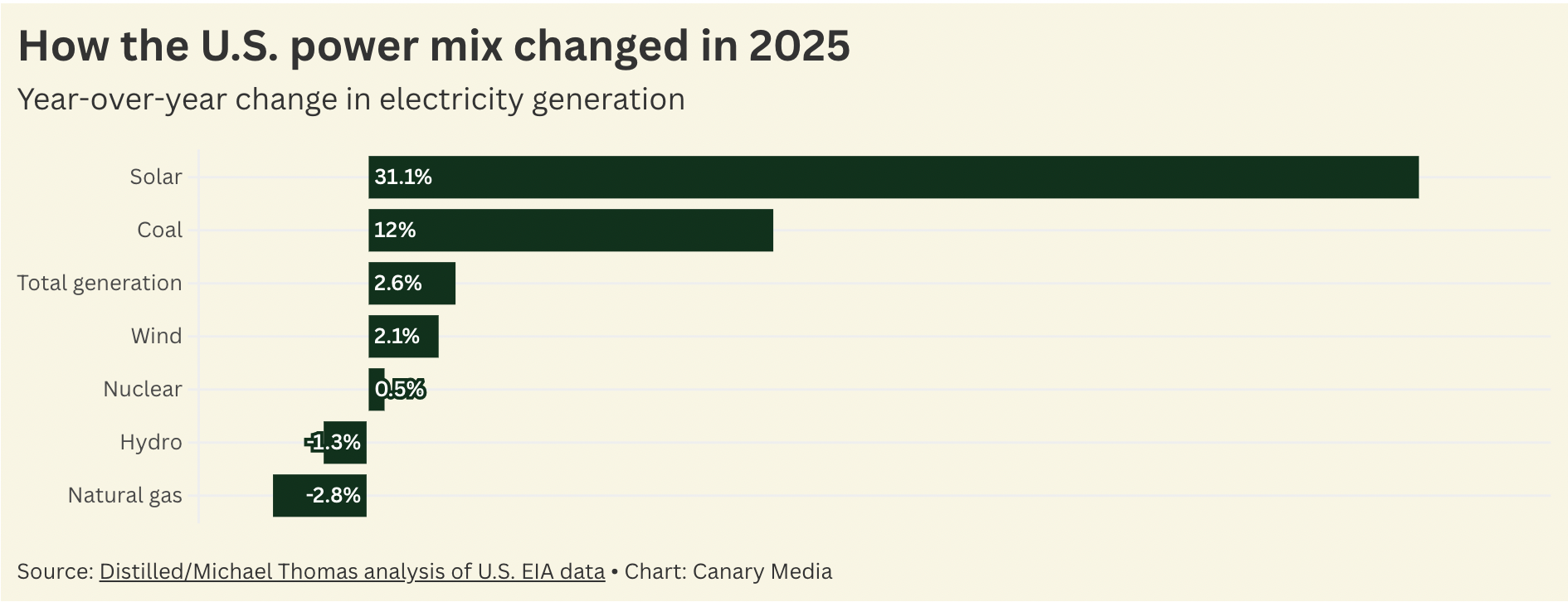
Yet despite the excitement, the broader electricity mix looked about the same as ever. Natural gas provided by far the biggest share of the country’s electricity, followed by nuclear, followed by coal, per U.S. Energy Information Administration data released in December.
The story gets more interesting, however, when you zoom in. Last year, solar panels produced 31.1% more electricity than in 2024, while coal-fired power plants generated 12% more megawatt-hours, according to EIA data crunched by Michael Thomas at Distilled. Natural gas generation, meanwhile, fell by nearly 3%.
Overall, power demand ticked up by 2.6% — a seismic number for a sector that has been stagnant for over a decade.
Solar’s growth is easy enough to explain: We need more power, and no source of electricity is quicker or cheaper to deploy. The rise of cost-effective battery storage has made solar even more attractive. In fact, despite the considerable roadblocks created by the Trump administration last year, solar and batteries together accounted for more than 80% of new energy capacity added to the grid between last January and November.
The dynamics around coal and gas are a bit wonkier.
Yes, as Thomas points out, President Donald Trump made a show of celebrating “beautiful, clean coal” last year. His administration also used emergency powers to order a number of aging, expensive-to-run coal plants to stay open on the eve of their planned closures. But it’s not as if Trump isn’t also supportive of the U.S.’s natural gas industry. So why the rise for one and the fall for the other?
It boils down to market forces. Gas prices spiked last year, and so did electricity demand. That bolstered the financials for some coal plants, resulting in more coal generation — and, as Thomas points out, a dirtier grid. Power-sector emissions jumped by 4.4% from 2024 to 2025, per Thomas, a significant leap and the second year in a row of rising emissions after years of consistent declines. The EIA expects coal-fired power to shrink this year, however, as more renewables come online and once again erode the economic case for burning the dirty fuel.
And despite coal’s brief resurgence, it wasn’t all positive for the fossil fuel in 2025. In fact, a separate metric may be a better indicator of its long-term outlook: For the second year in a row, wind and solar together produced more U.S. electricity than did coal.
Remember the climate crisis? The relentless, escalating threat to human health and safety that was once the main driver of clean energy policy?
You’d be forgiven if it’s all a bit hazy, given how swiftly the term was dropped from the energy-transition lexicon this year.
Starting on Inauguration Day, President Donald Trump not only eviscerated climate policy but completely upended the way Americans talk about energy. Though Trump seemed more concerned with taking down ideological rivals than helping constituents’ bottom lines, his new lexicon got a boost from consumer concerns about soaring energy prices that had people casting around for quick fixes. Climate change was out. Talk of “energy dominance,” “energy abundance,” and “unleashing American energy” rushed in. The shift was like “6-7” taking over a fourth-grade classroom: inexorable and irresistible.
The new terminology made the scene on Trump’s first day back in the White House, when he signed an executive order with a grab bag of fossil-fuel giveaways under the title “Unleashing American Energy.” A few weeks later, he used another executive order to create the National Energy Dominance Council. Both orders touted the country’s “abundant” resources.
Clean energy advocates quickly began invoking similar terminology in an attempt to shoehorn solar power into the new narrative. The Solar Energy Industries Association even passed out stickers with the phrase “energy dominance” on Capitol Hill as part of its lobbying efforts.
Some media outlets followed suit in deemphasizing climate. In November 2024, five major U.S. newspapers published a total of 524 stories about climate change; in the same month this year, those papers ran just 362 climate change articles, according to researchers at the University of Colorado Boulder — a drop of almost a third. (Both numbers are way down from the October 2021 peak of 1,049 climate articles.)
A number of Democratic politicians embraced the vibe shift in their own ways. “All of the above” crept in among leaders — notably New York Gov. Kathy Hochul and Massachusetts Gov. Maura Healey — who wanted to signal they are open to the changing conversation, but not ready to give up on renewables entirely. In New Jersey and Virginia, Democrats Mikie Sherrill and Abigail Spanberger ran successful gubernatorial campaigns with hardly any mention of climate change; likewise, New York City mayor-elect Zohran Mamdani spent little time on the topic.
Most notably, Democrats this year prioritized the issue of energy affordability, an increasingly urgent concern among voters — and one that Trump is belligerently dismissing.
Two liberal groups, Fossil Free Media and Data for Progress, put out a memo in November that endorses this affordability focus, suggesting it’s a way for Democrats to reconcile the new discourse with the old. The memo encourages them to promote the benefits of renewable energy as a cheap source of power in 2026. The headline: “Don’t run from climate — translate it.”
Though Republicans are failing to reckon with the issue of soaring energy costs, there’s still something seductive about their energy rhetoric. It suggests an economy teeming with possibility, held back only by those meanie Democrats with their snowflakey concerns about climate and their insufficient will to dominate. The language implies there are easy answers to at least some of our woes. Worried about soaring energy bills? Unleash the beautiful coal. Concerned about grid reliability? Exploit those abundant energy supplies. Never mind that fossil fuels are most definitely not the cheapest sources of electricity.
The vocab shift, particularly around “dominance,” also captures a vibe that has always appealed to Trump supporters: “That language does have this bravado and machismo that is important to his movement,” Cara Daggett, a professor of political science at Virginia Tech, told a reporter for Grist earlier this year.
What vocabulary will seize the collective imagination in 2026? Likely, more of the same (though Trump does have a seemingly inexhaustible ability to surprise us all with word choices). The bigger question for me, though, is which version of this new nomenclature will gain the most traction in the months to come. Will the left’s translations catch on, convincing people that clean energy too can be unleashed, abundant, and affordable? Or will the fossil fuel–loving MAGA crowd continue to corner the enticingly muscular language of supremacy?
This year was a big one for Canary Media. Our merger with the Energy News Network brought new reporters into the mix, expanding our focus on state and local clean energy policy and progress.
We sure needed the extra manpower to cover everything that 2025 brought. President Donald Trump shook up the clean energy landscape as soon as he entered the White House, taking particular aim at offshore wind and EVs. Worries about rising power demand from data centers reached a fever pitch. And startups boasted major breakthroughs in cleaning up manufacturing, decarbonizing home heating, and bringing battery storage to the masses.
That’s just a handful of the many, many topics Canary Media reporters covered this year through more than 600 stories. Here are 11 that you can’t miss, in chronological order.
Data centers are overwhelming the grid. Could they help it instead?
Jeff St. John started 2025 with a deep dive into what became one of the year’s hottest energy topics: data centers. In this first installment of a four-part series, Jeff explored the growing concern over AI data centers’ capacity to drive power demand to new heights, and how utilities may use that rising demand to justify new fossil fuel construction. But with effective regulation and demand management, it doesn’t have to be that way.
The smell of toasted rock could spell victory for geothermal energy
Julian Spector turned his visit to Quaise Energy’s Texas testing grounds into a feast for the senses. Whirring contraptions, hand-warming heat, and the smell of toasted marshmallows: Those are just a few of the ways Julian described the experience of watching the startup blast through rock with an electromagnetic beam. It’s all in hopes of accessing deeper, hotter levels of the Earth for geothermal power generation.
The rural N.C. mayor betting big on clean energy to uplift his hometown
Mayor Mondale Robinson has big clean energy dreams for his small rural town of Enfield, North Carolina, and shared them with Elizabeth Ouzts back in March. Residents of the largely Black, devastatingly poor town face massive winter energy bills, and Robinson envisions tackling them through a solar-plus-storage array that could help stabilize power costs — and a resilience hub that could teach residents about energy savings and keep them safe during emergencies.
From EVs to HVAC, clean energy means jobs in Central Illinois
In May, Canary Media joined fellow nonprofit newsrooms to report a series of stories on the growing clean energy workforce in rural America. That project took Kari Lydersen to Decatur, Illinois, which has been losing factory jobs for years. But a community college program is training a new generation of solar panel installers to change that dynamic, including Shawn Honorable, who’s planning to start a solar-powered hot dog stand called Buns on the Run.
US hydropower is at a make-or-break moment
Since the late 1800s, America’s network of hydroelectric dams has provided a steady, clean source of electricity. But their age is catching up with them, Alexander C. Kaufman reported in this deep dive. Nearly 450 dams across the country will need to be relicensed in the next decade, but many must make significant, costly upgrades to keep operating — and may opt to shut down instead.
How Trump gutted the team meant to build America’s energy future
The end of 2025 may also signal the end of the Office of Clean Energy Demonstrations. Created under the Biden administration, the office was meant to be a federally backed launchpad for ambitious but unproven clean technologies. In a thoughtful obituary for OCED, Maria Gallucci recounts the office’s biggest wins, and how that all started crumbling on Day 1 of the Trump administration.
Inside the Colorado factory where AtmosZero is electrifying steam
Cheez Whiz, notepaper, and beer all have one thing in common: They’re made with the help of gas-burning boilers. But if it’s up to AtmosZero, that’ll soon change. Alison F. Takemura took us on a tour of the Colorado factory where AtmosZero will soon start building steam-producing heat pumps, in hopes of decarbonizing all sorts of polluting processes.
Why utility regulators need to do more than call ‘balls and strikes’
Marissa Gillett didn’t make a lot of friends during her time leading Connecticut’s Public Utilities Regulatory Authority. While consumer advocates heralded her assertive oversight, investor-owned utility regulators accused her of inappropriate, and even unlawful, bias. In an interview with Sarah Shemkus after she stepped down from PURA, Gillett didn’t back down from her “sustained, rigorous” approach, and called on other regulators to do the same.
This Ohio county banned wind and solar. Now, residents are pushing back.
Ohio has become a hot spot for anti-clean-energy rules, with more than three dozen counties outlawing utility-scale solar development in at least one of their townships. Richland County is among them, but in the new year, residents may reverse the ban. Kathiann M. Kowalski reports on how a group of local advocates secured a referendum on the decision made by just three county commissioners — and how they could inspire other Ohioans to do the same.
As solar booms and coal fades, Greece’s mining region struggles to adapt
This fall, Dan McCarthy took us on a trip to Greece. Far from Athens and the iconic whitewashed buildings of the Cyclades islands is Western Macedonia, which remains the country’s energy-producing hub even as its coal plants and mines shutter. Solar farms have rapidly taken the fossil fuel’s place, but residents are frustrated that the region’s economy hasn’t kept up.
The man behind the fall of offshore wind
Our list closes with a story Clare Fieseler started following three years ago, at a time when Republican lawmakers didn’t have much to say about offshore wind. Since then, the industry has become a prime target for the Trump administration, and David Stevenson is a big reason why. Stevenson is a 75-year-old grandfather from Delaware who believes in climate change — but not in offshore wind’s ability to fight it. Through numerous conversations with Stevenson, Clare shares the winding tale of how his activism brought the fight against offshore to the highest levels of government.
Think of the Washington Monument. Imagine it sitting on the surface of the sea, with blades as long as a football field slowly spinning. It’s futuristic and white with rounded edges, like a rocketship. But there are no blasts or flares. There is no noise at all but calling gulls.
Sitting on the stern of a shrimp boat in early November, this is what I saw. The captain steered us directly under one of two “pilot” turbines. In the distance, I saw foundations for 176 more, poking a few dozen feet out of the sea. The Hoover Dam came to mind, another landmark feat of energy engineering. Each new turbine will be roughly the same height as the famous dam, from blade tip to the surf below.
“Why do people think they are an eyesore? Doesn’t bother me none,” said the captain, Bob Crisher, a commercial fisherman. He’s in favor of the wind farm and believes it will bring down his electricity bills.
Coastal Virginia Offshore Wind, America’s largest planned offshore wind farm, was then being built about 27 miles east of Virginia Beach. It’s slated to power up to 660,000 homes in a region with the highest concentration of data centers in the world. With energy demand skyrocketing and electricity costs rising, Virginia needs the last construction push on this project to go smoothly. The developer, utility Dominion Energy, promised the turbines would start feeding the grid by March 2026.
How quickly things fell apart.
Last week, the Trump administration ordered a pause on all five in-progress offshore wind projects in America — including Virginia’s — citing unspecified risks to “national security.” It was the largest blow yet to a once-growing industry that Trump has brought to its knees in just 11 months. While Trump spent much of 2025 slowing the incredible rise of renewables, his unrelenting war on so-called “windmills” has been more vicious and personal.
In many ways, Trump’s attacks on offshore wind this year encapsulate this new era of politics. He throttles long-held norms in favor of retribution and personal grievance, acting with dizzying speed. He contorts facts and pushes officials in his administration to do the same.
Left in the wake are everyday citizens — including dozens I’ve interviewed over the past year — who are losing the prospect of good-paying jobs. They and their neighbors are also losing access to public goods like lower emissions, revitalized ports, reliable electricity, and a buffer against skyrocketing power bills driven by an AI boom.
Trump’s grudge against offshore wind began more than a decade ago, when he tried — and failed — to stop 11 turbines from being built within view of one of his Scottish golf courses. He has been disparaging offshore wind turbines as “ugly” and “eyesores” ever since.
He cranked up the intensity when he embarked on his second presidential campaign in 2023, branding big ocean turbines as dangerous. “[W]indmills are causing whales to die in numbers never seen before,” he said that year — a false statement. Still, attacking offshore wind seemed little more than an odd punchline for his campaign rallies. After all, the Trump administration backed the sector for much of his first presidential term, executing multiple offshore wind auctions that had been queued up by the Obama administration.
But Trump’s hyperactive second term has turned fringe movements and personal grudges into full-blown policies. Like his attacks on vaccines and higher education, his blitz on offshore wind farms is having far-reaching implications that will take years to fully enumerate.
Here’s some initial accounting: In-development wind projects have been paused, delayed, and paused again. One fell apart. Two are essentially mothballed after Trump sunsetted wind tax credits. Port revitalizations got cancelled. Developers lost billions. Related manufacturing is drying up. Tens of thousands of once-promised jobs may never be created. Workers already on the job are sitting idle.
One Trump-voting fisherman called the president’s anti-wind campaign “madness.”
But while vaccines and universities will endure through Trump’s political attacks, in one form or another, the U.S. offshore wind industry may not. Despite the ubiquity of offshore turbines in northern Europe and China, there is only one large-scale wind farm fully operational in American waters today. When Trump moved back into the White House, the industry was just taking off.
J. Timmons Roberts, a Brown University professor of environmental studies who tracks opposition to offshore wind, put it simply: “They’re killing the baby while it’s still in the cradle.”
When Trump’s first term ended, there were no federally approved plans for offshore wind farms. When President Joe Biden left office, there were nearly a dozen. All together, there were 40 active leases in various stages of planning, development, and construction in waters along the East Coast from Maine down to the Carolinas, across the Gulf of Mexico, and along the California coast.
But, on the first day of his second term, Trump signed an executive order that froze offshore wind permitting, blocking proposed projects that didn’t already have federal approval. And he ordered a new review of the projects that did have federal permits but were not yet fully completed, throwing their future into doubt. (The executive order was ultimately struck down by a federal court on December 9.)
Unease amongst state leaders, developers, and investors immediately took root.
Within days, the first permitted project began to fall apart due to “uncertainty” over federal actions. In late January, Shell — one of two developers of the Atlantic Shores wind farm slated to be built east of New Jersey — announced it was withdrawing from the project. New Jersey then abandoned plans to purchase power from the installation. The final blow came weeks later when Trump’s Environmental Protection Agency revoked a Clean Air Act permit for the project. One former EPA official called the move “unusual.”
Research cuts and funding clawbacks soon followed.
In May, Lincoln Varnum was called into his supervisor’s office at the University of Maine, where he worked as an instrumentation engineer. Varnum was one of nine employees laid off from the university’s high-profile engineering and offshore-wind research center due to the Trump administration pausing funding. The administration also cancelled federal funding for Maine’s first floating offshore wind array, which had been fully permitted; the project was then mothballed.
“I obviously got a little emotional in the meeting … Something that I cared about was getting terminated,” Varnum told me. “It was also the first time I had ever been laid off.”
He sees himself and others who’ve been working on offshore wind as collateral damage.
In the following weeks, Varnum, who once identified as a conservative, was hopeful that Republican members of Congress would speak up about the funding cuts, but none of them did — not even Maine’s Sen. Susan Collins, a long-time offshore-wind supporter. He described Collins’ silence as “rough,” especially since he had voted for Collins in the past.
“We’re a poor state. We need industry. To have a new industry that is unique to us, floating offshore wind, now targeted by the feds … It feels like a kick in the teeth,” said Varnum.
Trump yanked funding in other ways.
In September, the Department of Transportation pulled back $679 million for infrastructure projects that supported offshore wind, including one that would have cleaned up and revitalized a massive California port. Mandy Davis, a California resident and anti-wind activist, aligns herself with Trump’s false narrative that turbines harm the ocean environment. She was elated by cuts that might block turbine construction in California’s waters, but her joy was short-lived.
In November, when the Trump administration announced plans for new oil drilling off the California coast, she told me it was a “betrayal.”
New England communities, which spent over a decade preparing to build America’s first offshore wind farms, also felt betrayed. Prior to Trump’s December halt, two massive projects had been paused by the Interior Department earlier in the year. One of the projects, Revolution Wind off the coast of Rhode Island, was already 80 percent completed.
“It’s like having the rug pulled out from under you,” Jack Morris, a Massachusetts-based scalloper and Trump voter, told me earlier this year. “Nobody understands why Trump did it. I don’t know what Trump’s agenda is.”
Revolution Wind had employed 80 local fishermen, including Morris, to help with construction. The project’s pause caused Morris and others to lose some of the part-time income that helps them pay their bills as fishing revenues dry up.
The stop-work orders for Revolution Wind and New York’s Empire Wind were each lifted or reversed after about a month. But some damage was permanent. According to Harrison Sholler, an energy analyst for BloombergNEF, the orders were a signal to companies that America is not a sound investment. Foreign firms had invested heavily in the sector, lost billions, and are now looking for the door.
Trump’s more sweeping wind halt last week only reinforced that assessment.
“What exactly will America have lost? How do you even begin to answer that question?” pondered Elizabeth Wilson, a professor of environmental studies at Dartmouth College.
We could start by looking at how much new electricity capacity won’t be added to America’s increasingly strained grid.
Before Trump was elected last November, BNEF expected 39 gigawatts of offshore wind to be built in the U.S. by 2035. BNEF’s latest forecast is for just 6 gigawatts by 2035 — and even that number could come down thanks to Trump’s latest pause.
Another lens is employment. Together, the five wind farms currently underway have been slated to generate about 10,000 jobs. Now some of the highly skilled workers who have already trained for those projects face an uncertain future. And the 77,000 offshore wind jobs that the Biden administration had projected the country would see in the coming decades may never materialize.
Varnum, the laid-off engineer, said that if Maine’s nascent offshore wind industry rises from the ashes sometime in the future, he “certainly would want to help. It’s not something I’m turning my back on.”
He has since found a job working for a hydroelectric company. But Varnum said he fears for America’s energy future and how far Trump might take his broader war on carbon-free energy. The president has already boosted fossil-fuel production and nuclear power while trying to tamp down clean energy. His political revenge against offshore wind may be paving the way for more.
“The guy torpedoes us on Day One and how far is he going to go? How far will this go?” wonders Varnum.
Wilson of Dartmouth says that Trump’s assault on offshore wind is ultimately a battle over facts and truth.
Fossil fuel–backed activists and groups have for years been spreading misinformation about wind turbines harming whales. They lit the match and Trump fanned the flames. The president ranted and made false claims about offshore wind throughout 2025, in front of reporters, foreign heads of state, and the entire United Nations General Assembly
Meanwhile, his administration quietly axed over $5 million for research into the impact of offshore wind on the giant mammals, ending the best and longest-running studies on the issue, as Canary Media first reported.
Interior Secretary Doug Burgum justified the Trump administration’s pause of the Empire Wind project by claiming the Biden administration approved it based on “flawed & bad science” about impacts on marine life, but the Interior Department refused to share the report that supposedly backed that up. The project’s developer and Democrats in Congress are still waiting for an unredacted version.
“There’s no proof, right? There are no receipts,” Sen. Martin Heinrich, Democrat of New Mexico, told me in June. He said the administration hid the report and then used the permitting process as a “political tool,” something he sees as typical of “a banana republic.”
Without new offshore turbines going up, millions of households across the Northeast will soon pay more money for dirtier and less reliable electricity. According to a recent report, offshore wind power could help keep the lights on year-round in the Northeast and mid-Atlantic regions, especially during harsh winter weather when gas plants can fail. Cuts to planet-warming pollution, mandated by several East Coast states, are also now out of reach. All signs point to Trump’s second term creating a hotter and less affordable future for Americans.
Few people interviewed for this story expressed hope that the damage from Trump’s war on “windmills” could be reversed anytime soon.
“What Trump really killed was hope,” said Wilson. “And what is the value of hope?”
Two corrections were made on January 5, 2026: This article originally implied that Maine had more than one Republican member of Congress. In fact, it has only one: Sen. Susan Collins. The article also originally misstated the number of offshore wind leases in planning or development at the end of the Biden administration. The number was 40.
We’re proud of the 650+ clean energy stories our small team brought you last year. We’re so proud we even made a reading list of our favorite articles.
But this is a different type of list. It’s about the stories we didn’t write but wish we had — sharp pieces from rival outlets big and small that uncovered new information, reframed the debate, or were simply fun to read.
Here are some of the stories from last year we wish we could claim as our own. (In a moment of meta-jealousy, it bears mentioning that the idea for a “jealousy list” is borrowed from Bloomberg Businessweek, which has been publishing annual versions since 2015.)
Rooftop solar is a miracle. Why are we killing it with red tape?Mother Jones
Why don’t we have solar panels on every rooftop? Bill McKibben’s story in Mother Jones exposes the stark contrast between installing home solar in the U.S., a process mired in red tape, and doing so in Australia, Spain, Germany, and other countries where it’s so much cheaper and easier. This feisty piece makes you want to slap your forehead and ask, “Why can’t we have nice things, too?” — Alison F. Takemura, reporter
When the blade breaksThe Verge
Nantucket native and novelist Gabriella Burnham wrote for The Verge about the fallout from a 2024 incident in which a turbine blade broke off a New England offshore wind project. With rich detail and narrative momentum, Burnham’s reporting reveals how wealth and island dynamics became a perfect storm for renewables pushback. Nowhere else will you read about local dudes making T-shirts that read “Vineyard Wind is ISIS,” and no one but a local writer like Burnham could have written a piece like this. — Clare Fieseler, reporter
Trump’s quest for ‘energy dominance’ is all about the vibesGrist
President Donald Trump has pulled a total Gretchen Wieners from “Mean Girls” this past year: Just like she wanted to make fetch happen, he’s trying his darnedest to make the term “American energy dominance” stick. But what does it actually mean? Grist’s ever-thoughtful Kate Yoder has answers in a story I wish I had written that draws on experts, history, and smart analysis. — Ysabelle Kempe, associate editor
How a Koch-funded campaign is trying to reverse climate action in VermontVTDigger
Apparently I let this one linger a little too long on my to-do list, because VTDigger’s Austyn Gaffney beat me to it — and, with her in-depth knowledge of Vermont politics, did a better job than I could have. It’s a fascinating, rigorously reported, and kind of frightening look into how the Koch brothers’ Americans for Prosperity is setting up shop in one of the country’s bluest states, making inroads with its brand of clean-energy and climate disinformation. — Sarah Shemkus, reporter
Why did Hochul back down on New York’s gas ban?New York Focus
Democratic New York Gov. Kathy Hochul’s decision to suspend the state’s first-in-the-nation all-electric buildings law had every climate-conscious New Yorker shaking their head and asking “Why?” Colin Kinniburgh of New York Focus provided an answer, albeit not a very satisfying one for anyone who cares about cleaner buildings and a healthier planet. Regardless of how you feel about the state’s constant climate backtracking, it’s a great example of journalism that breaks down the legalese so you don’t have to. — Kathryn Krawczyk, engagement editor
The airline industry’s dirty secret: Clean jet fuel failuresReuters
For journalists, there’s always a push and pull between covering news as it happens and stepping back to make sense of the headlines. This Reuters investigation on “sustainable aviation fuels” does an excellent job at the latter, with a data-driven, multimedia approach. The feature reveals that, behind all the promise of progress, airlines and energy companies are falling far behind on efforts to bring low-carbon jet fuel to the skies. — Maria Gallucci, senior reporter
Is data center flexibility a ‘regulatory fiction’?Latitude Media
Everyone’s talking about data center “flexibility” as the solution to the cost pressures the AI boom is putting on everyday utility customers. But what does “flexibility” mean — and is it allowed? In this quick-turnaround story, Maeve Allsup does an extraordinary job condensing the highly wonky conflicts between grid experts seeking to make data center flexibility a reality in the most data center–impacted U.S. power market. — Jeff St. John, chief reporter and policy specialist
River rafting in Colorado offers climate lessons for Southern CaliforniaLos Angeles Times
Sammy Roth excels at grounding big climate and energy debates in the parched dirt of the Western landscape. As a reporter and commentator for the L.A. Times, he held California leaders accountable when their actions on climate didn’t match their rhetoric. I’m especially partial to (and envious of) his dispatches from far-flung corners of the West, like this one in which a rafting trip in the high mountains of Colorado reveals unexpected linkages from wilderness river guides to inner-city L.A. renters. We’re lucky Sammy kept the whitewater off his notebook, and now he continues the chronicle at his new Substack, Climate Colored Goggles. — Julian Spector, senior reporter
The quick and shameful death of Biden’s biggest policyThe New Republic
Kate Aronoff gives the death of the Inflation Reduction Act the deep treatment it deserves. Her story is sweeping and nuanced, and explains not only the rise and fall of the now-gutted climate law, but also sketches out where climate politics might go from here. If you want to read one thing to better understand where U.S. climate policy stands as we enter 2026, it should be this. — Dan McCarthy, senior editor
Why the time has finally come for geothermal energyThe New Yorker
I’ve covered the rise of geothermal energy in recent years and, in 2024, I was lucky enough to visit Iceland to learn more firsthand. So I was especially jealous to see this beautifully written dispatch by Rivka Galchen about her own tour of the Nordic country. It’s filled with lush details about the landscape, people, and even tiny horses, and it’s a vivid account of how geothermal has developed over centuries — and could help meet the energy and climate challenges we’re facing today. — Maria Gallucci, senior reporter
The obscure philosophical battle that could reshape the clean energy economyHeatmap
If you’re an energy-policy nerd like me, you’ve probably seen he-said, she-said coverage of the battle playing out over renewable energy certificates, and perhaps you’ve asked yourself why we can’t find a win-win solution to the problem of properly accounting for the carbon impacts of clean energy purchases by tech and corporate giants. This story from Emily Pontecorvo does an excellent job of explaining what’s at stake and why it has been so hard to find consensus. — Jeff St. John, chief reporter and policy specialist
The backlash to high electric bills could transform U.S. politicsTIME
As an editor, I’m perpetually preoccupied with how to make wonky topics accessible to non–energy nerds. Rising power costs is one such topic — and the public is sitting up and paying attention to it. This TIME article by Justin Worland was published in the lead-up to the November election for two seats on Georgia’s Public Service Commission, but it remains relevant as an easy-to-grasp primer on things like data center growth, utility regulation, and surging electricity demand. Plus, it tees up all of the issues everyone will be talking about even more this coming year as the 2026 midterms approach. — Wendy Becktold, managing editor
Liberal Oregon and Washington vowed to pioneer green energy. Almost every other state is beating them.Oregon Public Radio/ProPublica
State leadership on clean energy has become all the more vital since the federal government launched an all-out war on renewables. This investigation, by Oregon Public Radio and ProPublica, shows why Oregon and Washington have struggled to build many clean energy projects in spite of passing some of the most ambitious climate laws in the country. Surprisingly, the evidence points to a nonprofit public power agency from the New Deal era holding things up. — Julian Spector, senior reporter


.svg)
