

 Back
Back
See more from Canary Media’s “Chart of the Week” column.
The U.S. is the world’s largest exporter of liquefied natural gas — and the war in the Middle East is about to bring massive profits to its gas producers.
As the war destabilizes oil and gas production in the region, LNG prices have shot up globally. Qatar — a U.S. ally and the world’s second-largest LNG supplier — halted production of the fuel on Monday after Iranian drones targeted its energy facilities in retaliation for ongoing U.S. and Israeli strikes. The country accounts for one-fifth of the global LNG supply, and the vast majority of its output goes to Asia.
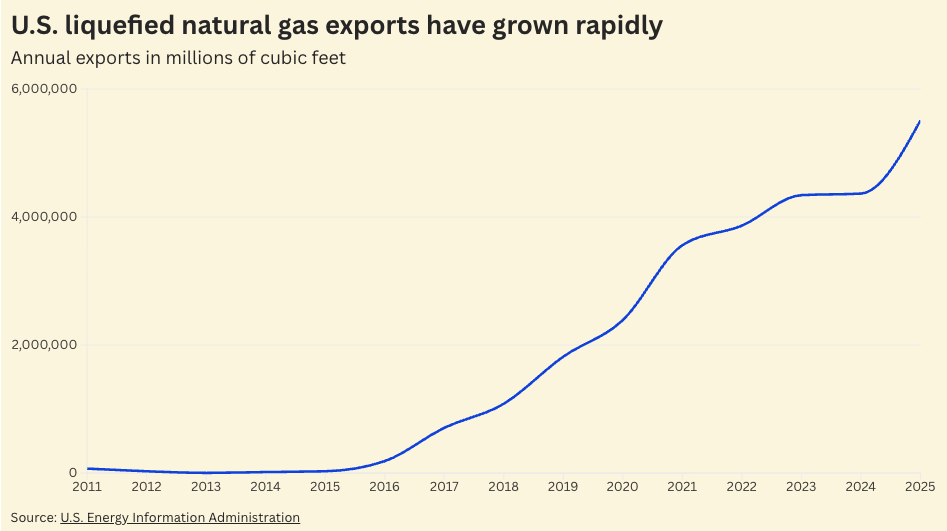
Analysts say American suppliers could be in for a windfall as desperate international buyers bid top dollar to secure what fuel is available. U.S. LNG export terminals are already operating at full bore, so there is unlikely to be a surge in the volume of gas sent abroad — just in the profits firms rake in on each shipment.
Already, the effects of the energy shock are rippling across the world.
In India, the government began rationing natural gas on Tuesday. Meanwhile, Taiwan, which gets 40% of its electricity from LNG and imports heavily from Qatar, said it will take immediate measures that include sourcing more gas from the U.S.
In Europe, natural gas prices have risen less sharply than in Asia but still enough to exacerbate energy affordability problems in the region, which was plunged into an energy crisis following Russia’s 2022 invasion of Ukraine. After mostly quitting Russian gas, Europe has come to rely heavily on LNG from the U.S., though in recent months it has sought to diversify through deals with Qatar and other countries as the Trump administration threatened to annex Greenland.
Since returning to power last January, the Trump administration has pushed to further expand the nation’s lead in LNG exports, despite warnings from analysts that doing so will drive up costs at home. Before the war broke out, the U.S. Energy Information Administration forecast that natural gas prices would climb for Americans in 2027 in part due to expanding LNG exports. The country is already on track to double its LNG export capacity by 2029.
Amid this expansion, Trump has been pressuring allies from Japan to the EU to buy even more U.S. natural gas. But the war only strengthens the case against a deeper dependence on LNG. The more a country relies on shipped-in energy, the more vulnerable it is to global shocks like the one unfolding now.
Renewables, in contrast, are a source of refuge. You install them once and for decades they produce electricity that, though tied to the weather, is completely insulated from global energy markets. Just look at Europe: The region doubled down on wind and solar following the Russian gas crisis, not because of concern for the climate but because of a desire to make its energy system as self-sufficient as possible.
Now, yet another war underscores the perils of relying on imported energy in an increasingly volatile world.
See more from Canary Media’s “Chart of the week” column.
President Donald Trump claimed in his Tuesday night State of the Union speech that Americans worry that “we are winning too much” under his administration. That assessment does not apply to everyone in the U.S., judging by recent public opinion polls, but it rings surprisingly true for the clean energy sector in 2026.
Each year around this time, the federal government releases its expectations for new power plant construction. The latest data drop shows clean energy is going to dominate this year, just as it has for many years running. Even as the Trump administration has employed novel and at times legally dubious means to block renewable energy growth, the power sector keeps choosing clean energy again and again — attracted by its low costs, speed to build, and climate and environmental benefits.
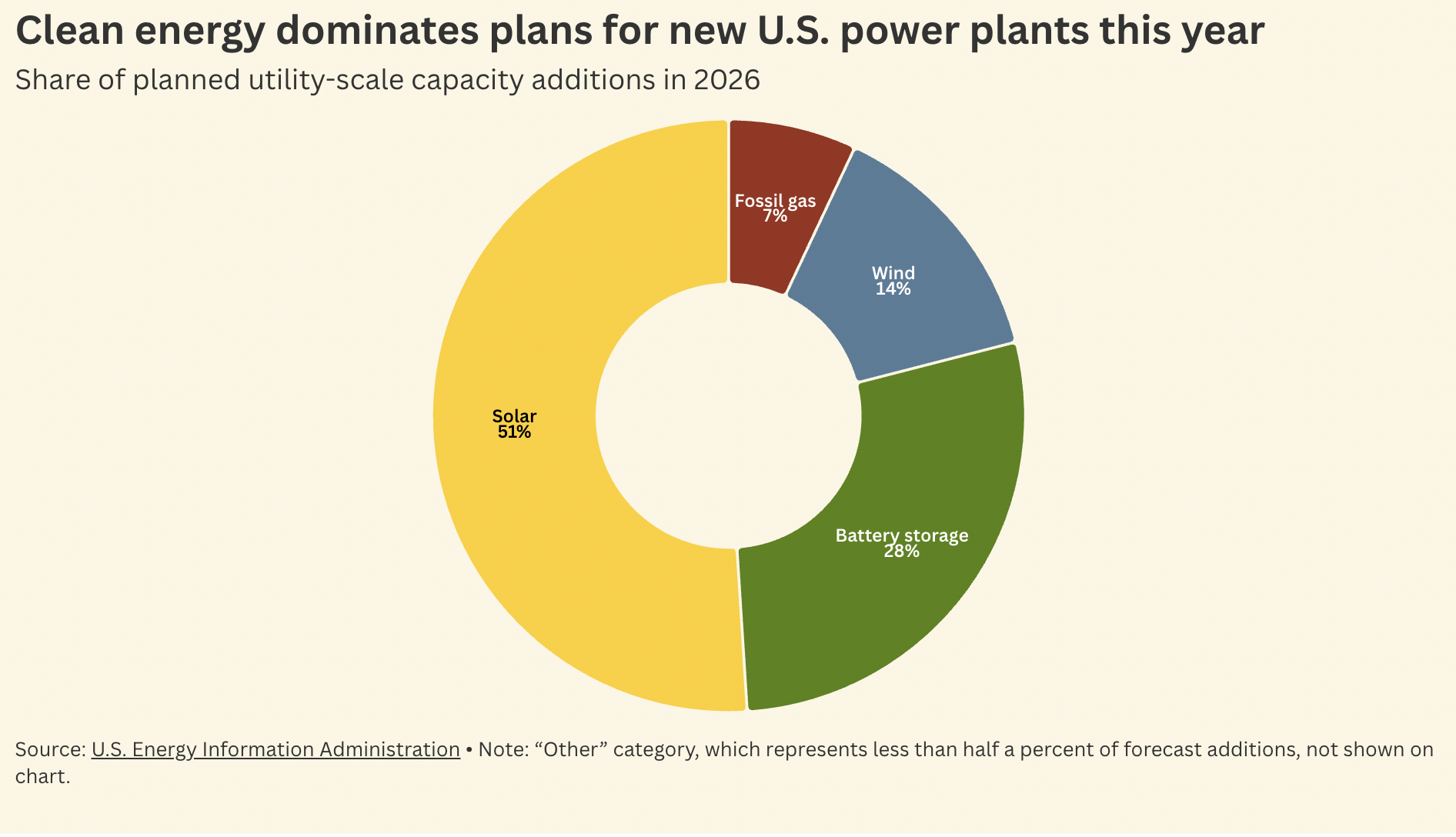
This year, solar will provide 51% of the new utility-scale electricity capacity slated to come online, batteries will deliver 28%, and wind will add 14%, according to the U.S. Energy Information Administration. Fossil gas, one of the polluting fuels most supported by the Trump administration, makes up only 7% of that new capacity. Coal, the other polluting fuel favored by the White House, does not appear in the ranks of power plants under construction.
This clean energy success is all the more notable because of the massive amount of total power plant capacity that developers are set to build in 2026: 86 gigawatts, more than the U.S. has ever added in a year. The U.S. constructed 33 GW less in 2025, which was the biggest yearly power plant build-out since 2002. Clean power plants are consuming nearly all of a vastly expanded pie, while gas gets a scant sliver.
Still, gas dominates the existing power plant fleet, producing about 40% of annual generation, compared with less than 10% percent from solar. But the renewable energy source’s odds of dethroning gas improve with each year that solar delivers such a lopsided share of new construction. In California, home to the world’s fourth-largest economy, ascendant solar generation is poised to imminently eclipse the gradually declining portion provided by gas.
The Trump administration’s anti-renewables machinations could slow this trend in coming years. Courts threw out an order to stop construction at five fully permitted offshore wind farms, but an effective blockade on new permits for projects touching federal lands could kill or delay installations that would otherwise get built in the late 2020s. Even so, solar developers hope they can keep the success going by serving the AI sector’s overwhelming demand for quick-turnaround power sources.
Whatever tumult comes after 2026, the U.S. will face the situation with tens of gigawatts of brand-new solar, wind, and batteries in its arsenal.
This analysis and news roundup come from the Canary Media Weekly newsletter. Sign up to get it every Friday.
No matter how you feel about data centers, we all rely on them: for reading this email, for scrolling through TikTok when you should be asleep, for streaming last night’s “Traitors” finale, and so on. And as AI becomes more powerful and more widespread, tech companies are building more of these power-hungry facilities — though exactly how many, and how much energy they’ll need, is unclear.
That fuzzy future is what makes data centers so complicated. Utilities that are rushing to meet data centers’ massive projected demand run the risk of building too many power plants, locking in more greenhouse gas and health-harming emissions, and passing unnecessary costs on to households.
It’s a dilemma that lawmakers on both sides of the aisle are finally waking up to. In the early years of the data center boom, governors and the federal government created tax breaks and other incentives to secure a slice, betting that the facilities would create jobs. But just last week, Illinois Gov. JB Pritzker (D) announced a two-year pause on tax incentives for data centers in his state. Similar rollbacks have been proposed in Maryland, Michigan, Oklahoma, and Virginia, Stateline reports.
Pennsylvania Gov. Josh Shapiro (D) has meanwhile called for data centers to make sure their power demand isn’t saddling residents with unfair costs. It’s a message with bipartisan support: U.S. Sens. Josh Hawley (R-Mo.) and Richard Blumenthal (D-Conn.) introduced a long-shot bill earlier this month that would ensure each new data center has its own power supply that doesn’t connect to the grid that the public relies on.
The idea that data centers should pay their own way is gaining traction with the White House, too. In his State of the Union address on Tuesday, President Donald Trump said he will push tech companies to promise that their data center build-outs won’t leave Americans with higher power costs. This “ratepayer protection pledge” wouldn’t be binding, however.
It’s a conversation worth following as congressional primaries begin this month, including in the data center hotbeds of Illinois, North Carolina, and Texas. A handful of Democratic candidates are already looking to differentiate themselves from crowded primary fields by going hard on data centers’ energy impacts, E&E News reports. And we can expect that Pritzker, Shapiro, and other governors and senators will do the same as they gear up their reelection campaigns for November — and as they consider running for the White House in 2028.
Will these fossil-fuel plants ever shut down?
The Trump administration’s push to keep fossil-fueled power plants running past their prime is stretching into a new year.
Just this week, the Department of Energy ordered Pennsylvania’s Eddystone oil and gas plant to keep operating for another three months, stretching its life nearly a year past its planned retirement. It’s one of several fossil-fuel plants that were supposed to retire last year but are now racking up millions of dollars in costs for grid operators to contend with.
Those cost battles are coming to a head in the Midwest. Federal energy regulators already agreed to spread the cost of keeping a Michigan coal plant running across 11 states served by the Midcontinent Independent System Operator. And in Indiana, the owners of two coal-fired plants forced to stay open are currently looking for a similar arrangement.
The problem is only likely to grow this year as the Trump administration forces gigawatts’ worth of fossil-fuel generation to keep operating with no end in sight.
Supreme Court considers a major climate case — with a catch
The U.S. Supreme Court agreed this week to take up the fossil fuel industry’s attempt to shut down city and state climate lawsuits — but it could face a surprising obstacle.
The case centers on a challenge brought by the city and county of Boulder, Colorado, against two oil and gas companies. After the Colorado Supreme Court ruled in Boulder’s favor last year, the companies appealed to the U.S. Supreme Court. And now, the case could determine the fate of several dozen other local climate lawsuits.
But the EPA’s recent repeal of the endangerment finding could pose a problem for the fossil fuel companies it was intended to help. Because the rollback effectively erased federal climate and emissions regulations, legal experts tell E&E News, it could be harder for oil and gas companies to make their case against local protections.
Virtual popularity: Virtual power plants — which tie batteries, solar panels, and other resources into energy management systems — are gaining popularity across the U.S. as states look to curb rising power prices without the need for grid upgrades. (Canary Media)
Shifting gears: The U.S. EPA will“revamp” the Clean School Bus program and shift $2.3 billion in remaining funds away from electric buses and likely toward vehicles powered by natural gas, biofuel, and hydrogen. (Inside Climate News)
Solar finds a spark: A growing number of states are considering legislation to allow for “balcony solar” systems, which can plug in to conventional outlets and help users lower their utility bills. (Canary Media)
Escaping eternal limbo: The Interior Department is reviewing at least 20 commercial-scale projects that have been stuck in permitting since Trump took office, including the massive Esmeralda project in Nevada. (E&E News)
Resilient rebuilds: While Oregon loosened building codes for families rebuilding in the wake of devastating wildfires, state incentives have still encouraged some residents to opt for resilient, energy-efficient new homes. (Canary Media)
New federal funds: The DOE has announced a $26.5 billion loan, its largest ever, to help Southern Co.’s Georgia and Alabama subsidiaries build new gas plants and transmission lines and upgrade existing power plants. (Associated Press)
“Coal has become its curse”: A small Pennsylvania coal-mining town is on the verge of collapse under the pressure of noxious, smoldering underground fires; pollution; and economic challenges. (Morning Call)
Nuclear who? The Trump administration is considering awarding a $25 billion contract to little-known nuclear power company Entra1 Energy, which appears to have just a handful of employees, to build new energy infrastructure using money pledged by Japan to avoid tariffs. (Politico)
This story was originally published in the Daily Yonder. For more rural reporting and small-town stories, visit dailyyonder.com.
When Chad Raines took over his family’s Texas cotton farm in 2008, he thought the going would be easy. That’s because their first year was relatively profitable — but the success was short-lived.
“The next 11 years was just loss after loss after loss,” Raines said in a Daily Yonder interview. “We just kept digging our hole deeper.” Raines soon began to question whether he should continue running the farm or pivot to something else.
Then came a third option, one in the form of solar panels and sheep: a type of farming called agrivoltaics. Now, he raises 3,000 head of sheep on about 8,000 acres throughout West Texas, and all under solar panels.
Raines is contracted by the solar companies to graze his sheep under their panels, keeping the vegetation short and feeding his sheep at the same time. He is one of a growing number of farmers leasing out their own land to renewable energy companies or grazing livestock on land already in use for solar or wind.
Scientists say widespread renewable energy development — the vast majority of which will be located in rural America — plays a key part in decreasing the country’s carbon emissions, but pushback from the Trump administration has stalled progress on many solar and wind projects.
In August 2025, the U.S. Department of Agriculture ended funding to loan programs that supported solar projects on farmland. The agency pointed to rising farmland prices as the primary reason for shutting down these projects.
“Our prime farmland should not be wasted and replaced with green new deal subsidized solar panels,” Secretary of Agriculture Brooke Rollins said in a press release. The USDA defines prime farmland as land with the “best combination of physical and chemical characteristics for producing food, feed, forage, fiber, and oilseed crops.” These characteristics include a region’s growing season, soil properties, and water supply.
“Subsidized solar farms have made it more difficult for farmers to access farmland by making it more expensive and less available,” Rollins said.
Whether this claim is true is up for debate. Land use experts say the real threat to farmland is urban sprawl into rural areas, not solar development.
“Thousands of acres [of farmland] are going to [urban development], and that’s completely taking it out of commission,” said Jeff Risley, executive director of a new organization called the Renewable Energy Farmers of America. The group helps farmers negotiate land leases with solar and wind companies.
Once an area is turned from farmland into parking lots or apartment buildings, the likelihood of it returning to agricultural land is extremely low. “Solar and wind, it’s a 30- to 40-year commitment, but it can also go back to agriculture land at the end of that time,” Risley said.
Over the next two years, solar is projected to be the fastest-growing power generator in the country, according to a recent report from the U.S. Energy Information Administration. An estimated 83% of solar projects are expected to be built on farmland, according to projections from the American Farmland Trust.
While the estimated amount of farmland to be converted to solar is just a small fraction of the total farmland available in the U.S., for some rural residents, the transition is an unwelcome wave on the horizon.
In upstate New York, Alex Fasulo has spent the last year organizing against a solar project in the town of Fort Edward that would have an estimated 530-acre footprint with solar arrays, access roads, power lines, and a substation. She’s garnered more than 650,000 followers on Instagram alone, posting videos opposing the project, which is being conducted by the Canadian energy company Boralex.
For Fasulo, the solar development threatens the rural way of life she was looking for when she first moved to the area in 2023.
“I knew I was going to be surrounded by houses, farmhouses, and farms,” Fasulo said. “But [had I known] a commercial industrial complex would be able to come into this rural zoning, I would’ve bought land next to a Walmart [instead]. I didn’t sign up for this.”
This sentiment is shared by many neighbors of utility-scale solar projects, especially in states like New York, where there are more small communities interspersed with farmland, making solar development a lot more noticeable than in a state like Texas, where hundreds of acres of contiguous land can be developed far from any town.
“When solar comes into a place like that, it can feel like, ‘Oh my gosh, it’s taking over all of our land,’” Risley said. He tries to encourage the communities he works with to see solar projects as an opportunity rather than a threat to rural lifestyles. Risley recommends the use of a community benefit agreement, which is a contract between the solar developer and the town that can guarantee the building of a new grocery store or community center.
“On top of taxes that they might earn locally, you can also think about: What does our community need, and could this development help us achieve it?” Risley said.
Solar development on farmland could also help mitigate rural America’s carbon footprint. A 2025 report by the philanthropy organization Rural Climate Partnership found that 38% of the country’s total carbon emissions come from rural America, despite being home to less than 20% of the total population.
That’s because carbon-intensive industries are located in rural places — like agriculture, which accounts for 10.5% of total U.S. emissions. One way to shrink this footprint is through the widescale deployment of renewable energy projects, which the report said could create more rural jobs, provide tax revenue to local communities, and diversify farmers’ incomes.
“If you are used to looking at farmland that’s been growing corn or soybeans, I will not deny that replacing those crops with solar panels is a significant aesthetic change,” said Scott Laeser, senior working lands adviser for the Rural Climate Partnership.
“It’s a concern that we see raised, but I think that also assumes that our farmland has always been used the way that it’s used today, even though we used to have much more pasture and crop diversity in our agricultural landscape.”
To Laeser, introducing solar panels into the mix is just the latest in an ever-changing farm landscape.
“I think that as we build more solar projects and as developers incorporate design efforts … like trees and bushes along the edges of the projects to reduce the abrupt visual change, and people design projects based on topography as well, it can help minimize some of those concerns,” Laeser said.
But progress could be slow for at least the next three years because of the Trump administration’s attempts to limit solar development on farmland. This includes halting funding to the Rural Energy for America Program (REAP), which provides grants to farmers and rural small-business owners to install solar panels and make energy efficiency improvements to their operations.
“It’s really unfortunate because many of those [REAP] projects are not large, and so they’re not being built on prime farmland generally,” said Alex Delworth, senior clean energy policy associate at the Center for Rural Affairs. “They’re taking up a pretty small project size.”
The current status of REAP funding is unclear. In the same August announcement about ending funding to renewable energy loan programs, the USDA said it would ensure that “American farmers, ranchers and producers utilizing wind and solar energy sources” could install units that are “right-sized for their facilities.” No explanation was provided for how the USDA decides what is “right-sized” or not, and as of Jan. 19, 2026, there’s been no announcement for a new REAP grant cycle.
Regardless of what happens at the federal level, solar development is still underway in many parts of the country. Texas, where Chad Raines grazes his sheep, is projected to overtake California in solar production by 2030, according to research from the Solar Energy Industries Association. Much of this development will happen on farmland if current trends continue — and it could be one of the only ways farmers can make a living.
“If you want farmers or landowners to stop taking farmland out of agriculture and putting it into renewable energy, then the first thing that needs to be fixed is the farming landscape,” he said. Competing with large agribusiness has become a nearly impossible venture for most small and midsize producers.
“It needs to be more profitable for farmers to be able to make it,” Raines said.
It’s a tough time for U.S. companies trying to make a go of green hydrogen.
The Trump administration is threatening to cut billions of dollars in funding for hydrogen hubs and rapidly phasing out key tax incentives for the fuel. Major projects are getting canceled. Companies banking on the sector are struggling. And the wholesale abandonment of U.S. climate policy has undermined confidence in market prospects for low-carbon hydrogen that were already shaky before President Donald Trump won a second term.
Even so, Raffi Garabedian, CEO of U.S.-based electrolyzer manufacturer Electric Hydrogen, sees a path forward for his firm — and the industry as a whole.
It won’t be nearly as smooth or as fast as he had hoped. And much of it will take place in Europe, where climate policy and fossil fuel costs make green hydrogen more viable. But even in the U.S., there are still some promising prospects for projects that can get built quickly enough, capture ever-cheaper renewable energy, and find motivated buyers, he said.
Take Project Roadrunner, which is being built in West Texas by alternative-fuels startup Infinium to produce “e-fuels” — drop-in replacements for jet fuel and other fossil fuels made by combining low-carbon hydrogen with waste carbon captured from industrial emissions. Infinium plans to start commercial production at the site in 2027. Last May, Infinium selected Electric Hydrogen’s 100-megawatt HYPRPlant electrolyzer system, which uses water and electricity to make the hydrogen.
Infinium is contracting for clean electricity for the site, including 150 megawatts of wind power from NextEra Energy. It has also won long-term offtake commitments from American Airlines, Citibank, and International Airlines Group to pay for Project Roadrunner’s sustainable aviation fuels made with renewable electricity — “eSAF” in industry jargon. That’s a vital step for securing the stable financing required to build first-of-a-kind facilities, particularly in the nascent green-hydrogen field.
To wit, Brookfield Asset Management and Breakthrough Energy Catalyst are providing funding.
“We’re superexcited about eSAF in particular, because there’s strong policy support. And even at the voluntary level, there seems to be strong corporate willingness to pay for air-travel decarbonization,” Garabedian said.
Other orders have followed for his firm. In September, HIF Global announced it will use Electric Hydrogen’s electrolyzers for a plant in Texas that will produce e-fuels. And in December, Synergen Green Energy said it would install two 120-megawatt HYPRPlants for a green ammonia plant it’s developing on the Texas Gulf Coast.
The HIF Global and Synergen projects are in the early stages of development, and seeing them through will depend on securing financing, permits, and buyers for their e-fuels. In today’s post-boom green-hydrogen market, that’s far from a sure thing.
But in Texas, several factors work in their favor. The Gulf Coast has the infrastructure, from its oil and gas industries, to make, store, and transport hydrogen at large scale. It has access to large and growing amounts of solar and wind power to supply electrolyzers that need affordable clean electricity to compete with fossil fuels.
Another key factor in driving down green-hydrogen costs is making cheaper electrolyzers and supporting equipment. And on that front, Electric Hydrogen is relying on proving out its lower-cost claims to win advantage.
The company, which has raised over $600 million, has built a factory in Devens, Massachusetts, to make its electrolyzer stacks — the core parts of the proton exchange membrane (PEM) systems that use electricity to split water into hydrogen and oxygen. It has also partnered with other component manufacturers and engineering firms to streamline and standardize building the many other working parts of a green hydrogen plant — including power conversion, gas processing, water treatment, and thermal management — in a more modular way, Garabedian said.
Overall, Electric Hydrogen claims its total installed costs are less than half those of systems using electrolyzers from PEM competitors such as Germany’s Siemens Energy and Thyssenkrupp Nucera, as well as those of lower-cost alkaline electrolysis systems built by Chinese companies, which make up the majority of installed capacity today.
“The most important thing in our business is cost,” Garabedian said, but “it doesn’t matter what your electrolyzer costs — it’s what your total installed plant costs.”
However, cost comparisons between different electrolyzer manufacturers and fully built green-hydrogen facilities are far from an exact science in this industry, said Pavel Molchanov, an energy analyst at Raymond James.
The world had approximately 2 gigawatts of hydrogen electrolyzers in operation at the end of 2024, according to the International Energy Agency’s “Global 2025 Hydrogen Review.” That amount, Molchanov said, is “a rounding error” compared with global fossil fuel–based hydrogen capacity.
Electrolyzer companies face a tough market, Molchanov added. The International Energy Agency reports that global electrolyzer manufacturing capacity expanded from just over 10 gigawatts in 2022 to more than 50 gigawatts in 2025. But in that time, forecasted demand for green hydrogen has plummeted, which leaves “far more manufacturing capacity available than what’s getting deployed,” Molchanov said. “That’s a lot of underutilized factories.”
That imbalance between electrolyzer supply and demand has taken its toll. Last week, major U.S. engine and generator manufacturer Cummins announced it was halting commercial efforts for its electrolyzer business, which constitutes about 1 gigawatt of manufacturing capacity in the U.S. and Spain. Demand for electrolyzers has “dried up,” Chief Financial Officer Mark Smith said in a November earnings call.
Garabedian conceded that challenge: “We definitely built the company for growth, and we’ve seen growth slower than we anticipated and hoped. As I look at the market, I think we’re looking at another year and a half of muted activity.”
But he also stressed that buyers for green hydrogen and products made from it aren’t likely to be found in the U.S., at least not in the near term. Neither the politics under Trump nor the economics are in its favor.
The country’s cheap and abundant supply of fossil gas means that green hydrogen remains roughly three times more expensive than “gray hydrogen,” which is derived from fossil gas. This is true even for projects that secure the 45V hydrogen tax credits, which expire at the end of next year.
“No one in the U.S. is thinking about deep decarbonization these days,” Garabedian said. “And the price of natural gas is such in the U.S. that it’s hard to impossible for green hydrogen to compete head-to-head economically.”
In Europe, by contrast, gas prices are regularly three to four times as high as they are in the U.S., making green hydrogen more cost competitive, Molchanov noted. And policies set by the European Union and adopted by national governments require major industries to meet carbon-cutting targets, which are expected to spur demand for clean hydrogen.
That’s why the HIF Global and Synergen projects that Electric Hydrogen is supplying electrolyzers to in the U.S. are aimed at exporting their products, primarily to Europe, Garabedian said.
It also explains Electric Hydrogen’s push into Europe for its next wave of electrolyzer deals. In 2024, Germany-based energy company Uniper picked Electric Hydrogen for a 200-megawatt green hydrogen and ammonia plant, set to start production in 2028. Garabedian said the company will soon announce a similarly scaled German project, though he declined to provide more details.
“It is a complicated global market. And we, as an American supplier, have a strategy to address that,” he said. “Unfortunately, it does mean moving a lot of our supply chain to Europe for European suppliers.”
It’s not just federal headwinds that threaten to constrain renewable energy development. State and local restrictions on solar and wind are spreading across the United States, too.
Few states highlight this fact as well as Ohio does. The Buckeye State makes solar and wind farms go through extra hurdles that don’t apply to fossil-fueled or nuclear power plants, including counties’ ability to ban projects. Its siting authorities have also deferred to local opposition for renewable energy while granting opponents little say over where petroleum drilling rigs and fracking waste can go.
A bill now working its way through the Republican-controlled Ohio legislature threatens to raise even more barriers for wind power and solar farms. On Tuesday, the Ohio Senate’s Energy Committee held its third hearing on Senate Bill 294. It’s unclear whether the committee will hear additional testimony, so under state law the bill could pass out of committee as soon as its next meeting.
The bill would declare it to be state policy “in all cases” for new electricity-generation facilities to “employ affordable, reliable, and clean energy sources.” But the bill’s definitions not only veer from common usage in ways that would exclude renewables but also threaten to block wind and solar development altogether.
“If Senate Bill 294 were enacted, the Ohio Power Siting Board would be unable to support renewable energy projects under the bill’s restrictive definition. This would place Ohio at a disadvantage,” said Evangeline Hobbs, a deputy director at the American Clean Power Association, in joint testimony for that group and fellow industry organization MAREC Action. “At precisely the moment when Ohio needs every available energy source, this bill would tie the state’s hands.”
Based on model legislation from the American Legislative Exchange Council, or ALEC, SB 294 is sponsored by Republicans George Lang of West Chester and Mark Romanchuk of Ontario.
Louisiana passed a similar bill last year that prioritized natural gas. A pending bill in New Hampshire says that energy sources “shall” be reliable, meaning not subject to routine daily weather variations.
Lang praised natural gas during his Oct. 28 proponent testimony, noting the bill is designed to take advantage of the fossil fuel. In contrast, he claimed renewable energy “doesn’t meet those qualifications of being cheap. It misses the reliability … And it doesn’t really meet clean yet.” During the Feb. 10 hearing, however, he claimed solar and wind were not really excluded and stressed that “there are definitions that have to be met.”
Those definitions, however, uniformly ding renewables.
SB 294’s definition of a reliable energy source would require it to be “readily available” with minimal interruptions during high-usage times and for it to have a 50% capacity factor. That’s the ratio of its actual power output to the potential maximum. This condition would exclude virtually all land-based wind and solar generation.
A high capacity factor “does not mean that an energy source will be available during extreme weather, or even generally available at peak times,” said Michelle Solomon, manager of electricity for Energy Innovation, an energy and climate policy think tank. In practice, grid operators “consider how combinations of resources on the grid can work together to meet needs.”
Instead of ensuring systemwide reliability, a single-minded focus on a high capacity factor will distort markets and raise costs for consumers, noted Brendan Pierpont, Energy Innovation’s director of electricity.
In fact, a high penetration of renewables can reduce the intensity of blackouts and vulnerability to extreme weather, according to a 2024 peer-reviewed study in Nature Energy. And, in general, a portfolio of energy-generation resources is more reliable than dependence on only a few sources.
“Reliability is really not a characteristic of a certain technology,” said Diane Cherry, MAREC Action’s deputy director. “And so taking things out of the ‘all-of-the-above’ is a problem.”
SB 294’s perspective on what counts as clean energy is even more questionable than its definition of “reliability.”
Under the legislation, natural gas is called “clean energy,” and language in the bill could potentially even count some coal plants as clean. Meanwhile, solar and wind are only implied to be clean, by way of the bill’s reference to a federal law that deems them so. Nuclear power, which is carbon-free when generated but produces radioactive wastes before and after that point, is also dubbed “clean.”
The definition of “affordable energy source” likewise diverges from the common meaning of those words.
Data released by the consulting firm Wood Mackenzie last October shows land-based solar and wind having lower average lifetime costs, called their “levelized cost,” compared with those of other types of power. Storage costs have also dropped substantially since 2020, and will likely fall even more.
Yet “the bill seems to want energy that is cheaper than renewable energy, which really does not exist,” Solomon said.
Ultimately, consumers would pay under the legislation, at a time when utility bills are already rising fast. Failure to add more clean energy sources to the PJM Interconnection region will cost the average Ohio customer roughly $6,500 more by 2035 than they would otherwise pay, American Clean Power reported in a Feb. 6 fact sheet.
Overall, SB 294 adds uncertainty for the industry and investors at a time when they want to build projects, Cherry said. Many companies are under the gun to start construction by July 4 or place projects in service by the end of 2027 in order to get federal tax credits.
The bill also does not mention energy storage, which can require permits from the power siting board. Pairing storage with renewables can raise their capacity factor.
“Energy storage will be increasingly critical to grid reliability and cost control,” said Nolan Rutschilling, managing director of energy policy for the Ohio Environmental Council Action Fund, calling for the bill to be amended to include storage so that the board “has the full toolbox to evaluate projects that can deliver reliability without increasing fuel-price volatility or long-term customer costs.”
For their part, representatives of ALEC and the Heartland Institute gave proponent testimony on the bill last fall.
Both are “among the most notorious climate-denial organizations out there that have been funded by fossil fuel interests,” said Dave Anderson, policy and communications manager for the Energy and Policy Institute. Yet they also “claim to be totally free-market and libertarian,” he added, an ironic point given the bill’s potential to distort the market in favor of fossil fuels.
To that end, SB 294 “will destroy competition by declaring renewable energy unreliable, and it’s picking winners and losers,” said Janine Migden-Ostrander, who formerly served as the Ohio consumers’ counsel and is a fellow at the Pace Energy and Climate Center. “The legislature should not be deciding this. Let the market decide. If projects are uneconomical, they will not be built.”
Bone-chilling cold and Arctic winds gripped the northeastern U.S. over the past few weeks, straining electricity systems and raising power prices as people cranked up their heat. Now, as the region finally starts to thaw, early data shows how America’s offshore wind farms helped keep electricity flowing during the extreme-weather stretch.
The results demonstrate the bitter irony of the Trump administration’s ongoing — and potentially unlawful — battle against U.S. offshore wind development. Federal officials are calling for additional fossil-fueled power to prevent future winter blackouts, all while trying to block the build-out of offshore wind, one of the most valuable resources for cold-climate coastal states.
“Performance data is showing in real time that offshore wind delivers reliable power when the grid needs it the most … at the scale this region and our country need,” said Liz Burdock, president and CEO of Oceantic Network, which advocates for marine renewable energy sectors.
Burdock was speaking on Tuesday in New York City at the group’s annual International Partnering Forum, where hundreds of offshore wind developers, policy experts, and labor leaders gathered to regroup following President Donald Trump’s yearlong attacks on five in-progress offshore wind farms.
For years, independent energy experts have forecast that offshore wind could deliver substantial amounts of power to densely populated, land-constrained communities along America’s east coast — particularly during winter cold spells, when demand for fossil gas exceeds supply. And grid operators in the region have been banking on offshore wind capacity to come online to meet the rising electricity needs of data centers and electrified homes and vehicles.
The data from January shows that the nation’s two operating utility-scale offshore wind farms — South Fork Wind and Vineyard Wind — performed as well as gas-fired power plants and better than coal-fired facilities, including during last month’s Winter Storm Fern, experts said at the event.
The 132-megawatt South Fork Wind farm, which delivers power to Long Island, New York, had a “capacity factor” of 52% last month. The metric reflects how much electricity the project actually generated compared with the maximum amount it could generate in a given period. That puts South Fork Wind on par with New York state’s most efficient gas plants.
“The wind capacity in the Northeast is absolutely amazing, particularly over the winter,” said Mikkel Mæhlisen, vice president of the Americas Generation division for Ørsted, which jointly owns South Fork Wind with Skyborn Renewables.
The 12-turbine project became America’s first utility-scale offshore wind farm in 2024, when it started providing power to some 70,000 homes. Last winter, it was also a beacon of reliability, notching a 54% capacity factor between December 2024 and March 2025.
Vineyard Wind, meanwhile, can already produce as much as 600 MW of clean electricity off the coast of Massachusetts. The project, which is 95% complete, is one of the five offshore wind farms that were forced to halt construction late last year in response to Trump’s stop-work orders, which cited ambiguous “national security” concerns. Federal judges have allowed all five projects to proceed as the developers’ complaints move through the legal system.
However, Interior Secretary Doug Burgum says the Trump administration plans to appeal those court rulings, Bloomberg reported on Wednesday.
During Winter Storm Fern, Vineyard Wind had a 75% capacity factor, Burdock said. Once fully operational, the project will deliver power at a price of $84.23 per megawatt-hour to the New England grid. That’s markedly less than spot wholesale prices during the storm, which spiked to over $870 per MWh on Jan. 25.
Soaring gas prices and limited supplies pushed utilities in New England to fire up oil-burning power plants in order to avert blackouts, assets that are typically too expensive to justify running. The result will be even higher bills for the region’s residents, who have historically faced some of the highest energy costs in the nation — in part because New England lacks recoverable resources like oil and gas, said Katie Dykes, commissioner of Connecticut’s Department of Energy and Environmental Protection.
Having a more diverse energy mix would help states reduce their reliance on firm, dispatchable, but also costly and dirty power plants during such challenging periods.
“Variable resources like wind and solar, when they’re operating during these cold weather periods, they’re actually helping to keep a lid on prices,” Dykes said during a panel. “It means we can reduce the runtimes of those more expensive oil units. It also means that we can preserve the runtime of those [fossil] resources that are relying on stored fuel.”
Proponents of America’s nascent offshore wind industry said they’re hopeful the five in-progress projects will be completed as planned. In New York, Ørsted’s Sunrise Wind and Equinor’s Empire Wind would together provide 1.7 gigawatts of new capacity — enough to meet more than 10% of the electricity needs in New York City and Long Island.
“The last few weeks have been extremely stressful,” Gary Stephenson, a senior vice president for the Long Island Power Authority, said about the region’s cold snap. The municipal utility, which serves 1.2 million customers, purchases power from South Fork Wind and will connect its grid to Sunrise Wind, which is expected to start operating in 2027.
“I really wish we had that Sunrise facility online. That would have taken so much pressure off the natural gas system,” Stephenson said at the event. “So we’re looking forward to that [coming online] towards the end of next year.”
A correction was made on Feb. 12, 2026: This story originally said Vineyard Wind delivered power at $84.23 per megawatt-hour during Winter Storm Fern, but that is the price the installation will deliver once fully operational.
See more from Canary Media’s “Chart of the Week” column.
Not convinced the energy transition is actually happening? Take a look at how much cash is flowing toward fossil fuel–free technologies.
Investors poured a record amount of money into the energy transition last year: $2.3 trillion worldwide, according to new figures from research firm BloombergNEF. That number represents spending on everything from renewables and batteries to power grids and electric vehicles.
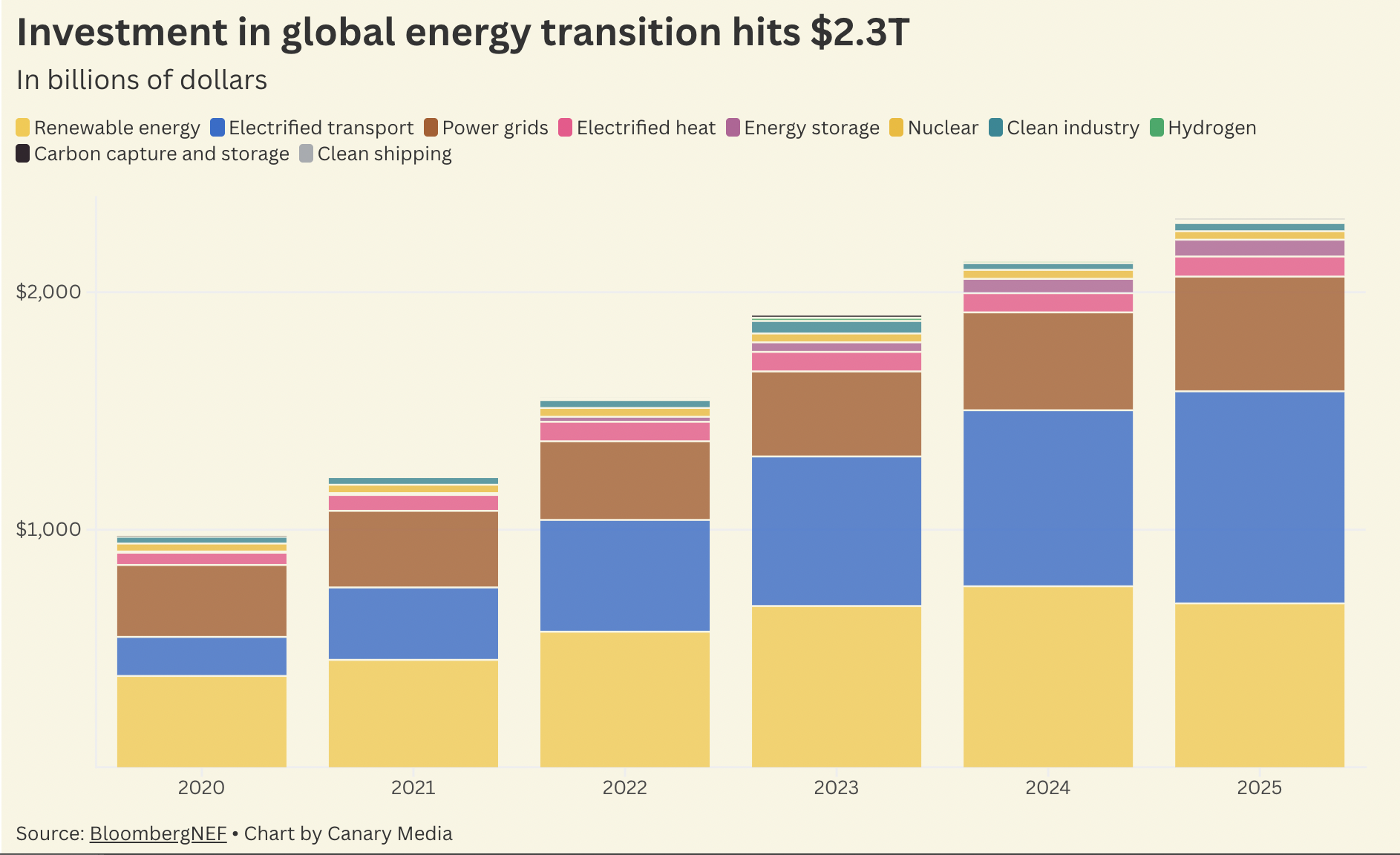
Global investment in the energy transition has broken records over and over again in recent years, and for good reason. Wind turbines, solar panels, and batteries are fast and increasingly cheap to install. Grid operators are scrambling to build out their systems as the world’s demand for electricity skyrockets, driven in large part by the AI data center boom. Meanwhile, electric cars are becoming hugely popular in places like China, where they are often cheaper than gas-fueled vehicles, and Norway, which has long-standing policies incentivizing car buyers to go electric.
Let’s dig a little deeper into the numbers on spending. Investment in clean energy and the grid outpaced the amount spent on fossil fuel supply in 2025 — marking the second year in a row that has happened. And investment in fossil fuel supply dropped last year for the first time since 2020, with BNEF reporting a $9 billion decline from 2024.
Now for the less-great news. Investment in the energy transition is growing overall, but more slowly than it used to —and right when the world needs it to accelerate.
Last year, it rose by only 8% — less than the 12% jump in 2024 and much less than the 22% one in 2023. Plus, while investment in sectors like clean industry and energy storage increased, the amount for renewable energy specifically declined by nearly 10%, something BNEF attributes to uncertainty caused by new power market rules in China. Even so, the Asian country is by far the largest market for energy transition investment, followed by the European Union and then the U.S.
Despite those slips, growth is growth — and the global shift to cleaner energy isn’t stopping just because of recent headwinds in the U.S. and beyond.
This story was originally published by Grist. Sign up for Grist’s weekly newsletter here.
The ostensibly barren Mojave Desert is in fact teeming with plants and animals, including a rare species known as the threecorner milkvetch. It’s a member of the pea family, splaying across the ground instead of climbing up a garden trellis. Given the harsh desert conditions, it waits until the arrival of rains to burst from the earth — flowering, fruiting, and reproducing.
Though hardy, the threecorner milkvetch — which is under consideration for listing under the Endangered Species Act — and its fellow species in the Mojave are still sensitive to disturbance, like when solar farms literally break ground. Traditionally, energy companies “blade and grade” habitats, meaning they cut out vegetation and even out the soil, which disrupts the seed banks stored within the ground.
In the desert outside Las Vegas, the Gemini Solar Project took a gentler approach, instead trying to preserve the ecosystem. According to a new study, that paid off for the threecorner milkvetch: Before the development, scientists found 12 plants on the site; afterward, in 2024, they found 93, signifying that the seeds survived construction. Compared with those at a nearby plot of land, the plants at Gemini grew wider and taller, and produced more flowers and fruits. That might be because the solar panels shade the soil, slowing evaporation, which makes more water available to the plants to grow big and strong. “So you just have the potential for a lot more plants,” said Tiffany Pereira, an ecologist at the Desert Research Institute and lead author of the paper, which was published late last year. “There’s seedlings of so many other species coming up as well. And so the fact that seed bank survived is phenomenal.”
It’s yet more evidence that solar farms can be built in ways that minimize disturbances to ecosystems. (The company behind the Gemini project, Primergy, did not respond to requests for comment.) This technique is called ecovoltaics: Instead of blade-and-grade, facilities are built with native species in mind. To give the ecosystem a boost, for instance, a crew can seed the soils with native grasses and flowers. “Some of those seed mixes do quite well at solar facilities, and they attract pollinators, birds, and other wildlife as a result,” said Lee Walston, an ecologist at Argonne National Laboratory who wasn’t involved in the new paper. “Sort of asking that umbrella, ‘Field of Dreams’ question, right: If you build it, will they come?”
In Minnesota, at least, the answer is yes. Walston led a study of two solar sites on converted cropland there, observing the growth of biodiversity over the course of five years. The researchers found that the number of unique flowering plant species increased sevenfold, and the abundance of insect pollinators tripled. Native bees alone increased by 20 times. In a follow-on study across a dozen solar sites, grassland birds flocked to the areas, likely attracted by the abundance of insects — same goes for bats. Birds could also nest among the panels, hiding from predators. “We’ve seen positive outcomes, sort of across the board,” Walston said. “Anytime that you’re seeing increases in insect prey, you’ve got at least a really strong potential for also seeing greater bird activity and bat activity, as they are attracted to those sites.”
Such a significant boost to biodiversity is not a given, though. Certain plant species will need more or less shade from the panels: In the Mojave, Pereira found only one threecorner milkvetch, for example, growing directly under a panel. The rest were popping up in the sunnier spaces between them. Young plants of other species, by contrast, might prefer shadier spots, because too much sunlight can stress them.
Panel height is a major factor, too: Taller ones let bigger plant species grow to their full potential — but the higher the supports, the more a solar company must spend on materials. A facility might also set a specific height to accommodate livestock like sheep and goats, used for “conservation grazing” to clear out invasive weeds, which in turn reduces the fire risk of dead plants. “We’re trying to work with developers,” Walston said, “to say, ‘OK, well, if all you can do is 2 feet, what might be the best mix of seed mixes and management styles that could really optimize the habitat?’”
That mowing might sound destructive, but it mimics the natural order of things, as grazers like deer and buffalo, in addition to wildfires, have historically served the same purpose. Ecovoltaics can also return former agricultural fields to more of their natural state. “I think there is real potential for solar farms to be especially good for biodiversity in prairie ecosystems, since prairies evolved over time to require repeated disturbance,” said Johanna Neumann, senior director of the Campaign for 100% Renewable Energy at the nonprofit Environment America, who wasn’t involved in the new research.
The blade-and-grade alternative, on the other hand, doesn’t just disrupt a habitat. With native plant species cleared out, the earth loses the root structures that keep soils from blowing away. Then, opportunistic and fast-growing invasive species can take over, muscling out the natives. And their flowers might not be as enticing for indigenous pollinators, like bumblebees.
Just as endemic plants can grow among solar panels, so too can crops, a technique known as agrivoltaics. Researchers are finding, for example, that things like cucumbers grow like crazy on rooftops. The panels create a unique microclimate that keeps crops from getting too hot in the summer and too cold in the winter, and uses about one-third of the water compared with growing in full sun. Now, scientists are trying to figure out which crops — especially high-value ones that can make up the cost of installing solar — will do the best growing under panels, both on rooftops and on the ground. “If you’re going to grow something, you want to grow something that a potential farmer could sell for decent profit,” said horticulturist Jennifer Bousselot, who studies rooftop agrivoltaics at Colorado State University but wasn’t involved in the new paper. “You name the crop, and there’s interest.”
All told, ecovoltaics and agrivoltaics have the potential to bolster biodiversity and the food supply while generating clean electricity. “Rather than a moonscape of invasive species and dust blowing into cities, why not strive for something better?” Pereira said. “It’s a wild and beautiful place that we live in, and it’s our job to look out for these species as well.”
In December, the Trump administration issued a sweeping stop-work order to every single offshore wind installation underway in America. But, as of today, all five projects have either resumed construction or received the green light from judges to do so.
A federal judge ruled Monday that the 924-megawatt Sunrise Wind project, located off the coast of New York, can resume construction. The wind farm is nearly halfway complete and, before the stop-work order, was expected to begin producing electricity this year.
Ørsted said in a statement that it will “restart impacted activities immediately.”
The December order had cited ambiguous national security concerns in halting construction of Sunrise Wind and the other offshore wind farms. But Judge Royce Lamberth of the U.S. District Court for the District of Columbia found this justification insufficient after reviewing the classified report detailing those threats. He granted project developer Ørsted a preliminary injunction that allows work to proceed as the complaint moves through the legal system.
It’s the fifth such court order in recent weeks, and a welcome reprieve for a sector that promises to provide huge amounts of clean electricity to the East Coast in a time of surging demand.
In mid-January, the 704-MW Revolution Wind project, which is being developed off the coast of Rhode Island by Ørsted, became the first to receive an injunction. By the end of the month, every project aside from Sunrise Wind had secured a similar ruling and restarted work. Vineyard Wind, an installation so close to completion that it is already partially supplying power to the New England grid, was the latest to do so. Its final turbine tower left the New Bedford, Massachusetts, port last Wednesday.
The December order from the Trump administration ground construction of the megaprojects to a halt, costing developers millions of dollars, delaying the arrival of much-needed new electricity, and threatening the outright cancellation of the multibillion-dollar developments.
It also capped off a yearlong assault from the Trump administration against the emerging sector.
That assault has largely been successful. Offshore wind was once seen as the future cornerstone of Northeastern grids, but now only a fraction of what was once planned for the next decade is likely to get built: Research firm BloombergNEF slashed its forecast for 2035 offshore wind capacity by a staggering 85% between November 2024 and October 2025.
But the Trump administration has, so far, failed to permanently stop the construction of the five projects already underway. It’s not for lack of trying.
Last April, the administration issued a stop-work order to New York’s Empire Wind, one of the five projects that was halted by the December order as well.
The developer, Norway’s partially state-owned energy firm Equinor, declined to sue over the April order and instead lobbied the Trump administration behind the scenes. The administration lifted the order after about one month, which White House officials said was the result of New York Gov. Kathy Hochul (D) agreeing to support new gas pipelines in the state. Hochul denied those allegations, but her administration green-lit one such project in November.
The Trump administration issued another stop-work order in August — this time to Revolution Wind. Ørsted immediately challenged the directive in court and was granted relief a month later.
Rather than targeting any individual project, the December order took a dragnet approach, citing still-unclear national security risks. The Trump administration has yet to publicly release details regarding the alleged threats.
Similarly, the administration has refused to share a National Oceanic and Atmospheric Administration report that it said justified the April stop-work order on the Empire Wind project.
In response to a Freedom of Information Act request from E&E News, the administration last year released a copy of the report that was almost entirely redacted. Instead of providing damning evidence that the Biden administration had rushed the project’s approval or relied on flawed science, as Interior Secretary Doug Burgum had claimed at the time, the file contains a cover sheet and research references — and about two dozen pages of black rectangles.
It’s unclear where the administration will go from here. Several of the five now-unpaused projects will be complete, or at least begin producing power, if they can continue unabated for even a few more months.
Meanwhile, across the Atlantic, the prospects for the energy source are very different.
Last Monday, 10 European nations banded together to announce a plan to install 100 gigawatts of offshore wind in the North Sea. The agreement was motivated in part by Europe’s desire to forge its own path on energy as it grows less comfortable with relying on natural gas imports from an increasingly erratic and hostile United States.
Just days before, in fact, President Donald Trump took time out of his World Economic Forum speech in Davos, Switzerland, to complain about wind turbines — and to call European nations “losers” for installing them.


.svg)
